
The "Inner Beauty" of In-Mold Labels for Biscuit Boxes – How Material Selection Affects Quality
The "Inner Beauty" of In-Mold Labels for Biscuit Boxes – How Material Selection Affects Quality
When you pick up a beautifully printed IML biscuit box, you see vibrant colors and feel a smooth surface. But few people know that behind this "talking" label lies a sophisticated material science system.
An in-mold label is not an ordinary printed film. It is a three-layer composite structure:
- Printing layer (top layer): Carries the ink to form color graphics
- Middle support layer: Provides stiffness to prevent deformation under high temperature
- Hot-melt adhesive layer (bottom layer): Melts during injection molding to firmly bond the label to the container
The choice of printing layer material – BOPP, PE, or PE+PP – directly determines the label's print quality, adhesion performance, durability, and ultimately the quality of the biscuit box.
📖 Table of Contents
- 1. The "Material Family" of In-Mold Labels – Four Mainstream Materials
- 2. BOPP – The "Top Student" with the Best Print Quality
- 3. PE – A "Perfect Match" for PE Containers
- 4. PE+PP – The "All-Rounder" Balancing Aesthetics and Performance
- 5. Paper – The "Economy Option" for the Low-End Market
- 6. How to Choose the Most Suitable Material for Biscuit Boxes?
- 7. FAQ
1. The "Material Family" of In-Mold Labels – Four Mainstream Materials
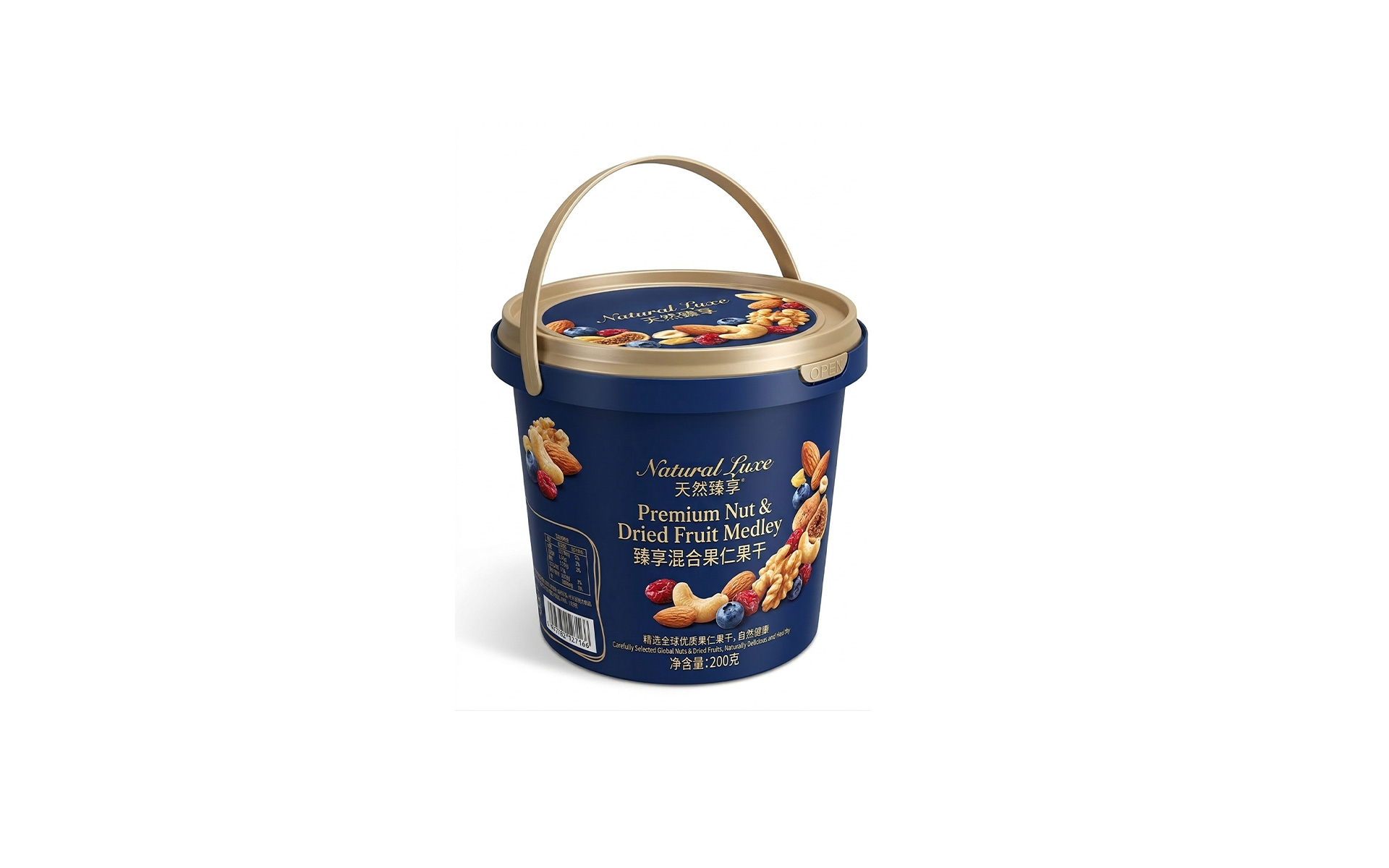
The printing layer materials for in-mold labels fall into four main categories: BOPP, PE, PE+PP, and paper. Among these, film-based materials dominate the market – film-type labels account for approximately 80% of sales value and about 60% of consumption volume.
| Material Type | Key Characteristics | Main Advantages | Main Limitations |
|---|---|---|---|
| BOPP | Biaxially oriented, with special coating | Excellent printability | Different shrinkage rate from PE containers; may cause "orange peel effect" |
| PE | Non-oriented, requires corona treatment | Perfect match with PE containers | Poor printability; prone to deformation after hot stamping |
| PE+PP | Mono-oriented, requires corona treatment | Smooth surface, no deformation, excellent visual effect | Requires low-temperature foil for hot stamping |
| Paper | Traditional material, good printability | Low cost | Low-grade appearance; not suitable for premium products |
These four materials have different physical and chemical properties, and their application results vary significantly. Choose the right material, and your biscuit box looks "premium"; choose the wrong one, and even the best design will be wasted.
2. BOPP – The "Top Student" with the Best Print Quality
BOPP (Biaxially Oriented Polypropylene) offers the best printability among in-mold label materials.
2.1 Advantages of BOPP
BOPP undergoes biaxial stretching and has a special coating on its surface, enabling high-resolution, multi-color fine printing. The photo-quality biscuit images, delicate brand logos, and subtle color gradients on biscuit boxes – BOPP can reproduce them all perfectly.
At the same time, BOPP film has relatively high stiffness, making it suitable for converting and producing large-area labels.
2.2 The Fatal Flaw of BOPP – "Orange Peel Effect"
BOPP's biggest problem lies in shrinkage rate mismatch.
If the biscuit box body is made of PE material, and the label uses BOPP (whose substrate is actually PP), their shrinkage rates differ. After injection molding and cooling, the label and the box body shrink at different rates, causing the label surface to develop fine wrinkles resembling orange peel.
"If the container material is PE and the in-mold label material is PP, because their shrinkage rates differ, the container surface often exhibits an 'orange peel effect' after label application."
The "orange peel effect" seriously affects the visual quality of the biscuit box, making an otherwise beautiful package look cheap and rough.
Conclusion: BOPP is suitable for applications with extremely high printing requirements and where the container material is also PP. If the biscuit box is PE, BOPP should be used with caution.
3. PE – A "Perfect Match" for PE Containers
PE (Polyethylene) is another common in-mold label material.
3.1 Advantages of PE
PE's biggest advantage is material matching. If the biscuit box body is PE, PE labels have the same shrinkage rate as the container, ensuring no deformation issues after molding.
3.2 Disadvantages of PE
PE's shortcomings are equally evident:
- Poor printability: PE surfaces require corona treatment for printing, and the print quality is far inferior to BOPP
- Significant deformation after hot stamping: If the biscuit box label requires hot stamping, PE tends to deform after the process
- Microscopic surface wrinkles: After PE label application, the container surface may exhibit microscopic wrinkles, affecting visual appearance
Conclusion: PE is suitable for biscuit boxes where the container is PE and printing precision requirements are low. If high-quality printing is desired, PE is not an ideal choice.
4. PE+PP – The "All-Rounder" Balancing Aesthetics and Performance
PE+PP composite material offers the best overall performance among in-mold label materials.
4.1 Advantages of PE+PP
PE+PP composite material combines the strengths of both materials:
- Good printability: The material undergoes corona treatment and can support high-quality printing
- Stable tension: Dimensional stability during printing and processing – resistant to deformation
- Smooth surface: After label application, the surface is smooth, non-deforming, and visually excellent
PE+PP's biggest highlight is "smooth surface, no deformation, excellent visual effect". For biscuit boxes that need to "rely on appearance to sell" on the shelf, this is crucial.
4.2 Considerations for PE+PP
Because PE+PP contains PE, it requires low-temperature hot stamping foil during the hot stamping process. The ideal hot stamping method is rotary hot stamping.
Conclusion: PE+PP is the preferred material for biscuit box IML labels – it offers good print quality while ensuring a smooth, non-deforming surface with the best visual effect.
5. Paper – The "Economy Option" for the Low-End Market
Paper-based in-mold labels are mainly used in low-end consumer products.
5.1 Characteristics of Paper Labels
- Good printability: Paper surfaces are smooth, and print quality is decent
- Minimal deformation: Suitable for non-deforming or minimally deforming containers
5.2 Limitations of Paper Labels
Paper labels have a lower-grade appearance and are not suitable for premium biscuit box packaging. Additionally, paper is less durable than film materials, performing poorly in moisture resistance, oil resistance, and abrasion resistance.
Conclusion: Paper is suitable for low-end, single-use biscuit packaging. For mid-to-high-end biscuit brands pursuing quality, paper is not recommended.
6. How to Choose the Most Suitable Material for Biscuit Boxes?
Selecting IML label material for biscuit boxes requires considering the following factors:
| Consideration | Recommended Material | Reason |
|---|---|---|
| Best print quality desired | BOPP (when container is PP) | Best printability, exquisite graphics |
| Container is PE | PE or PE+PP | Matching shrinkage rates, no deformation |
| Smooth surface, best visual effect | PE+PP (top choice) | Smooth surface, no deformation, excellent visual effect |
| Premium biscuit brands | PE+PP or BOPP (match container) | Premium appearance, enhanced brand image |
| Low-end, single-use packaging | Paper | Low cost, meets basic requirements |
For most mid-to-high-end biscuit boxes, PE+PP is the safest and highest-quality choice.
7. FAQ
The "orange peel effect" occurs because of a shrinkage rate mismatch between the label material and the container material. If the container is PE and the label is BOPP (substrate is PP), the two shrink at different rates after cooling, causing fine wrinkles resembling orange peel on the label surface.
PE surfaces require corona treatment for printing and are non-oriented, resulting in lower surface smoothness than BOPP. Therefore, PE labels have lower printing precision and color performance than BOPP.
PE+PP combines the dual advantages of good print quality and a smooth, non-deforming surface. It supports high-quality printing while ensuring perfect label-to-container adhesion with excellent visual effect.
The label material should have a matching shrinkage rate with the container material. If the shrinkage rates differ, deformation or the "orange peel effect" will occur after cooling. Therefore, PE containers should use PE or PE+PP labels, and PP containers should use BOPP or PP-based labels for the safest choice.
The typical thickness for in-mold labels is 65-80μm, and they must have anti-static properties.
Yes. In-mold labels are made of the same material as the plastic container. During recycling, there is no need to separate the label – it can be shredded and recycled together with the container. This is a key environmental advantage of in-mold labels over traditional pressure-sensitive labels.
Contact Us
Name*
Telephone*
Region*
Please fill in your request*


