
How Does a Biscuit Box Put on a "Seamless Garment"? – Revealing the Complete Process of In-Mold Labeling
How Does a Biscuit Box Put on a "Seamless Garment"? – Revealing the Complete Process of In-Mold Labeling
When you pick up a box of biscuits from the shelf, you notice that the graphics and text on the packaging appear to have "grown" directly onto the plastic surface. There are no sticker traces, no raised edges. This is not magic – it is a sophisticated industrial technology called In-Mold Labeling (IML).
In simple terms, IML means "planting" the label into the box body at the same time the biscuit box is being manufactured. The entire process flows seamlessly, from raw material to finished product in one continuous operation, with no additional labeling steps required in between.
📖 Table of Contents
- 1. Step 1: The Label's "Past Life" – From Film to Precision-Printed Label
- 2. Step 2: The Robot's "Precision Strike" – Label Placement into the Mold
- 3. Step 3: The "Magic" of Static Electricity – Securing the Label Firmly
- 4. Step 4: Injection "Fusion" – The Label and Box Body Become One
- 5. Step 5: Cooling and Demolding – The "Seamless Garment" Is Born
- 6. Why Is Injection Molding the Mainstream IML Process?
- 7. FAQ
1. Step 1: The Label's "Past Life" – From Film to Precision-Printed Label
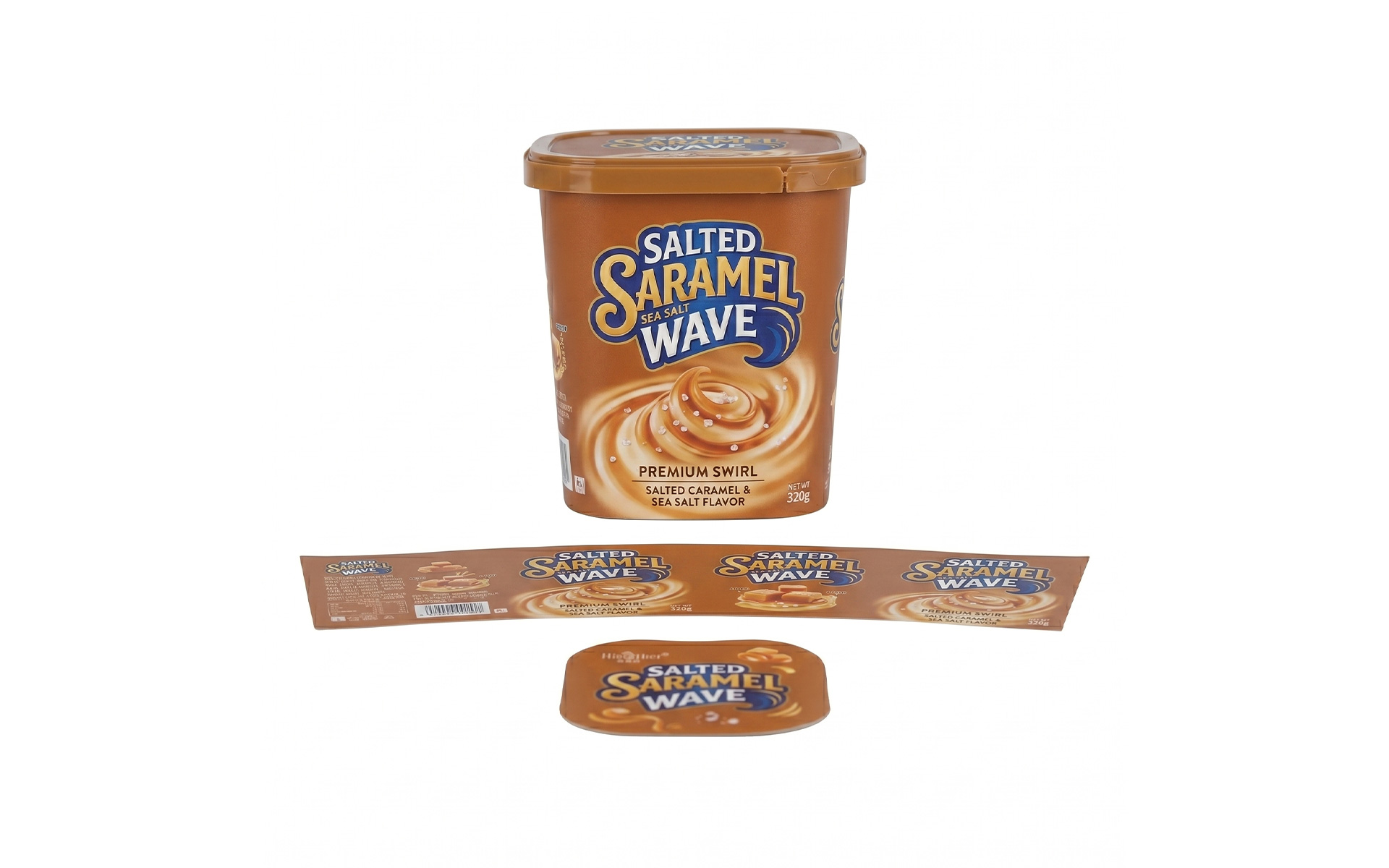
The beautiful graphics and text on a biscuit box are not printed directly onto the box itself. They are first printed onto a plastic film.
The label production process generally follows these steps:
- Sheet Cutting: The roll of film is cut into sheets of the designed dimensions.
- Printing: Patterns, text, and logos are printed onto the film. In-mold labels support high-resolution, multi-color fine printing – the tempting product images and delicate brand logos on biscuit boxes are all completed in this step.
- Ink Drying: The printed film is placed in a high-temperature oven to cure and fix the ink.
- Protective Lamination: A protective layer is applied to prevent the printed surface from being scratched in subsequent steps.
- Punching Registration Holes: Registration holes are punched for the subsequent thermoforming process – these determine the positioning precision for all later operations.
- Thermoforming: The printed film is heated and then pressed using a high-pressure machine to form a three-dimensional shape matching the contours of the biscuit box's inner wall.
- Trimming the Outline: The excess waste material around the formed three-dimensional film is trimmed away, resulting in an independent label ready for direct use in injection molding.
At this point, a beautifully printed "three-dimensional" label is ready to enter the mold and fuse with the biscuit box.
2. Step 2: The Robot's "Precision Strike" – Label Placement into the Mold
After the mold opens, an automated robot picks up the pre-printed label from the label magazine and precisely places it into the mold cavity.
This action may seem simple, but the precision required is extremely high. IML is a complex process that requires close coordination between the injection molding machine, the mold, the automation robot, and the label. The robot's positioning accuracy and the injection molding machine's mold opening positioning accuracy both directly affect the final product quality.
When the label is placed into the mold, the printed side faces the mold wall, while the back (coated with hot-melt adhesive) faces outward. This ensures that the molten plastic contacts the back of the label during injection, without damaging the printed pattern.
3. Step 3: The "Magic" of Static Electricity – Securing the Label Firmly
After the label is placed into the mold, it must be securely fixed against the mold wall – otherwise, the high-speed molten plastic will displace it.
In injection IML processes, electrostatic adsorption is the standard method. After the robot places the label into the mold cavity, a static generator applies a short charge to the label through a discharge needle. The charged label is then firmly held against the mold wall.
Why is vacuum adsorption not used?
This is a critical technical detail. Blow molding uses lower pressure and can employ vacuum adsorption; however, injection molding uses extremely high pressure – if vacuum adsorption were used, the molten plastic would puncture the label, and the injected resin would clog the vacuum holes, severely affecting production continuity. Therefore, electrostatic adsorption is the standard method for injection IML.
4. Step 4: Injection "Fusion" – The Label and Box Body Become One
After the label is fixed, the mold closes.
Molten PP plastic is injected from the injection molding machine's nozzle into the mold cavity. As the high-temperature melt (200-280°C) flows across the back of the label, the heat activates the hot-melt adhesive layer on the label's back.
Under the combined effects of high temperature and high pressure inside the mold:
- The hot-melt adhesive on the label back melts
- The label and the molten plastic bond tightly
- The two materials fuse as one at the molecular level
The label is no longer "stuck onto" the biscuit box – it is "born together" with the biscuit box.
5. Step 5: Cooling and Demolding – The "Seamless Garment" Is Born
After injection is complete, the product undergoes a brief cooling and solidification period inside the mold.
After cooling, the mold opens. At this point, a beautifully printed biscuit box is completed in a single injection molding cycle.
The label and the box body are on the same plane – you cannot feel the label's presence at all. The colorful graphics appear as if printed directly onto the box surface. The label and the substrate material become one, embedded in the outer wall of the container. The entire process, from label placement to finished product ejection, is completed in one continuous operation.
This is the true meaning of a "seamless garment" – the label is not "stuck on," but is "born together" with the biscuit box.
6. Why Is Injection Molding the Mainstream IML Process?
IML has two molding methods: blow molding and injection molding.
Blow molding is mainly used for hollow containers such as detergent bottles and juice bottles. Injection molding, on the other hand, is widely used for food packaging such as ice cream cups, yogurt cups, and biscuit boxes. Currently, 80% of in-mold labeling in Europe is accomplished through injection molding.
The advantages of injection molding include:
- One-shot molding: The biscuit box and label are completed simultaneously, eliminating subsequent labeling steps
- Higher precision: Injection-molded products offer superior dimensional accuracy and appearance quality
- Higher efficiency: Depending on the system configuration, the entire cycle time can be completed in 4-8 seconds
7. FAQ
Because the label fuses with the box body during injection molding, and the label and the box body are on the same plane. The label edges are "encased" by the plastic, resulting in a completely smooth surface with no detectable label presence.
IML labels are not "stuck on." They are fused with the molten plastic during injection molding. There is no adhesive layer between the label and the box body, so there is no "adhesive aging and failure" problem.
Because injection pressure is extremely high. If vacuum adsorption were used, the molten plastic would puncture the label, and the injected resin would clog the vacuum holes. Electrostatic adsorption reliably secures the label against the mold wall without affecting production continuity.
Very high. Depending on the system configuration, the entire cycle time is typically 4-8 seconds. From label placement to finished product ejection, the entire process is fully automated with no manual intervention required.
No. IML ink is sandwiched between the film and the plastic, not directly exposed to air or friction. The label surface has a hardened transparent protective layer with good wear resistance and scratch resistance.
Traditional labeling means the box is made first, and then the label is "stuck on" – with risks of peeling, curling, and fading. IML means "planting" the label into the box at the same time it is made – the label and the box body are integrally molded, never peeling, never curling, never fading.
Contact Us
Name*
Telephone*
Region*
Please fill in your request*


