
The Three-Layer Structure of In-Mold Labels: Material Design and Synergy
The Three-Layer Structure of In-Mold Labels: Material Design and Synergy
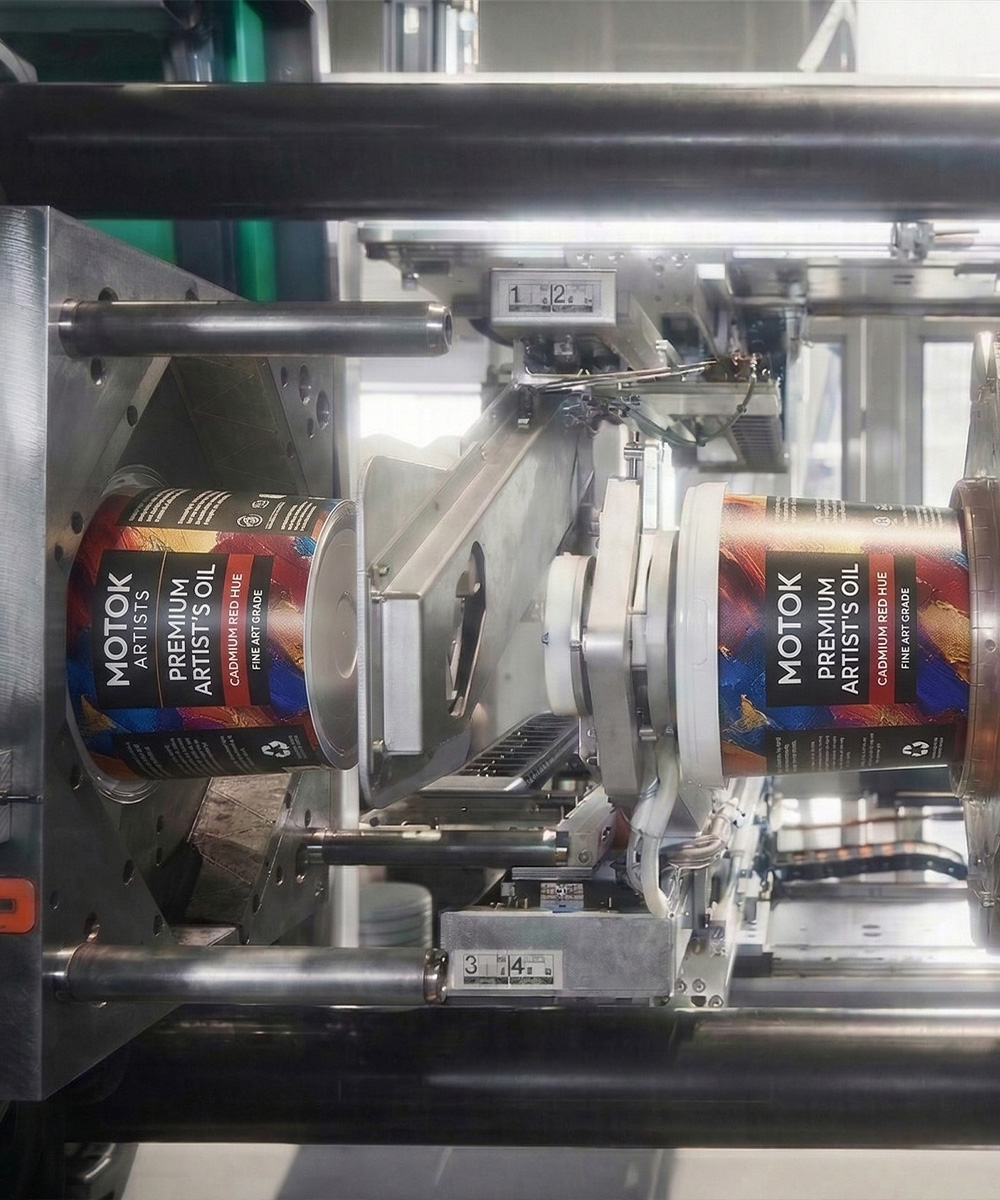
The fundamental reason why in-mold labels achieve a firm bond with plastic containers under high-temperature, high-pressure molding conditions lies in the special multi-layer construction of the label material. Unlike ordinary pressure-sensitive labels, in-mold labels are not a single film but a composite of three layers, each with distinct functions – the printing layer (top layer) , the middle layer (support layer) , and the adhesive layer (bottom layer) . Each layer performs its own role, and together they coordinate during the in-mold process to accomplish the label’s decoration, positioning, fusion, and durability functions.
1. Printing Layer (Top Layer): The Stage for Graphics
The printing layer is the outermost layer of the in-mold label, facing the consumer directly. It is responsible for carrying the ink and presenting the graphic information. During molding, this layer contacts the hot mold wall (typically mold temperature 20–50°C, but instantaneous radiant heat can approach the melt temperature), so it has strict material requirements.
1.1 Main Functions
Carry ink: Provide a surface energy suitable for printing so that ink adheres uniformly and maintains color saturation.
Thermal protection: Protect the ink from decomposition or fading under the high-temperature environment inside the mold, and prevent the label substrate from melting or deforming.
Surface aesthetics: Depending on the mold surface finish (glossy, matte, brushed, textured), the printing layer can present different appearance effects.
Scratch and chemical resistance: During product use, the printing layer must resist daily abrasion, detergents, oils, etc.
1.2 Common Materials
| Material | Characteristics | Typical Applications |
|---|---|---|
| PE (Polyethylene) | Soft, good stretchability, same material as PE containers – suitable for blow molding. Lower heat resistance, fair printability (needs corona treatment). | Detergent bottles, shampoo bottles (PE containers) |
| BOPP (Biaxially Oriented Polypropylene) | High rigidity, good heat resistance (melting point ~160–170°C), excellent printability (fine halftone printing), high transparency. The most widely used top layer material for IML. | Ice cream tubs, butter boxes, yogurt cups (PP containers) |
| PE+PP Composite | Combines the flexibility of PE with the heat resistance of PP. Used where some stretchability but also higher heat resistance is required. | Shaped containers, deep‑draw products |
| PET (rare) | Very high heat resistance, but higher density and incompatible with PP/PE, affecting recyclability. Used only for special requirements (e.g., extreme heat resistance). | Microwave containers, hot‑fill products |
1.3 Key Considerations for Material Selection
Same‑material matching with the container: For recycling convenience, the top layer should be the same as or compatible with the container. For example, BOPP top layer is preferred for PP containers.
Molding process compatibility: Blow molding requires the top layer to have some extensibility to accommodate parison expansion; injection molding requires less extensibility but more rigidity and heat resistance.
Printing method: Flexo, gravure, offset, or digital printing have different requirements for top layer surface energy and smoothness. Corona or coating treatment is usually applied to achieve surface energy above 38 dynes/cm.
Transparency: If a “no‑label” effect is desired (label background color matching the container background or being clear), high‑transparency BOPP should be chosen.
2. Middle Layer (Support Layer): The Backbone of Stability and Stiffness
The middle layer sits between the printing layer and the adhesive layer. It acts as the “skeleton” of the label structure, providing stiffness, dimensional stability, and resistance to deformation. It ensures that the label remains flat, does not curl, and does not shrink during printing, die‑cutting, handling, and placement inside the mold.
2.1 Main Functions
Provide stiffness: Gives the label enough rigidity to stay flat when picked up by robot vacuum or electrostatic heads, preventing wrinkling inside the mold.
Dimensional stability: Under printing drying heat, die‑cutting, and high temperature inside the mold, the middle layer should have low shrinkage to ensure accurate registration and positioning.
Barrier function (optional): By adding special fillers or co‑extruded layers, the middle layer can provide some water vapor, oxygen, or UV barrier performance.
Optical effects: The middle layer can be designed as transparent (revealing the container background or contents) or opaque (providing a white or metallic background to enhance graphic contrast).
2.2 Material Composition
The middle layer is typically the same as or compatible with the top layer material to ensure strong lamination. Common structures include:
Same‑material co‑extrusion: Both top and middle layers are BOPP, co‑extruded or laminated together.
White filled layer: Titanium dioxide or other white pigments are added to PP or PE to create an opaque background, making color graphics more vivid.
Foamed layer: A small number of applications use micro‑foaming to reduce density and achieve a special tactile or matte effect.
2.3 Key Performance Indicators
| Property | Target | Explanation |
|---|---|---|
| Stiffness (bending resistance) | Relatively high (especially for large labels) | Prevents label sagging or curling during transport and inside mold |
| Thermal shrinkage | < 1% @ 150°C | Ensures no deformation under in‑mold high temperature |
| Tensile strength | MD/TD > 80 MPa | Withstands printing tension and in‑mold thermal stress |
| Haze | Transparent grade < 5%, opaque grade > 90% | Meets optical design requirements |
2.4 Thickness Design
Total in‑mold label thickness is typically between 50 and 120 μm. The middle layer accounts for the majority (about 60–70%). Examples:
Thin‑wall small containers (yogurt cups): total thickness 50–70 μm, middle layer approx. 30–45 μm.
Large containers (detergent bottles): total thickness 80–120 μm, middle layer approx. 50–80 μm.
A label that is too thin lacks stiffness and is prone to wrinkling inside the mold; a label that is too thick increases cost and may affect fusion uniformity.
3. Adhesive Layer (Bottom Layer): The Key to Integrated Fusion
The adhesive layer is the core technology that enables the in‑mold label to permanently bond with the container. It directly contacts the molten plastic, melts under high temperature, develops adhesion, and solidifies upon cooling to form a strong bond. Without a properly designed adhesive layer, even the best top and middle layers cannot make the label fuse with the container.
3.1 Main Functions
Melt‑bonding at high temperature: Under the high temperature inside the mold (typically 160–240°C), the adhesive melts rapidly, wets the container surface and the label substrate, and upon cooling forms mechanical interlocking and intermolecular forces.
Air venting: For large labels, prevents air from being trapped between the label and the mold or between the label and the plastic, avoiding bubbles.
Antistatic and slip properties: Prevents labels from sticking together or causing static‑related failures during printing, die‑cutting, stacking, and robot pick‑and‑place.
3.2 Adhesive Type and Surface Structure Design
Depending on label area and application requirements, the adhesive layer can be designed with two surface structures:
| Structure Type | Feature | Suitable Applications | Advantages | Disadvantages |
|---|---|---|---|---|
| Plain (non‑embossed) | Continuous, smooth adhesive coating | Small labels (< 50 cm²), e.g., bottle cap tops, small can lids | Simple coating, large bonding area, high bond strength | May trap air and cause bubbles on large areas |
| Embossed mesh/dot pattern | Adhesive applied as grid or dots, leaving intersecting venting channels | Large labels (e.g., wrap‑around bottle labels, large tub fronts) | Rapid air venting, avoids bubbles; reduces adhesive usage, saves cost | Requires precision coating roller, more complex process; slightly smaller bonding area |
Design parameters for embossed structures:
Embossing depth: typically 10–30 μm
Grid width: 0.5–2.0 mm
Open area ratio (proportion of adhesive coverage): 60–80%
3.3 Adhesive Material
The adhesives used for in‑mold labels are typically thermoplastic hot‑melts, mainly composed of:
Modified polyolefins (e.g., EVA, POE, APAO): Good compatibility with PP/PE, tunable melting point (90–150°C).
Tackifying resins: Improve initial tack and melt flow.
Waxes: Adjust melt viscosity and open time.
Antistatic agents: Reduce surface resistance to prevent static buildup.
Key performance indicators:
Melting point: Above room temperature storage (<50°C) and below the melt temperature of the plastic (typically 140–180°C).
Melt viscosity: Must flow sufficiently at molding temperature to spread evenly.
Thermal stability: Does not decompose or generate gas at processing temperature (to avoid ink wash‑off or bubbles).
Peel strength: After cooling, the peel force between label and container should exceed the tear strength of the container material itself.
3.4 Antistatic and Slip Properties
The adhesive layer usually contains antistatic agents (e.g., ethoxylated amines, conductive carbon black) to reduce surface resistance to 10⁹–10¹¹ Ω, preventing labels from sticking to each other or attracting dust due to static charge during automatic stacking and robot picking. Additionally, an appropriate amount of slip agent (e.g., amides) gives the label surface a low coefficient of friction (COF < 0.35), allowing smooth separation and feeding from the label magazine.
4. Synergistic Workflow of the Three Layers
During typical in‑mold label production and use, the three layers work together as follows:
Printing stage: Ink adheres to the top layer; the middle layer provides stiffness for stable press registration; the adhesive layer (sometimes covered by a protective film) is not yet active.
Die‑cutting and stacking: Labels are die‑cut to shape. The middle layer ensures clean edges; the antistatic and slip properties of the adhesive layer allow individual labels to separate easily without sticking.
Label placement: The robot picks the label and places it into the mold. The middle layer’s stiffness prevents the label from warping on the suction pad; the adhesive layer’s antistatic property prevents the label from clinging to the robot arm due to static charge.
High‑temperature in‑mold stage: The mold closes and molten plastic fills the cavity. Heat transfers through the plastic to the back of the label, melting the adhesive layer, which wets the container surface and the middle layer. The top layer contacts the mold wall; due to its heat resistance, it does not melt or discolor.
Cooling stage: The adhesive recrystallizes and solidifies, locking the label firmly to the container. The middle layer maintains dimensional stability, preventing shrinkage‑induced stress cracking. The top layer presents the final appearance.
Product use and recycling: After consumer use, because the three layers are of the same material as (or compatible with) the container, the entire package can be sent directly to shredding and recycling without label separation.
5. Practical Guide to Selecting In‑Mold Label Materials
For different applications, Motek recommends the following material combinations:
| Application | Container Material | Recommended Top Layer | Recommended Middle Layer | Adhesive Layer Structure | Total Thickness |
|---|---|---|---|---|---|
| Shampoo bottle (PE) | HDPE | PE | White PE | Embossed (large area) | 80–100 μm |
| Ice cream tub (PP) | PP | BOPP | White BOPP | Embossed | 70–90 μm |
| Transparent butter tub | PP | Clear BOPP | Clear BOPP | Plain (small area) | 60–75 μm |
| Oil bottle (HDPE) | HDPE | PE+PP composite | White PE | Embossed | 90–120 μm |
| Cosmetic jar (PP) | PP | High‑gloss BOPP | White BOPP | Plain | 50–70 μm |
6. Conclusion
The three layers of an in‑mold label – printing layer, middle layer, and adhesive layer – each play an indispensable role: the printing layer provides aesthetics and durability, the middle layer supplies stiffness and stability, and the adhesive layer achieves high‑temperature bonding, venting, and bubble prevention. Only when these three layers are carefully selected, proportioned, and processed can the in‑mold label perform excellently in a high‑speed, high‑temperature, high‑pressure molding environment.
Motek has many years of experience in formulation development and application of in‑mold label materials. We offer customized three‑layer solutions including material selection, adhesive pattern design, antistatic treatment, and more. For further consultation or sample trials, please contact the Motek technical team.
Contact Us
Name*
Telephone*
Region*
Please fill in your request*


