
Recyclable Eco-Friendly Plastic Storage Containers – Does the IML Label Affect the Container's Recycling and Reprocessing?
Recyclable Eco-Friendly Plastic Storage Containers – Does the IML Label Affect the Container's Recycling and Reprocessing?
If you are looking for an eco-friendly labeling solution for your storage container products, you will inevitably face a core question: When an IML in-mold label is applied to a storage container, does it need to be removed during recycling? If not, will it affect the container's recycling and reprocessing?
The answer is: No removal is needed. The entire container can be directly shredded and recycled. IML labels do not affect the container's recycling and reprocessing.
📖 Table of Contents
1. The Fundamental Difference Between IML Labels and Pressure-Sensitive Labels
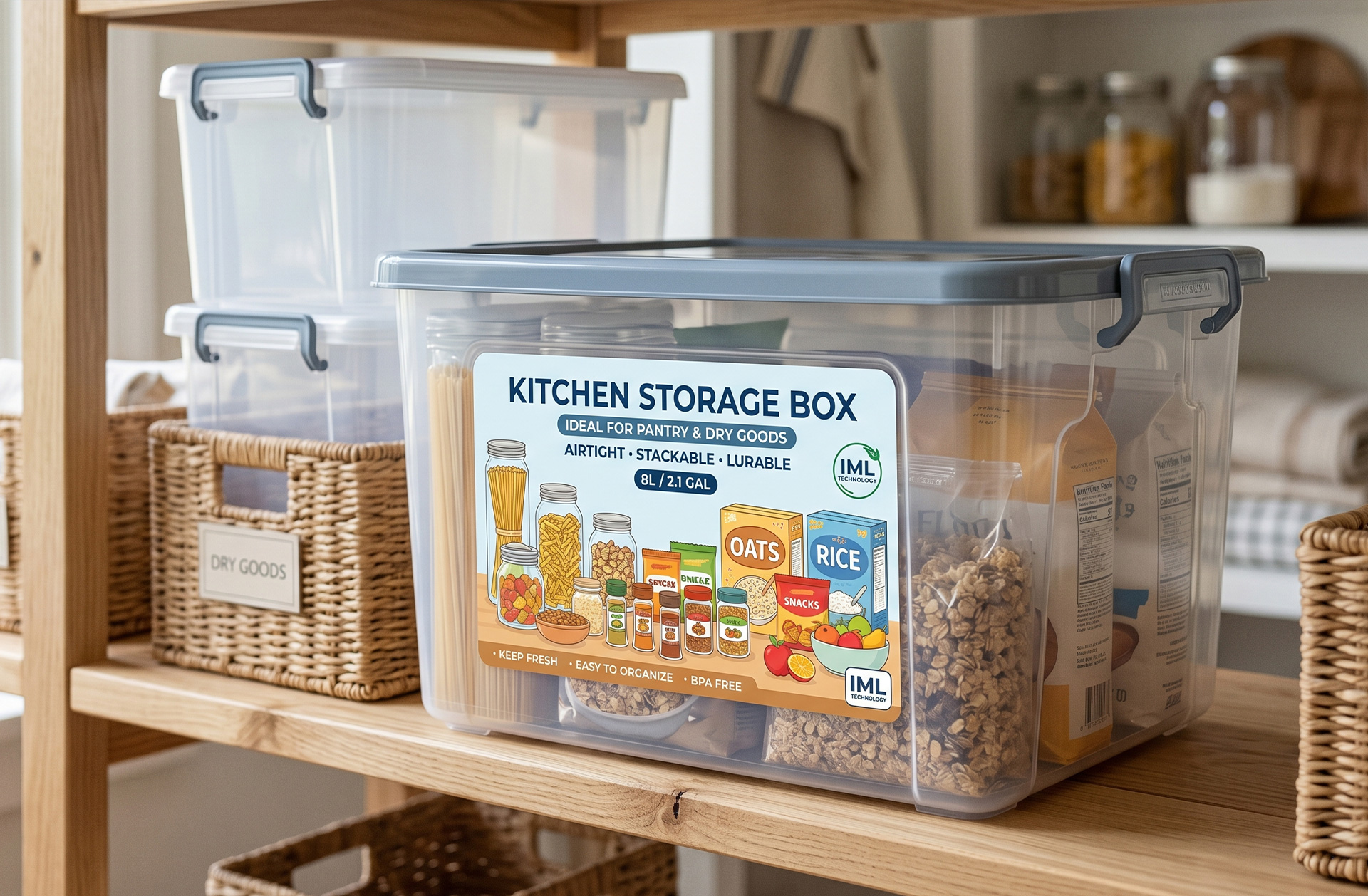
To understand why IML labels do not affect recycling, you first need to understand the fundamental difference between IML and traditional pressure-sensitive labels.
Pressure-sensitive labels have adhesive on the back. The label is "stuck" onto the container surface. During recycling, the label must first be peeled off, and the residual adhesive must be removed before the container can be shredded and reprocessed. This label-removal and adhesive-removal process is cumbersome, inefficient, and costly. More critically—if the label is not completely removed, residual adhesive will contaminate the recycled material, affecting the quality of the reprocessed material.
IML in-mold labels are completely different. IML labels are placed into the mold before the storage container is injection-molded. When the molten plastic is injected, the label fuses with the container body—becoming one seamless unit. The label is not "stuck on" but "grown into" the container.
This fundamental difference determines the completely different approach to recycling.
2. Same Material PP: The "Passport" for Recycling
Another key feature of IML labels is that the label and the container use the same material.
The vast majority of IML storage containers use polypropylene (PP) for both the label and the container body. Both the label and the container are PP, with identical chemical composition.
What does this mean? When the storage container reaches the end of its useful life and enters the recycling stream, the entire container can be directly fed into a shredder—label and container body together—with no separation process required.
The recycled PP flakes are then melted and repelletized for use in manufacturing new plastic products. The entire process requires no label peeling, no adhesive removal, and no additional separation steps.
In one sentence: Recycling an IML storage container means throwing the whole container into the shredder, rather than "skinning" it first and then recycling.
3. Industry Recognition and Certifications
The recycling advantages of IML labels have been recognized by multiple global authoritative organizations.
The Association of Plastic Recyclers (APR) has recognized IML as the "preferred" labeling method for polypropylene (PP) and high-density polyethylene (HDPE) containers, because the label is fused with the package wall.
RecyClass (a European authoritative certification body for plastic recycling) has demonstrated through testing that PP-based IML technology is fully compatible with colored PP recycling—provided that the total ink volume does not exceed 1% of the total package weight. This condition is easily met for standard storage container products.
The World Packaging Organisation (WPO) has listed IML in the green "best case" rating in its design guidelines.
IML achieves true "mono-material packaging" —both the container and the label are PP, with no adhesive and no contamination from other materials. This mono-material structure maintains the highest purity and value in the recycling stream.
4. Recycling Comparison: IML vs. Traditional Labeling
For a more intuitive comparison, here is a side-by-side look:
| Comparison Dimension | IML In-Mold Label | Traditional Pressure-Sensitive Label |
|---|---|---|
| Label-container relationship | Fused during injection molding | Adhered to the surface with adhesive |
| Label removal required before recycling? | No | Yes, label must be peeled off first |
| Adhesive removal required? | No (no adhesive) | Yes, residual adhesive must be removed |
| Recycling process | Direct whole-container shredding | Peeling → adhesive removal → shredding |
| Recycling efficiency | High | Low |
| Recycling cost | Low | High |
| Recycled material purity | High (mono-PP) | May be contaminated by adhesive |
5. How Can Brands Communicate Environmental Value to Consumers?
For storage container brands, the recycling advantage of IML is not just a "production convenience"—it is an environmental value that can be communicated to consumers.
You may consider adding the following information on the storage container:
- "100% PP Recyclable" logo: Clearly inform consumers that the entire container (including the label) is PP material and can be directly recycled
- "No label removal needed – recycle as is" instruction: Eliminate consumer confusion about whether to peel off the label
- Recycling process illustration: Use simple graphics to show the closed-loop process: "whole container into recycling bin → shredding → reprocessing"
This information helps consumers feel more confident about sorting and recycling, while also enhancing your brand's environmental image.
6. FAQ
No. The IML label fuses with the container during injection molding—both are the same material (PP). The entire container can be directly shredded and recycled without removing the label.
No. The IML label and the container use the same PP material. After shredding, the resulting PP flakes are of uniform composition. As long as the ink volume is within a reasonable range (typically far below 1% of total weight), there is no negative impact on recycled material quality.
Pressure-sensitive labels have adhesive on the back. During recycling, the label must first be peeled off and residual adhesive removed; otherwise, the adhesive contaminates the recycled material. This process is inefficient and costly.
IML is more environmentally friendly. IML uses same-material PP labels, no adhesive, and enables direct whole-container recycling. Traditional labeling requires additional label-peeling and adhesive-removal steps, and residual adhesive may contaminate the recycled material.
The recycled PP flakes are melted and repelletized for use in manufacturing new plastic products—achieving a closed-loop "from storage container to storage container" cycle.
Contact Us
Name*
Telephone*
Region*
Please fill in your request*


