
Small-Batch Niche Storage Container Customization: What Are the Advantages of Digital IML Printing Compared to Traditional Printing?
Small-Batch Niche Storage Container Customization: What Are the Advantages of Digital IML Printing Compared to Traditional Printing?
A cultural and creative brand designs a limited-edition storage container. The concept is excellent. But when it comes to production, the traditional printing factory quotes tens of thousands of yuan for plate-making fees and requires a minimum order quantity of several thousand units. The project is likely dead in the water.
This is not a hypothetical scenario. It happens every day.
For products like storage containers, traditional printing methods such as gravure and flexography are mature and stable, but they have an unavoidable barrier: plate-making. Whether it's gravure cylinders or flexographic resin plates, a fixed plate-making cost must be invested upfront. The larger the order volume, the lower the plate cost per unit. But for small-batch customization, this cost becomes "prohibitively expensive."
Digital IML printing has completely removed this barrier. It has made small-batch, niche storage container customization a reality.
📖 Table of Contents
1. First Understand: Why Are Gravure and Flexography "Expensive"?
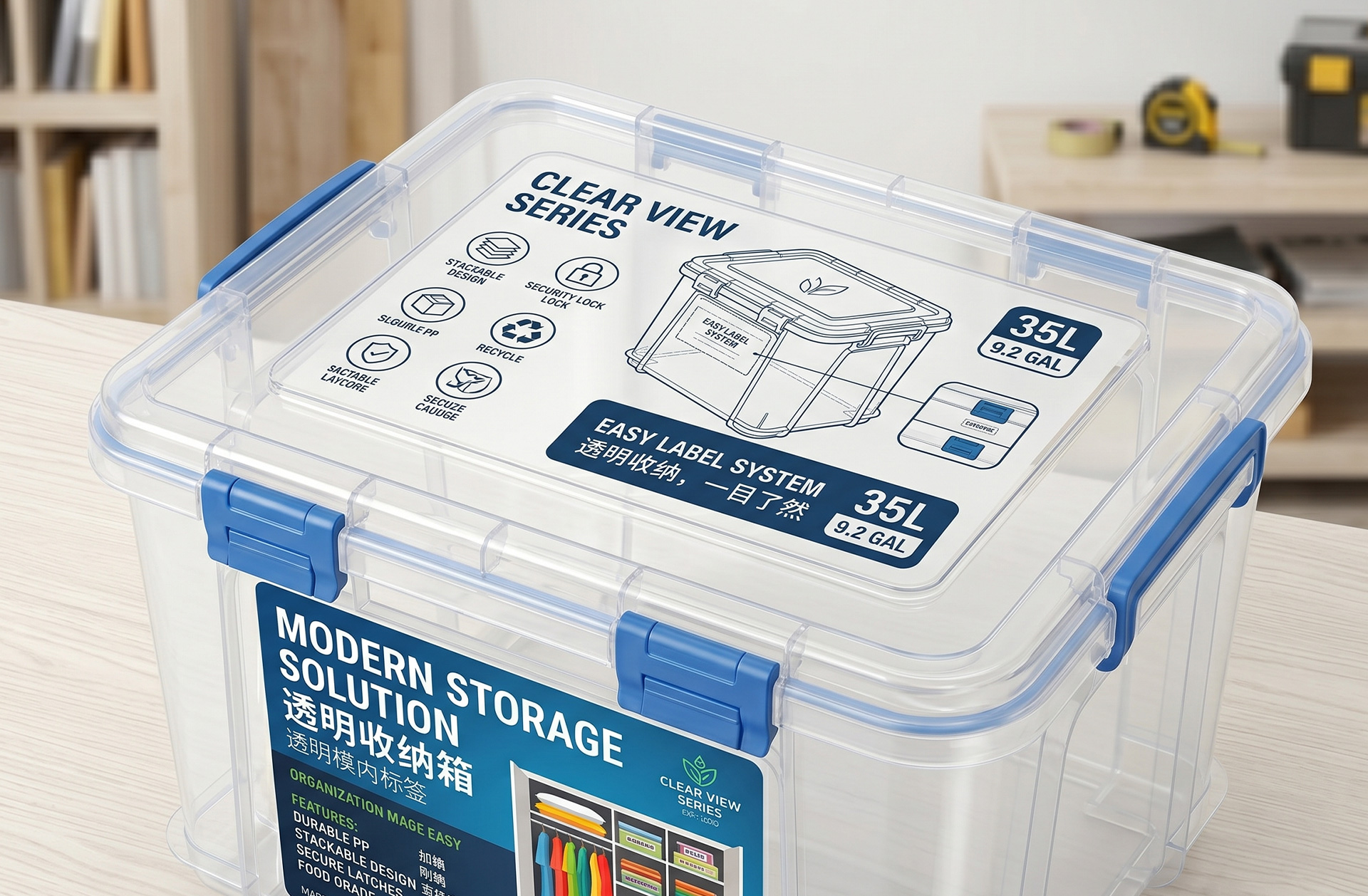
To understand the advantages of digital printing, we first need to understand where traditional printing's "expensiveness" comes from.
Gravure printing requires engraving recessed images onto metal cylinders. Flexographic printing requires manufacturing photopolymer relief plates. Either way, plate-making is a fixed cost—whether you print 100 units or 100,000 units, this cost must be paid upfront.
Beyond plate-making fees, traditional printing has several other "hidden costs":
- Long plate-making lead times: From design approval to completed plates typically takes several days or longer
- High MOQ thresholds: Plate-making costs must be amortized across enough units to be economical, so traditional printers typically set very high minimum order quantities
- High revision costs: Once a design is finalized and plates are made, any modification requires remaking the plates—repeating the entire process
These cost structures mean traditional printing is inherently suited for high-volume, low-variety production models. For small-batch, high-variety customization needs, traditional printing's "fixed-cost barrier" becomes the biggest obstacle.
For small-batch customization, digital printing—with no plate-making fees—means per-unit costs do not skyrocket due to low quantities. This is the core cost advantage of digital IML printing in small-batch scenarios.
2. Three Core Advantages of Digital IML Printing
2.1 Zero Plate-Making Fees: Small Batches Are Now Viable
This is the most direct advantage of digital IML printing.
Traditional printing plate-making fees range from a few thousand to tens of thousands of yuan. For storage container customization orders of just a few dozen or a few hundred units, amortizing this cost across each unit would make it prohibitively expensive.
Digital printing does not require plate-making—design files are transmitted directly from a computer to the printing equipment, eliminating the plate-making step. This means:
- Orders of just a few dozen units are viable: No hard MOQ threshold
- Cost is decoupled from quantity: Per-unit costs do not skyrocket with small volumes
- Extremely low trial costs: New products can be test-launched in small batches, with reorders if they sell well
For cultural and creative brands, niche designers, and corporate gift buyers, this dramatically shortens the path from "idea" to "physical product."
2.2 Rapid Sampling: Samples in Days, Not Weeks
The traditional printing workflow is: design approval → plate-making (several days) → machine setup → sampling → revisions (if needed, repeat plate-making) → mass production. The entire cycle often takes several weeks.
The digital printing workflow is: design approval → direct printing → sample produced. Eliminating the plate-making and setup steps compresses the sampling cycle to just a few days, or even the same day.
For storage container customization, the value of rapid sampling lies in:
- Design validation: See the physical result within days, make timely adjustments
- Market testing: Quick samples for trade shows, display, or pre-sales
- Urgent needs: Time-sensitive scenarios like corporate gifts and event customizations
2.3 Flexible Design Changes: Change the Design Today, Print Tomorrow
This is the most underestimated advantage of digital printing.
Once a design is finalized and plates are made in traditional printing, any modification means remaking the plates—cost and time make frequent design changes impractical.
Digital printing enables "print as you change"—today you print Design A, tomorrow you want to switch to Design B; simply replace the digital file. Without the constraints of plate-making, design iteration becomes extremely flexible.
For storage containers, the value of flexible design changes is reflected in:
- Multiple designs in parallel: A single order can include multiple different patterns
- Rapid response: Market trends change; designs can be adjusted quickly
- Personalized customization: Each storage container can have a different pattern (e.g., different department logos in corporate customization, different serial numbers in events)
Digital printing's fully digital nature provides more flexible printing options, enabling on-the-fly changes during production. This is the essence of flexible manufacturing.
3. Which Storage Container Customization Scenarios Are Digital IML Printing Best Suited For?
| Customization Scenario | Typical Requirements | Digital IML Advantages |
|---|---|---|
| Cultural and creative brand limited editions | A few hundred units per design, unique patterns, fine details | No plate-making fees, small batches viable, rapid market entry |
| Niche designer brands | Multiple designs in parallel, low quantity per design | Flexible design changes; multiple designs can be printed in one batch |
| Corporate gift customization | Dozens to hundreds of units, including company logo and personalized elements | Zero plate-making fees, controllable per-unit cost, variable data capable |
| Event/exhibition customization | Tight deadlines, low quantities, fast delivery needed | Rapid sampling and production; delivery within days |
| New product market testing | Small-batch trial to gauge market response | Low trial costs; reorder if successful |
| Seasonal/holiday limited editions | Short sales window, time-sensitive designs | Quick design changes to meet seasonal deadlines |
Data shows that digital printing offers fast turnaround with low startup costs, making it particularly suited for small-batch orders under a few thousand units, new product trials, and seasonal/holiday limited packaging. These scenarios closely align with the demands of the storage container customization market.
4. How Is the Print Quality of Digital IML Printing?
Many people ask: with no plate-making fees and faster turnaround, does quality suffer?
The answer is: No.
Digital printing uses high-precision printing equipment that achieves rich color gradations and fine image details. In terms of gradient transitions, image detail reproduction, and variable data printing, digital printing even outperforms traditional printing in some aspects.
Suppliers have noted that digital printing offers higher resolution, richer color expression, and more flexible design capabilities. Digital inkjet can achieve 1440dpi high-definition output, accurately reproducing spot colors and gradients with minimal color deviation—comparable to traditional gravure quality.
Moreover, digital IML printing is fully consistent with traditional IML in terms of scratch resistance, color durability, and curved-surface adaptability. Digital printing changes only the printing method, not the IML process itself.
The one thing to note: For large-volume production, digital printing's per-unit cost is higher than traditional printing. This is due to digital printing's cost structure—no plate-making fees, but per-unit-area printing costs remain relatively stable and do not decrease significantly with higher volumes.
So the selection logic is clear:
- Small batches, high variety, fast delivery → Digital IML printing
- Large batches, low variety, long production cycles → Traditional gravure/flexography
5. FAQ
Yes. Digital printing prints directly from digital files onto the film—no printing plates are required at all. This means there are no plate-making fees.
No hard MOQ threshold. Digital printing is "one-sheet-up"—tens or hundreds of units are all viable. The exact quantity depends on the supplier's production arrangements and minimum purchase quantities for film materials.
Digital printing eliminates the plate-making step. Once files are confirmed, production can begin very quickly—some equipment can even achieve same-day delivery. The exact timeline depends on order volume and the supplier's production schedule.
Yes. Digital inkjet can achieve 1440dpi high-definition output, accurately reproducing spot colors and gradients with minimal color deviation—comparable to traditional gravure quality. In terms of gradient transitions and image detail reproduction, digital printing may even have an edge.
No. For large-volume production, traditional printing (gravure/flexography) has significantly lower per-unit costs once plate-making fees are amortized. Digital printing's core advantages lie in small-batch, high-variety, fast-delivery scenarios.
Yes. Digital printing changes only the printing method—the IML process itself remains unchanged. The ink is still sandwiched between the film and the plastic substrate, isolated from air oxidation and chemical corrosion. Surface hardness, scratch resistance, and color durability are fully consistent with traditional IML.
Typically: CMYK color mode, resolution ≥300dpi, bleed area ≥3mm. For specific technical requirements, consult your supplier.
Contact Us
Name*
Telephone*
Region*
Please fill in your request*


