
How to Choose IML Label Thickness for Storage Containers for Different Use Scenarios? Differences Between Thin, Standard, and Thick Options
How to Choose IML Label Thickness for Storage Containers for Different Use Scenarios? Differences Between Thin, Standard, and Thick Options
Storage containers are probably the most "low-key" plastic products in the home—nobody pays much attention to them, but when moving, changing seasons, or organizing clutter, they become absolutely indispensable. For storage container manufacturers, the label on the container is the face of the product. How well the label is applied directly determines whether consumers perceive the container as "premium" or "cheap."
The thickness of the in-mold label (IML) is the key variable that determines whether this "face" can withstand the test of time.
📖 Table of Contents
- 1. IML Label Thickness: First Understand the Difference Between "Thick" and "Thin"
- 2. Thin Labels (50-70μm): Lightweight "Economy Option"
- 3. Standard Labels (75-100μm): Daily Use "All-Rounder"
- 4. Thick Labels (110-200μm+): Heavy-Duty "Armored Warrior"
- 5. Thickness Selection Guide for Different Use Scenarios
- 6. FAQ
1. IML Label Thickness: First Understand the Difference Between "Thick" and "Thin"
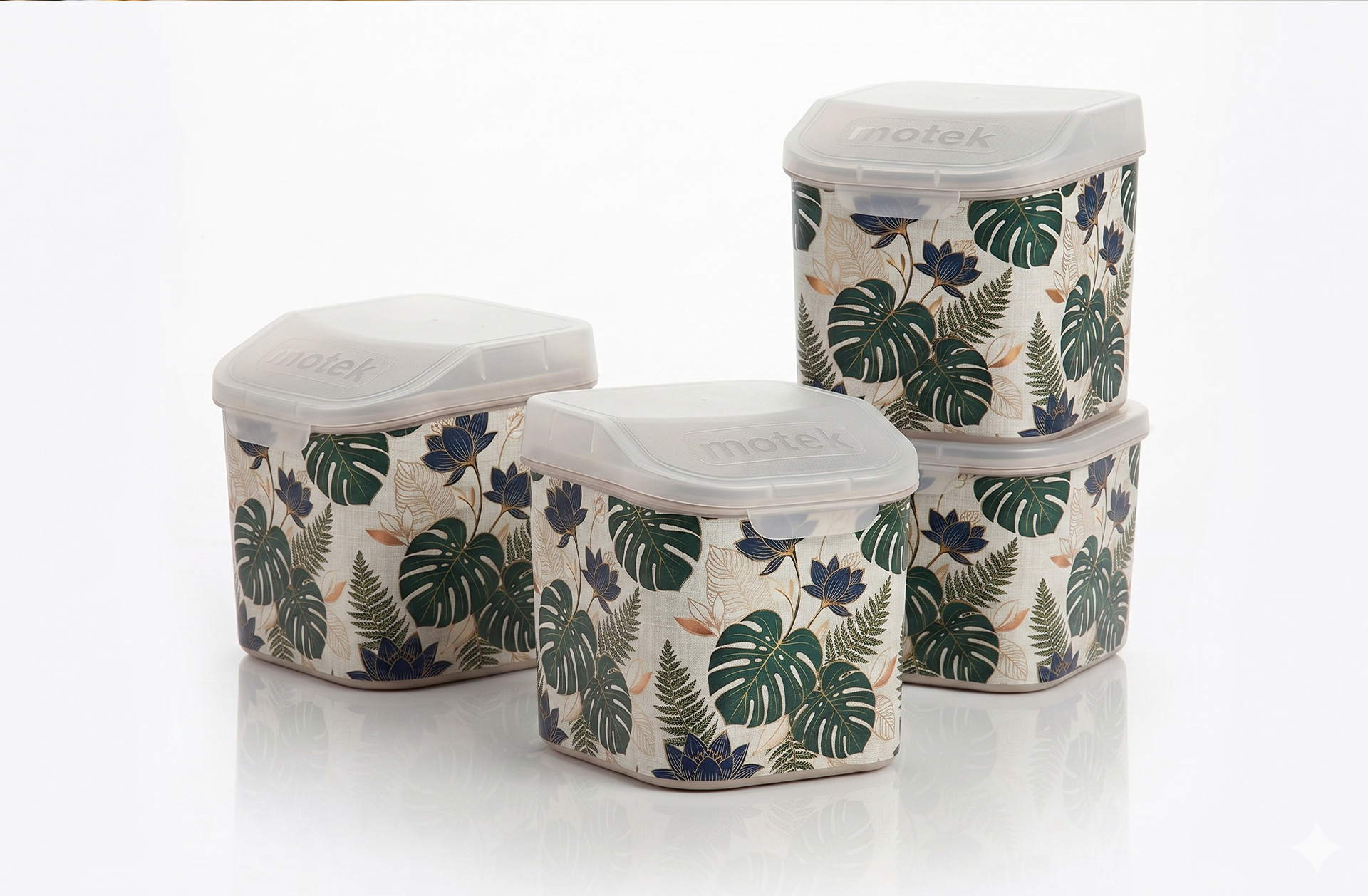
IML label thickness typically ranges from 50 to 400 microns (μm). Common specifications on the market include 40μm, 50μm, 60μm, 65μm, 70μm, 80μm, 90μm, 100μm, 110μm, 120μm, and more.
For easy understanding, we can roughly divide the commonly used IML label thicknesses for storage containers into three tiers:
| Thickness Tier | Typical Thickness | Common Name | Core Characteristics |
|---|---|---|---|
| Thin | 50-70μm | Economy | Soft, low cost, suitable for light-duty use |
| Standard | 75-100μm | Standard | Moderate stiffness, best cost-performance, widest application range |
| Thick | 110-200μm+ | Heavy-Duty / Industrial | High stiffness, impact-resistant, suitable for heavy loads and outdoor use |
Each increase in thickness improves the label's stiffness and tensile strength, but also increases cost accordingly. The middle layer of the label primarily provides stiffness and stability to ensure precise registration. For storage containers, choosing the right thickness means finding the optimal balance between cost, durability, and aesthetics.
2. Thin Labels (50-70μm): Lightweight "Economy Option"
Core Characteristics:
- Stiffness: Low, label is soft and conforms easily to curved surfaces
- Tensile Strength: Moderate, not suitable for repeated bending or heavy object compression
- Cost: Lowest
- Typical Thicknesses: 50μm, 60μm, 65μm, 70μm
The advantages of thin labels lie in their flexibility and low cost. They conform more easily to the curved surfaces and corners of storage containers, with less risk of stress concentration during injection molding. For smaller products, thin labels can also simplify the injection molding process.
Suitable Scenarios:
- Light-duty household storage containers: For storing clothing, toys, books, and other lightweight items
- Small storage boxes: Desk organizers, cosmetic storage boxes
- Single-use or low-frequency plastic containers
Selection Advice: If the storage container is primarily used indoors, with light loads and low opening frequency, a thin label of 50-70μm is sufficient. However, note that thin labels have relatively weaker scratch resistance. If the container is frequently dragged or stacked, thin labels are more prone to scratches.
Example Reference: For products such as lunch box lids under 20cm and small desk storage boxes, single-layer labels of 20-40μm can be chosen. For slightly larger household storage containers, 50-70μm is a common choice.
3. Standard Labels (75-100μm): Daily Use "All-Rounder"
Core Characteristics:
- Stiffness: Moderate, good label flatness
- Tensile Strength: Good, able to withstand daily mechanical stress
- Cost: Medium, best cost-performance
- Typical Thicknesses: 75μm, 80μm, 90μm, 100μm
Standard labels are the mainstay of IML storage containers. They balance cost, stiffness, and durability, making them the most widely used thickness range on the market today.
75-100μm labels are easier to keep flat and resistant to deformation during injection molding, with minimal label position deviation and high yield rates. At the same time, this thickness provides sufficient tensile strength to withstand the stress generated during stacking and handling of storage containers.
Suitable Scenarios:
- Standard daily-use storage containers: Various household storage containers for everyday use
- Children's toy storage containers: Require moderate durability without extreme strength
- Light-duty industrial returnable containers: Light-duty material handling within factories
- Supermarket shelf display boxes: Require good visual appearance and moderate durability
Selection Advice: For most household storage scenarios, standard labels of 75-100μm are the safest choice. They achieve the best balance between cost and quality, ensuring both label flatness and print quality while meeting the durability requirements of daily use.
Example Reference: Products such as paint buckets, large water jugs, and stools typically use labels around 70μm. Since storage container label areas are similar to these products, 75-100μm is a directly relevant reference range.
4. Thick Labels (110-200μm+): Heavy-Duty "Armored Warrior"
Core Characteristics:
- Stiffness: High, label is rigid and resistant to deformation
- Tensile Strength: Excellent, able to withstand high-intensity mechanical stress
- Cost: Higher, but long-term value from durability is more significant
- Typical Thicknesses: 110μm, 120μm, 188μm, 200μm+
The biggest advantage of thick labels is strength. Thicker labels mean higher tensile strength and flexural strength. In heavy-duty scenarios, storage containers may be stacked several meters high, handled by forklifts, or exposed to sun and rain outdoors—thick labels ensure the label remains intact and aesthetically pleasing under these extreme conditions.
For large-area products, thicker labels are also easier to injection mold because the label itself has sufficient stiffness to resist wrinkling or shifting in the mold.
Suitable Scenarios:
- Industrial heavy-duty returnable containers: Heavy-duty containers used repeatedly in factories and warehouses
- Large outdoor storage containers: Large storage containers for balconies, courtyards, and campsites
- Logistics transport containers: Transport packaging subject to repeated loading, unloading, and stacking
- Chemical/paint drums: Industrial containers that need to withstand chemical exposure and mechanical stress
Selection Advice: If the storage container requires frequent handling, heavy object stacking, outdoor storage, or if the product area is large (such as large storage containers), thick labels of 110μm or more are necessary.
Example Reference: For large tabletops or trash bins, labels of 90-110μm are recommended. For industrial returnable containers and outdoor storage containers, 110μm or more, or even 188μm thick specifications, are recommended.
Special Note: Thicker labels are more difficult to injection mold, and may require adjustments to injection temperature, pressure, and cooling time to ensure perfect fusion between the label and the container body. It is recommended to work with an experienced IML supplier for process debugging.
5. Thickness Selection Guide for Different Use Scenarios
| Use Scenario | Recommended Thickness | Reason |
|---|---|---|
| Light-duty household storage containers (clothing, books, toys) | 50-70μm | Low cost, soft and conformable, sufficient for indoor use |
| Standard daily-use storage containers (everyday household) | 75-100μm | Best cost-performance, balancing durability and cost |
| Children's toy storage containers | 75-100μm | Requires moderate impact resistance, not extreme strength |
| Supermarket shelf display boxes | 75-100μm | Visual appearance priority, moderate durability sufficient |
| Light-duty industrial returnable containers (factory internal handling) | 75-100μm | Can withstand daily handling stress |
| Industrial heavy-duty returnable containers (frequent handling, stacking) | 110-188μm | High stiffness, high tensile strength, suitable for high-intensity use |
| Large outdoor storage containers | 110-200μm+ | UV resistance, temperature resistance, impact resistance |
| Logistics transport containers (repeated loading/unloading) | 110-188μm | Label must withstand mechanical stress from handling and stacking |
| Chemical/paint drums | 70-100μm | Balances decorative effect and adhesion |
Selection Principles:
- First consider usage frequency: Daily opening/closing → thick; occasional use → standard or thin
- Then consider load requirements: Heavy object stacking → thick; lightweight storage → thin or standard
- Finally consider usage environment: Outdoor/humid/large temperature variation → thick; indoor constant temperature → thin or standard
6. FAQ
"μm" is the abbreviation for "micron." 1 micron equals one-thousandth of a millimeter (0.001mm). 50μm is 0.05mm, roughly equivalent to the thickness of a standard sheet of A4 paper.
Not necessarily. Thickness needs to match the use scenario. Thin labels are low-cost and conformable, suitable for light-duty storage. Thick labels offer high strength and durability, suitable for heavy-duty scenarios. There is no "best" thickness, only the "most suitable" thickness.
Yes. Thicker labels require higher injection temperature and pressure, and may also require longer cooling times. It is recommended to conduct trial molding before mass production to confirm the fusion quality between the label and the container body.
You can use a thickness gauge to measure, or request the label's technical specifications from the supplier. Without professional tools, you can also make a preliminary judgment by feel—thin labels feel soft, while thick labels have a noticeable "rigid" feel.
Relatively speaking, yes. Thin labels have a thinner surface protective layer, making them less scratch-resistant than thicker labels. If the storage container is frequently dragged or comes into contact with hard objects, it is recommended to choose a thicker label.
IML labels are decorative layers applied to the surface of the storage container—they are separate from the container body's wall thickness. However, label thickness does affect shrinkage rate and cooling uniformity during injection molding. For thin-wall storage containers (wall thickness below 1.2mm), excessively thick labels may increase molding difficulty.
Contact Us
Name*
Telephone*
Region*
Please fill in your request*


