
Screen Printing in In-Mold Labeling: The Finishing Touch for Special Effects and Thick Ink Layers
Screen Printing in In-Mold Labeling: The Finishing Touch for Special Effects and Thick Ink Layers
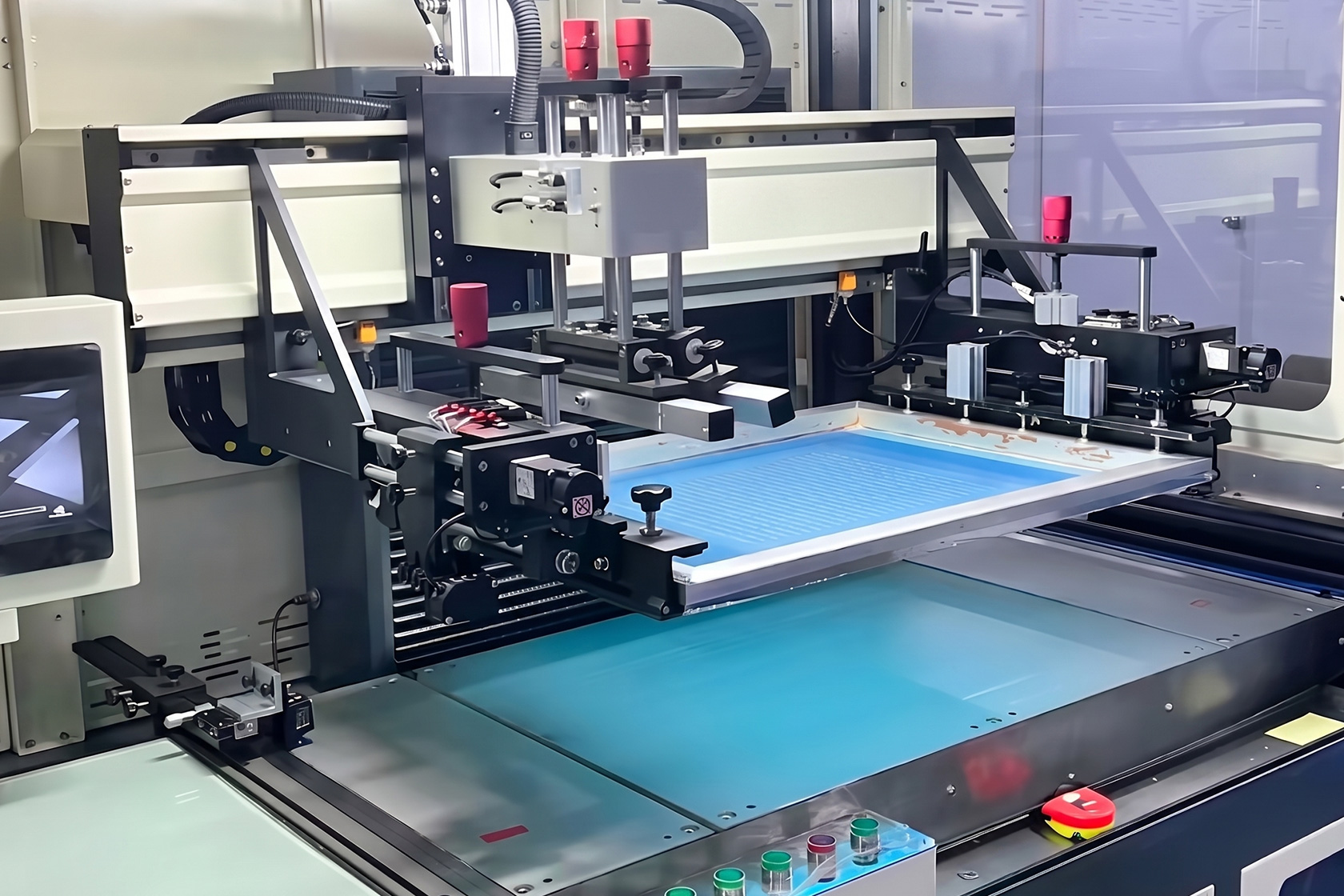
Among the printing methods for in-mold labeling (IML), screen printing (also known as silk screening) is a unique process. It does not pursue fine dots or high speed, but is known for its extremely thick ink layer, strong three-dimensional feel, and ability to create special textures. Screen printing is typically not used as the primary IML printing method (due to slow speed and limited resolution), but as a supplementary process for local decoration to achieve visual effects that conventional printing cannot, such as: high‑opacity white backing, braille dots, matte/satin tactile finishes, metallic inks, glow‑in‑the‑dark inks, and raised tactile coatings.
This article explains the technical principles of screen printing and analyzes its process characteristics, core advantages, limitations, typical applications, and comparisons with other IML printing methods.
1. Technical Principle of Screen Printing
Screen printing is a stencil printing method. The screen consists of a frame, a mesh (synthetic or metal), and a stencil. After exposure and development, the image areas are open (mesh holes clear), while the non‑image areas are blocked. During printing, ink is poured onto the screen, and a squeegee pushes the ink through the open mesh onto the substrate (IML label film).
Printing process:
The screen is held at a small distance from the substrate (snap‑off distance).
Ink is poured onto one end of the screen.
The squeegee moves across, pushing ink through the open mesh onto the substrate.
The screen snaps back, separating from the substrate.
The ink is dried (UV curing or hot air).
The ink layer thickness can be adjusted by choosing the mesh count and stencil thickness. A single pass typically yields 10–50 μm; multiple passes can exceed 100 μm – thicker than any other printing method.
2. Process Characteristics of Screen Printing for IML
2.1 Screen Making
Screen making process: select appropriate mesh count (typically 100–300 mesh) → stretch screen → apply emulsion → expose/develop → touch up. Low cost, short lead time (1-2 days), but low plate life (thousands to tens of thousands of impressions) – not for high volumes.
2.2 Ink Systems
IML screen printing mainly uses UV screen inks because of fast curing, good adhesion, no VOCs, and the ability to build thick films. Solvent‑based inks can also be used, but require long drying times and are less eco‑friendly.
Ink characteristics: High viscosity, high thixotropy (thins when sheared, thickens when still) to maintain printed shape.
Special effect inks: Matte/satin inks, foaming inks, phosphorescent inks, conductive inks, metallic inks, braille inks, etc.
Inks must have: heat resistance (160-240°C), good adhesion to PP/PE substrates, flexibility (to withstand blow molding stretching).
2.3 Offline Sheet‑Fed or Roll‑to‑Roll
Screen printing is typically offline, and mostly sheet‑fed (roll‑to‑roll screen printing requires specialized equipment and is more expensive). After printing, the sheets go offline for adhesive coating and die‑cutting.
2.4 Not for Full‑Coverage Printing
Screen printing is very slow (10-30 sheets/min sheet‑fed; 5-15 m/min roll‑to‑roll) and cannot be the primary IML printing method. It is used only for local areas (logos, pattern highlights, braille dots, etc.).
3. Core Advantages of Screen Printing for IML
3.1 Extremely Thick Ink Layer, Strong Three‑Dimensional Feel
Screen ink thickness is 3–10 times that of gravure and 5–25 times that of flexo. Printed text, lines, or patterns have a distinct raised tactile feel, useful for:
Simulated foil stamping: using metallic inks to create a glossy, raised metallic effect.
Braille dots: one or more passes to create tactile dots compliant with accessibility standards.
Simulated etching / matte texture: using matte inks or coarse mesh to produce a rough, satin tactile finish.
3.2 High Opacity
For dark‑colored containers (e.g., black HDPE bottles), a white underprint is needed to make overprinted colors bright. Screen‑printed white ink has extremely high opacity – one pass can fully cover a dark substrate, whereas flexo or gravure may require two or three passes.
3.3 Ability to Use Special Effect Inks
Screen printing can apply specialty inks that ordinary printing cannot:
Phosphorescent/fluorescent inks: glow in the dark – for safety labels or fun packaging.
Conductive inks: print RFID antennas or touch‑sensitive circuits (for in‑mold electronics).
Thermochromic/photochromic inks: change color with temperature or light.
Foaming inks: expand when heated to create very thick raised patterns.
3.4 Low Screen Cost, Suitable for Short Runs
For small‑batch, high‑mix IML labels requiring special effects, screen‑making cost is far lower than gravure, and also lower than flexo (especially for single colors or simple designs).
3.5 Wide Substrate Adaptability
Screen printing works on almost any film (PE, PP, BOPP, PET, etc.) with low surface energy requirements – it can even print on untreated films (though adhesion may suffer).
3.6 High Color Saturation
The thick ink layer delivers extremely high color saturation and density, especially for large solid areas.
4. Limitations of Screen Printing for IML
4.1 Very Low Printing Speed
Screen printing is one of the slowest methods. Roll‑to‑roll screen printing typically runs at 5–15 m/min, compared to flexo at 200 m/min – unsuitable for high volumes.
4.2 Limited Resolution
Screen printing resolution is limited by mesh count and thread diameter. Typical screen printing can only reproduce 40–60 lines per inch (15–25 lines/cm), far lower than flexo (175 lpi) and offset/gravure. Fine text (<2 pt) and thin lines (<0.2 mm) easily break or fill in.
4.3 Not Suitable for Multi‑Color Registration
Multi‑color registration is difficult with screen printing; registration accuracy is typically ±0.2–0.5 mm, leading to misalignment. Thus, screen printing is usually limited to one or two colors, or used as a local overprint after flexo/gravure.
4.4 Excessive Ink Thickness May Affect Molding
For IML, overly thick screen‑printed layers (especially large areas) can cause stress concentration during injection or blow molding, leading to label warpage, cracking, or poor fusion. Thickness and placement must be precisely controlled.
4.5 Complex Finishing Steps
Screen printing is usually offline, requiring separate varnishing and adhesive coating steps, increasing handling cost and time.
4.6 High Drying/Curing Requirements
Thick ink layers need higher UV energy (multiple high‑power lamps) to fully cure; otherwise the bottom of the ink layer may remain uncured. Solvent‑based inks require long hot‑air drying, further reducing efficiency.
4.7 Environmental Concerns
Solvent‑based screen inks have high VOC emissions. UV screen inks have no VOCs, but cleaning screens and squeegees generates waste liquid.
5. Typical Process Flow for Screen‑Printed IML Labels
Screen making: Produce screen stencil (non‑image areas blocked).
Screen printing: Print the required pattern onto the film (single color or multiple colors in sequence).
Drying/curing: UV cure or hot air dry (after each color if multiple).
(Optional) Multiple passes: Repeat printing if extremely thick effect is needed.
Adhesive coating: Offline coating or lamination of heat‑seal adhesive (embossed or plain).
Die‑cutting and finishing: Die‑cut into single labels or rewind.
Note: In most real production, screen printing is used as a post‑decoration step – after the main pattern is printed by flexo or gravure, special effects are screen‑printed locally.
6. Suitable Applications for Screen‑Printed IML Labels
| Application Category | Typical Products | Why Screen Printing |
|---|---|---|
| Braille labels | Pharmaceutical bottles, accessible packaging | Can print raised braille dots meeting standards |
| High‑opacity white underprint | Color labels on dark containers (black/dark blue HDPE) | One pass fully covers dark substrate |
| Metallic effects (simulated foil) | High‑end cosmetics, premium beverages | Thick metallic inks create strong metallic gloss and relief |
| Matte / tactile textures | Premium skincare packaging | Coarse‑mesh screen with matte ink produces soft‑touch feel |
| Glow‑in‑the‑dark / safety | Agrochemical bottles, emergency products | Phosphorescent inks glow in dark, improving safety |
| Conductive / smart packaging | RFID/NFC‑enabled IML labels | Print conductive antennas, integrate with container during molding |
| Limited edition / artistic | Promotional packaging, holiday specials | Achieves rough or heavy texture impossible with other methods |
7. Screen Printing vs. Other Printing Methods
| Aspect | Screen Printing | Gravure | Flexo | Offset |
|---|---|---|---|---|
| Print quality (resolution) | Low (40-60 lpi) | Excellent | Good | Top‑notch |
| Ink layer thickness | 10–50 μm (multiple passes) | 5-15 μm | 2-4 μm | 1-2 μm |
| Tactile / 3D effect | Very strong | Moderate | Weak | None |
| Opacity | Very high | High | Medium | Low |
| Special effects capability | Very strong (braille, glow, etc.) | Moderate | Medium (cold foil) | Medium |
| Printing speed | Very low (5-15 m/min) | 200-400 m/min | 100-200 m/min | 50-100 m/min |
| Plate/screen cost | Low | High | Low | Very low |
| High‑volume cost | High (inefficient) | Lowest | Medium | High |
| Low‑volume cost | Low | Very high | Medium | Lowest |
| Registration accuracy | ±0.2-0.5mm | ±0.1mm | ±0.1mm | ±0.05mm |
| Role in IML | Local special effects | Primary (long run) | Primary (medium‑long) | Primary (short‑run high quality) |
8. Integration Considerations for Screen‑Printed IML
Because screen‑printed ink layers are thick, special attention is needed during in‑mold molding:
Shrinkage mismatch: Thick ink and film substrate have different shrinkage rates, which may cause warpage or cracking. Keep screen‑printed areas small and use flexible inks.
Adhesive compatibility: Ensure the screen ink does not react chemically with the heat‑seal adhesive, which could reduce bond strength.
Molding temperature resistance: Screen inks must withstand 160-240°C without decomposing or migrating.
Pre‑testing: Always conduct small‑batch molding tests before mass production to verify fusion performance.
Motek offers testing services for screen‑printed IML labels, including thermal stability, shrinkage, and bond strength.
9. Future Trends: Screen Printing in IML
UV LED curing: Low‑heat, low‑energy UV LED curing is ideal for thick ink layers without damaging the film.
High‑resolution screen printing: Using finer mesh (400+ mesh) and thin emulsions, screen resolution is gradually improving (up to 80 lpi).
Digital screen printing: Inkjet‑based screen printing (digital stencils) is under development, potentially combining thick‑ink capability with digital flexibility.
Hybrid printing lines: Flexo + screen + gravure combination lines – print main pattern and local special effects in one pass for higher efficiency.
10. Conclusion
Screen printing is not a substitute for other IML printing methods, but rather a value‑added finishing process for local decoration, adding unique visual and tactile experiences to packaging. For applications requiring braille, high‑opacity white underprint, metallic relief, glow‑in‑the‑dark effects, or tactile textures, screen printing is irreplaceable.
For most IML labels, a sensible approach is: use flexo, gravure, or offset for the main pattern (high precision, high efficiency), then add local screen‑printed special effects. Motek provides films and adhesive coatings compatible with all printing methods, ensuring stable performance of screen‑printed IML labels during molding.
To evaluate the feasibility of screen printing for your product or to request sample testing, please contact the Motek technical team.
Contact Us
Name*
Telephone*
Region*
Please fill in your request*


