
Offset Printing in In-Mold Labeling: Top-Quality Graphics, Flexible Batch Size
Offset Printing in In-Mold Labeling: Top-Quality Graphics, Flexible Batch Size
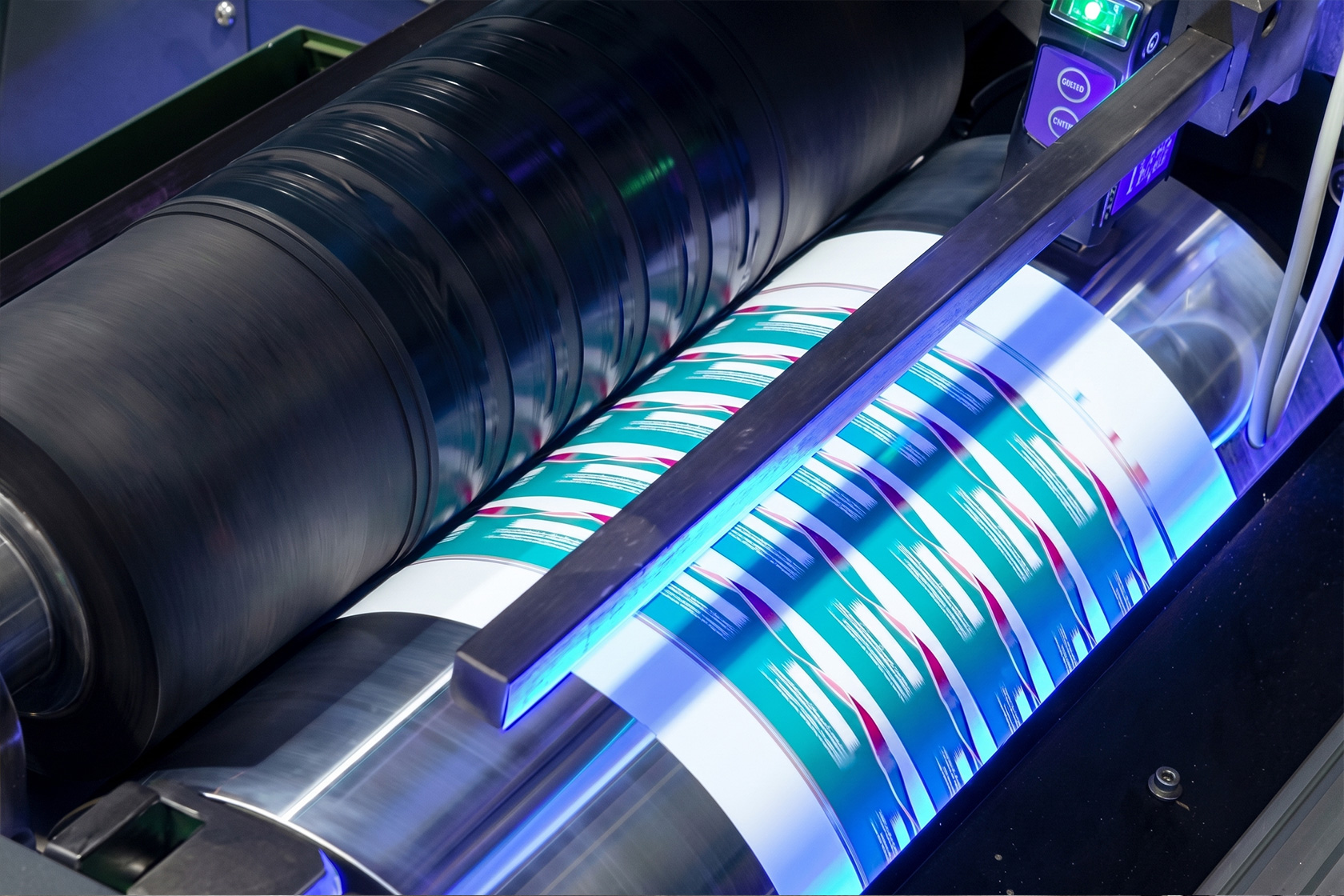
Among the printing methods for in-mold labeling (IML), offset printing (also called “lithography” or “planographic printing”) stands out for its fine dot reproduction, rich gradation, flexible batch size adaptability, and low short‑run cost. It is the preferred choice for products with demanding image quality, variable volumes, or frequent design changes. For cosmetics packaging, high‑end food containers, and other applications requiring photographic‑grade images, offset is often the best match.
This article explains the technical principles of offset printing and analyzes its process characteristics, core advantages, limitations, applications, and comparisons with other IML printing methods.
1. Technical Principle of Offset Printing
Offset printing is an indirect planographic printing method. Its core principle is based on oil‑water incompatibility. On the printing plate, the image areas are oil‑accepting and water‑repelling, while the non‑image areas are water‑accepting and oil‑repelling. During printing, the plate is first dampened with fountain solution (which adheres to the non‑image areas), then inked (ink adheres only to the image areas). The ink image is then transferred first to a rubber blanket and from the blanket to the substrate (IML label film). Hence the name “offset” (indirect transfer).
Printing process:
The plate cylinder: oil‑accepting image areas pick up ink; non‑image areas pick up fountain solution.
The plate contacts the blanket cylinder, transferring the ink image to the blanket (first transfer).
The blanket cylinder and impression cylinder work together to transfer the ink image to the substrate (second transfer).
The ink is dried (UV curing or hot air), fixing it onto the film.
The advantage of offset lies in the elasticity of the blanket, which compensates for microscopic irregularities on the substrate surface, achieving uniform and fine ink transfer. The ink layer is thin (1-2 μm), but dot reproduction is extremely precise, capable of reproducing gradations from 1% to 99%.
2. Process Characteristics of Offset for IML
2.1 Plate Making
Offset plates are planographic, typically made using CTP (computer‑to‑plate) technology that exposes the image onto an aluminum‑based photosensitive plate, followed by developing and washing. Plate making cost is low and lead time extremely short (hours to 1 day), suitable for frequent design changes. Plate life is moderate (50,000-100,000 impressions); for long runs, plates must be changed mid‑run.
2.2 Ink and Fountain Solution Systems
IML offset printing mainly uses UV offset inks, because UV curing is fast, provides good adhesion, has no solvent emissions, and withstands the high temperatures of in‑mold molding. Conventional oil‑based offset inks require fountain solution (with alcohol or substitutes), have slow drying, and emit VOCs – they are rarely used for IML.
UV offset inks: 100% solids, instant curing, bright colors, heat‑ and scratch‑resistant.
Fountain solution: Even with UV inks, a small amount of fountain solution is needed to maintain the hydrophilicity of the non‑image areas, but the volume is greatly reduced.
Inks must have: heat resistance (160-240°C), good adhesion to PP/PE substrates, flexibility (to withstand blow molding stretching), and low odor (for food packaging).
2.3 Mainly Offline Production
Offset is typically offline: the label top layer is printed on a sheet‑fed or web‑fed offset press, then offline processes such as varnishing, adhesive coating, and die‑cutting follow. Offset presses rarely have inline coating and die‑cutting units. This means offset IML requires more work‑in‑process handling and separate equipment.
2.4 High Substrate Requirements
Offset has high demands on film surface energy, flatness, and static control. Low‑surface‑energy materials such as PE and PP require corona treatment (surface energy ≥42 dynes/cm) or a primer coating; otherwise ink adhesion is insufficient. BOPP performs well after treatment and is the mainstream substrate for offset IML.
3. Core Advantages of Offset for IML
3.1 Top‑Notch Image Quality and Detail Reproduction
Offset provides the most accurate dot reproduction and smoothest gradient transitions among all printing methods. It can reproduce extremely fine dots below 1% and highlight details, with rich image gradation, natural skin tones, and sharp text edges. For packaging designs requiring photographic‑grade images and complex gradients, offset is the first choice.
3.2 Flexible Batch Size, Extremely Low Short‑Run Cost
Low plate cost and short lead time make offset ideal for small volumes (thousands to tens of thousands of labels), high‑mix products, and frequent design changes. Brands can conduct fast market tests, seasonal promotions, regional customizations, etc., without the high plate cost of gravure or high minimum order quantities of flexo.
3.3 Good Color Consistency
Modern offset presses are equipped with automatic ink supply systems and closed‑loop color control, maintaining batch‑to‑batch color stability. Although not as stable as gravure for ultra‑long runs, offset performs excellently for small to medium volumes.
3.4 Suited for Large Format and High‑Precision Registration
Offset presses can print large sheet sizes (e.g., 1020×720 mm), placing many labels per pass for high efficiency. Multi‑color registration accuracy can reach ±0.03 mm, meeting fine line and small text requirements.
3.5 Special Effects Possible
Offset can be combined inline or offline with UV varnishing (gloss, matte, spot), foil stamping, screen thickening, and other finishing to enhance label texture.
3.6 Mature Technology Ecosystem
Offset equipment is widespread, operators are readily available, and maintenance systems are mature. For printers entering the IML field, the learning curve is relatively low.
4. Limitations of Offset for IML
4.1 Thin Ink Layer, Relatively Weak Scratch Resistance
Offset ink layer thickness is only 1-2 μm, much thinner than gravure (5-15 μm) and flexo (2-4 μm). As a result, offset IML labels are less resistant to scratching and abrasion in harsh environments (frequent friction, hard objects). Protective varnish can be applied to improve scratch resistance, but at added cost.
4.2 Not Suitable for Ultra‑Long Runs
Offset plate life is limited (50,000-100,000 impressions). For annual volumes exceeding 5 million labels, frequent plate changes disrupt production efficiency. Gravure or flexo are more cost‑effective at high volumes.
4.3 Requires Offline Finishing, Multiple Steps
Offset cannot achieve “print + coat + die‑cut” in one pass like flexo. Adhesive coating and die‑cutting must be done offline, increasing material handling, storage, labor costs, and quality risks (scratches, dust).
4.4 High Demands on Film Surface Treatment
Non‑polar materials like PE and PP inherently have poor ink adhesion. They must be corona‑treated or primed. Improper treatment leads to poor ink adhesion, resulting in delamination or ink wash‑off during in‑mold molding’s high temperature and pressure.
4.5 Challenges with Fountain Solution
Even with UV inks, a small amount of fountain solution is required. Fountain solution may affect film surface energy or react adversely with the subsequent adhesive layer. Careful control of fountain solution formulation and dosage is needed.
4.6 Static and Dust Issues
During high‑speed operation, films can generate static electricity, attracting dust and causing print defects or “scratches.” Static eliminators and cleaning devices are necessary.
5. Typical Process Flow for Offset‑Printed IML Labels
Design separation: Separate colors considering offset characteristics, controlling total ink coverage and optimizing gray balance.
CTP plate making: Produce planographic printing plates.
Offset printing: Print the label top layer on an offset press (using UV inks with inline UV curing).
Offline quality inspection: Check registration, color deviation, and defects.
Protective varnish coating (optional): Improve scratch resistance.
Adhesive coating: Apply or laminate a heat‑seal adhesive onto the back of the printed film (embossed or plain).
Die‑cutting and rewinding/stacking: Die‑cut into single labels, rewind into rolls, or stack as sheets.
Final inspection and packaging.
6. Suitable Applications for Offset‑Printed IML Labels
| Application Category | Typical Products | Why Offset |
|---|---|---|
| Premium cosmetics | Compact cases, eyeshadow palettes, cream jars (injection IML) | Photographic images, fine gradients, metallic effects, flexible volumes |
| Fine food | Premium chocolate boxes, tea canisters, gift packaging | High image quality, short‑run refined packaging, seasonal/limited editions |
| Pharmaceutical & nutraceuticals | Supplement bottles, medicine jars | Fine text (instructions on label), high clarity needed, medium volumes |
| Brand promotion / sampling | New product test marketing, holiday limited editions | Small volume fast time‑to‑market, low plate cost, easy modification |
| Small‑/mid‑brand regular products | Regional personal care, food containers | Low minimum order quantity, less capital tied up, suitable for multiple SKUs |
7. Offset vs. Flexo vs. Gravure for IML
| Aspect | Offset | Flexo | Gravure |
|---|---|---|---|
| Print quality | Top‑notch detail and gradients | Good (UV flexo approaching gravure) | Excellent (thick ink, saturated) |
| Ink layer thickness | 1-2 μm | 2-4 μm | 5-15 μm |
| Scratch resistance | Fair (can be improved with varnish) | Good | Excellent |
| High‑volume cost (>5M/year) | High (frequent plate changes) | Medium | Lowest |
| Medium‑volume cost (0.5-5M/year) | Medium | Lowest | High (plate cost) |
| Low‑volume cost (<0.5M/year) | Lowest | Medium | Very high |
| Job changeover flexibility | Excellent | Good | Poor |
| Inline integration | Usually offline | Excellent (print+finishing one pass) | Usually offline |
| Plate making cost | Very low | Low | High |
| Plate lead time | Hours – 1 day | 1-3 days | 2-4 weeks |
| Recommended annual volume | ≤2M labels (flexible) | 500k – 5M labels | ≥5M labels |
| Typical speed | 50-100 m/min (multi‑color) | 100-200 m/min | 200-400 m/min |
| Substrate requirements | High (surface energy ≥42 dynes/cm) | Medium | Lower (accepts lower surface energy) |
8. Motek’s Offset IML Solutions
Motek provides targeted technical support for customers using offset‑printed IML labels:
Film surface treatment: Recommend BOPP/PE films suitable for offset, with corona treatment to ensure surface energy ≥42 dynes/cm. Provide primer coating solutions when necessary to guarantee ink adhesion.
Ink matching: Recommend UV offset inks compatible with Motek’s adhesive layer to avoid chemical reactions causing poor adhesion.
Custom adhesive layer: Based on the thin ink layer of offset, optimize the heat‑seal adhesive formulation and coating weight (embossed or plain) to ensure fusion strength.
Antistatic and cleaning: Provide antistatic coating solutions to reduce surface resistance (10⁹–10¹¹ Ω) and recommend static elimination equipment to reduce print defects from dust attraction.
Process validation: Assist customers in small‑batch trials, testing shrinkage, heat resistance, and fusion performance during injection or blow molding, and adjust pre‑compensation values.
Finishing integration advice: Provide optimal process routing from offset to coating to die‑cutting to minimize handling losses.
9. Future Trends: Offset in IML Evolution
UV offset technology maturity: UV curing completely solves ink drying problems, enabling high‑quality printing on non‑absorbent films – now the standard for offset IML.
Waterless offset: Eliminates fountain solution by using silicone‑based plates that repel ink. Provides sharper images and removes fountain solution issues, but at higher cost.
Hybrid printing (offset + digital): Offset for high‑quality base colors and main images, digital inkjet for variable data (QR codes, serial numbers, personalized text) – enabling “mass customization.”
Development of primer coatings: New water‑based primers allow difficult‑to‑stick materials like PE and PP to achieve excellent UV ink adhesion, expanding the substrate range for offset IML.
Inline offset IML lines: Some equipment manufacturers have developed inline offset + cold foil + coating + die‑cutting lines, but they are not yet widespread and have high costs.
10. Conclusion
Offset printing, with its top‑notch image quality, flexible batch size adaptability, and low short‑run cost, holds an irreplaceable position in the IML market. For high‑end cosmetics, fine foods, nutraceuticals, and promotional packaging requiring frequent design changes, offset is the best choice balancing quality and flexibility.
Of course, offset’s limitations – thin ink layer, relatively weak scratch resistance, and need for offline finishing – must be recognized. When selecting a printing method, companies should consider product positioning, annual volume, changeover frequency, and budget. Motek can provide end‑to‑end offset IML solutions from film selection, surface treatment, ink matching, to finishing processes based on your specific needs.
For more technical details on offset IML or to request samples, please contact the Motek technical team.
Contact Us
Name*
Telephone*
Region*
Please fill in your request*


