
Multi-Flavor Yogurt Series Packaging IML Brand VI Standardized Design Solution
Multi-Flavor Yogurt Series Packaging IML Brand VI Standardized Design Solution
On the supermarket yogurt shelf, dozens of brands and hundreds of flavors are squeezed together. As consumers walk past the shelf, their gaze lingers for only a few seconds – whether a brand gets recognized depends not on how good a single package looks, but on whether the entire series standing on the shelf looks like "one family."
For multi-flavor yogurt series, the core challenge of packaging design is not "making one attractive cup" but "creating a set of cups that consumers can recognize at a glance."
IML (In-Mold Labeling) technology is precisely the ideal vehicle for achieving brand VI standardization in multi-flavor yogurt series.
📖 Table of Contents
- 1. Three Core Pain Points of Multi-Flavor Yogurt Series Packaging
- 2. Why IML Is the Ideal Vehicle for Brand VI Standardization
- 3. Five Core Elements of IML Brand VI Standardization for Multi-Flavor Yogurt
- 3.1 Unified Layout – The "Skeleton" Must Be Consistent Across Flavors
- 3.2 Brand Color Values – Keeping Colors "Accurate and Consistent"
- 3.3 Font System – The Brand's Voice Cannot Change
- 3.4 Flavor Distinction Elements – Creating "Variation" Within "Unity"
- 3.5 Uniform Container Form – IML's "Three-Dimensional" Standardization
- 4. Implementation Process for IML Standardized Design
- 5. Case Study: Hiland Dairy's IML Yogurt Packaging Refresh
- 6. FAQ
1. Three Core Pain Points of Multi-Flavor Yogurt Series Packaging
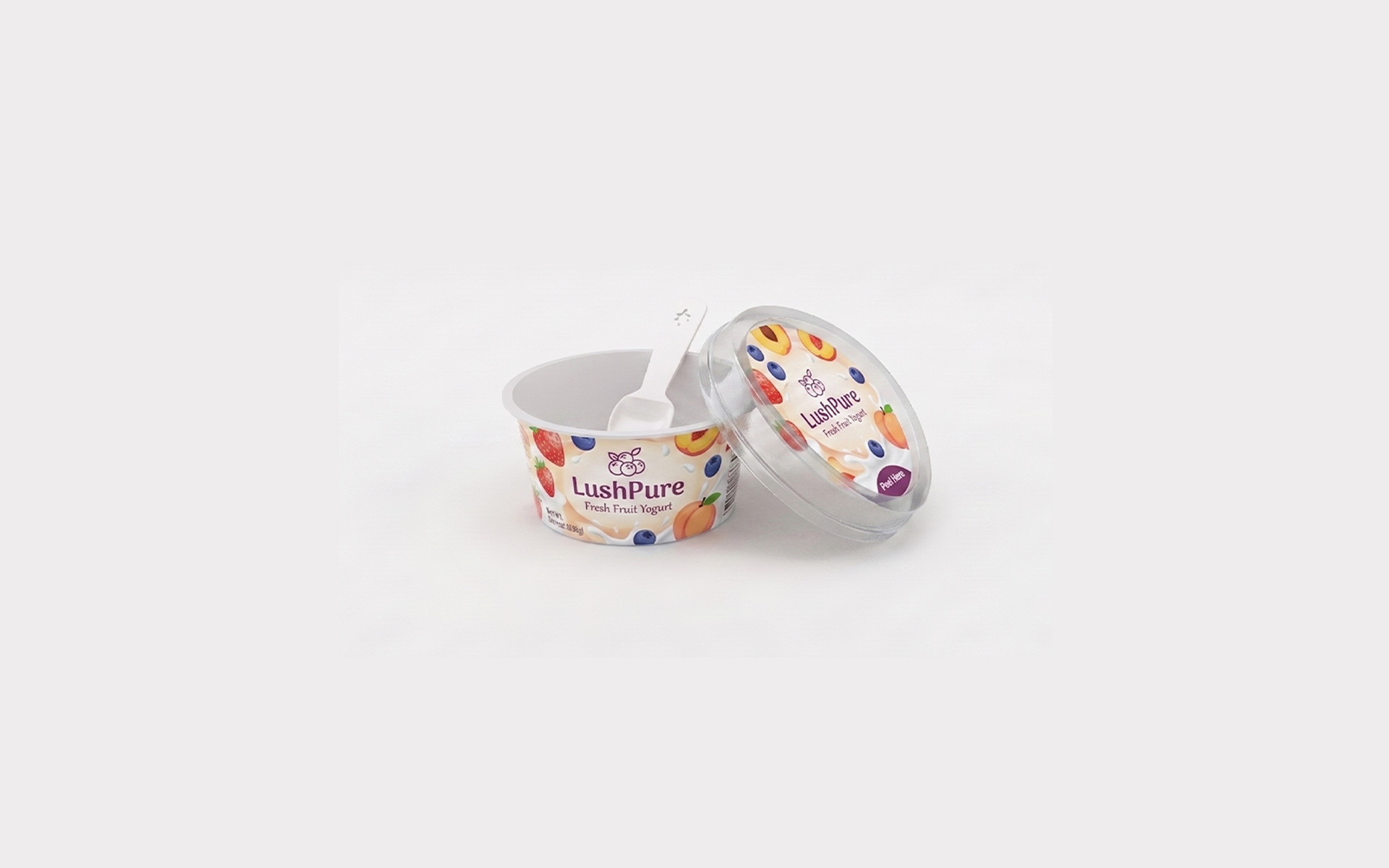
When yogurt brands launch multi-flavor series, packaging design typically faces three core issues:
Pain Point 1: When flavors change, the design falls apart.
Different flavors require different colors and patterns – strawberry is pink, blueberry is purple, vanilla is beige. If each flavor is designed independently, each may look good individually, but together they look like a "mishmash" rather than a "series." Brand recognition is diluted, and consumers struggle to identify "these are all from Brand X."
Pain Point 2: The more flavors, the more complex the supply chain.
Each flavor requires separate plate-making, separate printing, separate procurement – more flavors mean more SKUs and higher management costs. For traditional labeling processes, every additional flavor means a new set of plates, a new color matching scheme, and another inventory unit.
Pain Point 3: "Visual noise" on the shelf.
If different flavors of the same yogurt brand have inconsistent layouts, Logo positions, and font styles, consumers will feel confused during quick browsing – brand messaging efficiency is greatly reduced.
2. Why IML Is the Ideal Vehicle for Brand VI Standardization
IML (In-Mold Labeling) technology fuses the label with the container during the injection molding process. There is no interface between the label and the cup body – the pattern never peels off and never fades. But IML's value for brand VI standardization goes far beyond "durability."
IML's standardization advantages:
First, unified plate-making with "replaceable" flavor information. IML plate-making establishes the brand's standard visual elements (Logo, color scheme, layout). Different flavor labels share the same set of plates – only the flavor name and corresponding colors are replaced. This means switching from strawberry to blueberry only requires changing the print file, not remaking plates.
Second, high-precision printing with accurate brand color reproduction. IML supports CMYK four-color printing and spot color printing. The brand's standard color values can be maintained consistently across different flavor labels. Consumers see the exact same brand Logo color on different flavor packages.
Third, fully automated production with high batch consistency. IML production is fully automated from label placement into the mold to injection molding. Compared to traditional labeling processes, IML eliminates post-labeling steps and avoids position deviations and quality fluctuations caused by manual labeling.
3. Five Core Elements of IML Brand VI Standardization for Multi-Flavor Yogurt
3.1 Unified Layout – The "Skeleton" Must Be Consistent Across Flavors
Layout is the "skeleton" of brand visuals. In a multi-flavor yogurt series, all flavor labels must use exactly the same layout structure:
- Brand Logo position: Fixed in the same position on the label (e.g., top-left corner or center)
- Flavor name position: Fixed in the same area of the label
- Decorative element positions: Decorative lines, color blocks, and borders are unified across the series
- Information hierarchy: The arrangement order of brand name, flavor name, net weight, and nutritional information is consistent
Design principle: The layout is "fixed"; only the flavor information is "variable."
3.2 Brand Color Values – Keeping Colors "Accurate and Consistent"
Color is the most sensitive element in brand recognition. In a multi-flavor yogurt series, the brand's standard color values must run through all flavors.
Practical points:
- Use brand standard colors in fixed areas of the label (such as Logo background and decorative lines)
- Use flavor distinction colors (strawberry pink, blueberry purple) as secondary colors for the flavor name or pattern areas
- Establish a brand color value archive: clearly document CMYK values and Pantone numbers
- Ensure color consistency across flavors and batches through standard color sample control
3.3 Font System – The Brand's Voice Cannot Change
Fonts are a direct reflection of brand personality. In a multi-flavor yogurt series, all flavor labels must use the same font system:
- Brand name font: Unified across the series, not changing with flavor
- Flavor name font: Can use the same font as the brand name or a complementary one, but must be consistent across all flavors
- Auxiliary information font: Net weight, nutritional information, and other text fonts are unified across the series
3.4 Flavor Distinction Elements – Creating "Variation" Within "Unity"
The core of serialization is "unity with variation." Flavor distinction elements are that "variation."
Recommended approach:
- Color distinction: Different flavors use different secondary colors (strawberry pink, blueberry purple, mango yellow)
- Pattern distinction: Different flavors use different fruit or ingredient patterns
- Icon distinction: Use uniformly styled flavor icons (line or filled style)
Design principle: Distinction elements should occupy only 20%-30% of the label area, with the remaining 70%-80% being the brand's "unified skeleton."
3.5 Uniform Container Form – IML's "Three-Dimensional" Standardization
Yogurt packaging is not just about the label – it also includes the container form. IML integrates the label and container as one piece, so the container form is also part of the brand VI.
Practical points:
- Different flavor yogurts use the same cup form (shape, size, capacity consistent)
- The label's coverage area on the cup body is consistent across the series
- IML can cover both the cup body and lid simultaneously, allowing consumers to recognize the brand from any angle
4. Implementation Process for IML Standardized Design
For yogurt brands, the implementation of IML brand VI standardization can follow this process:
Step 1: Establish brand VI standards.
Before starting IML design, define the brand's VI specifications – Logo usage standards, brand color values, font systems, and auxiliary graphics. These are the "design constitution" for all subsequent flavor labels.
Step 2: Design the "master" label.
Using one flavor as a template, design the complete label layout, determining Logo position, information hierarchy, and decorative elements. This "master" label will serve as the template for all flavors.
Step 3: Create color and layout specification documents.
Document the master label's design parameters – precise Logo position (X, Y coordinates), dimensions and proportions of each element, CMYK values of brand colors, and font names and sizes. This document is the basis for all subsequent flavor label designs.
Step 4: Flavor derivative design.
Based on the master label, replace the flavor name and corresponding secondary colors/patterns. All flavors share the same set of plates – only the variable information in the print file is changed.
Step 5: Sample confirmation.
Select 2-3 flavors for IML sampling to confirm color reproduction, layout precision, and molding results. After the brand signs off on the standard color samples, proceed to mass production.
5. Case Study: Hiland Dairy's IML Yogurt Packaging Refresh
U.S. dairy brand Hiland Dairy refreshed its yogurt series packaging in 2025 – a typical example of IML brand VI standardization.
Project background: Hiland Dairy launched 14 yogurt flavors (7 low-fat, 7 fat-free), covering Key Lime Pie, Boston Cream Pie, Peach, Vanilla, Strawberry, Blueberry, and more.
IML application:
- IML technology used to achieve "bright, high-resolution graphics"
- Labels feature a durable, moisture-resistant surface finish to better protect product integrity
- Labels and containers use mono-material, making the packaging fully recyclable
- Hiland had previously converted its cottage cheese, sour cream, and dip series to IML packaging in 2024, reinforcing the brand's commitment to consistent innovation
Brand's feedback: "The refreshed packaging allows consumers to easily find their favorite flavors on the shelf and reinforces our commitment to delivering delicious, high-quality yogurt."
Implications for domestic brands: Hiland's case proves that IML not only creates a unified brand visual for multi-flavor yogurt series on the shelf but also meets increasingly stringent environmental requirements through mono-material design.
6. FAQ
IML plate-making costs are concentrated in the initial one-time investment. Once the standard plates are made, all flavors share the same plates – only the flavor name and corresponding colors are replaced. The more flavors, the lower the average plate-making cost per flavor.
Through standard color sample control. During the sampling stage, standard color samples for the brand colors are confirmed, and all subsequent flavor labels are color-matched against these standards. IML uses mechanical positioning printing, not manual adjustment, so cross-flavor color consistency is more reliable than traditional printing.
No. IML labels are fused with the container during injection molding – there is no possibility of "peeling." The ink is sandwiched between the film and plastic, not contacting air or UV radiation, so it will not fade.
Very suitable. IML labels have excellent water resistance, moisture resistance, and low-temperature performance. They will not curl, crack, or peel in cold storage or during cold chain transport. Traditional pressure-sensitive labels are prone to moisture damage and peeling in cold chains – IML completely avoids this issue.
Yes. IML labels and containers use the same PP material and can be directly melted and recycled without separating the label. This meets current green packaging and circular economy requirements.
IML is better suited for medium-to-large batch production due to higher upfront mold and plate-making costs. However, for multi-flavor series, all flavors share one set of plates – when total volume is large enough, the per-unit cost advantage is clear. If you have many flavors with small quantities each, it is recommended to discuss specific cost calculations with your IML supplier.
Contact Us
Name*
Telephone*
Region*
Please fill in your request*


