
The "Green Passport" for Paint Cans – How IML Supports Sustainability and the Circular Economy?
The "Green Passport" for Paint Cans – How IML Supports Sustainability and the Circular Economy?
Walk into any building materials store, and you'll see shelves lined with paint cans in every color, from every brand. You might notice their colors, brands, and prices, but you probably rarely think about one question: what happens to these cans after they're used?
Recycling traditional paint cans has always been a headache. The can body is PP plastic, but the labels are often pressure-sensitive stickers or heat-transfer films – different materials. Recycling requires first peeling off the labels, then removing the residual adhesive – a time-consuming and labor-intensive process. Even worse, labels are often not completely removed, and the residual adhesive and label fragments contaminate the entire batch of recycled material, forcing it to be downcycled.
IML (In-Mold Labeling) technology gives paint cans a "green passport" – the label and the can body use the same PP material, so no separation is required during recycling. The entire can can be directly shredded. This "passport" allows paint cans to meet functional requirements while easily passing environmental compliance.
Table of Contents
1. The "Big Challenge" of Traditional Paint Can Recycling
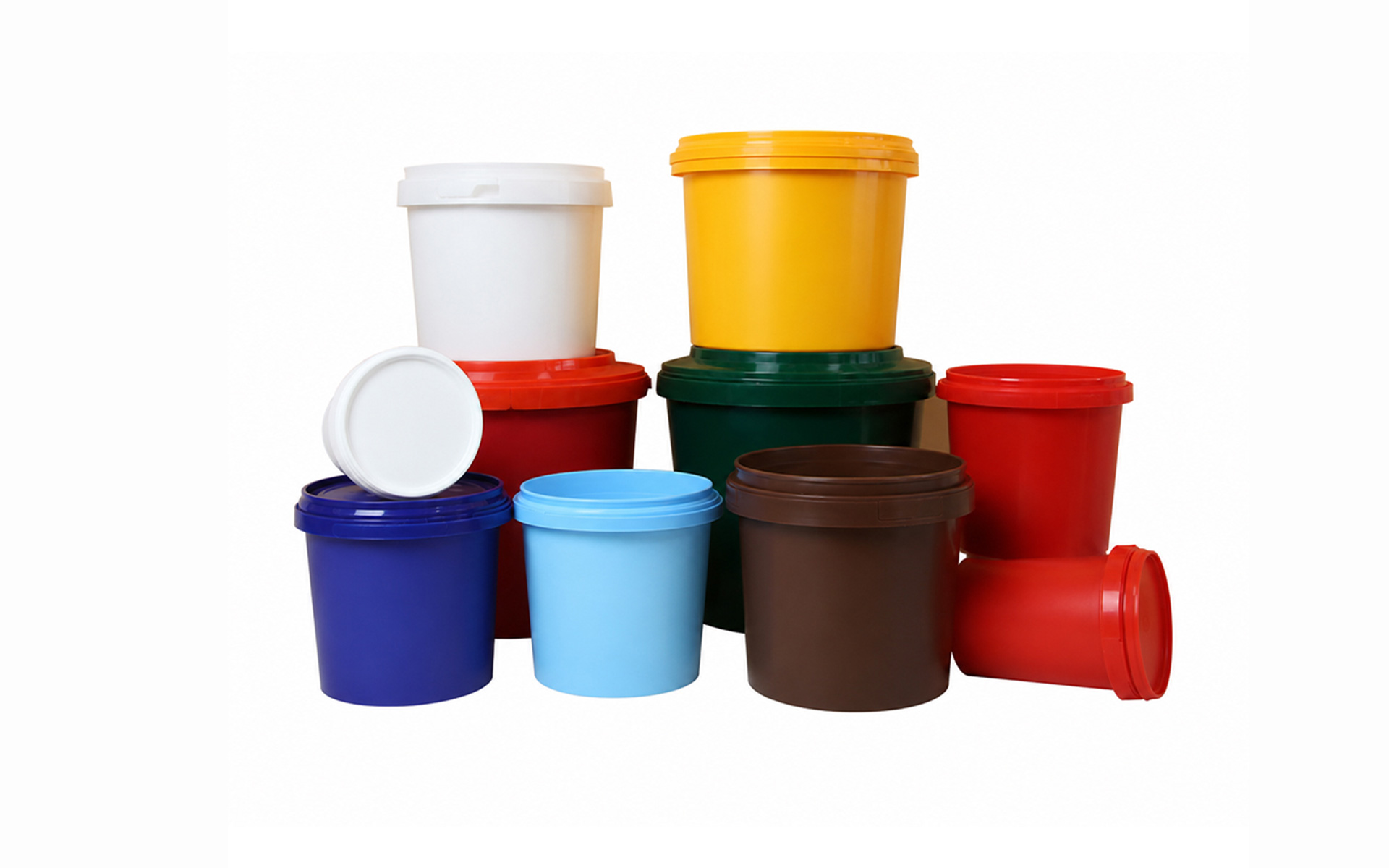
The difficulty in recycling paint cans stems from material inconsistency.
The can body itself is PP (polypropylene) – a highly recyclable plastic. But the labels on the can are often pressure-sensitive stickers or heat-transfer films. These labels are made of different materials from PP and have adhesive on the back.
During recycling, workers must first peel off the labels, then remove the residual adhesive, before the can body can be sent for shredding and reprocessing. This process is inefficient and costly, and labels are often not completely removed – residual adhesive and label fragments mix with the PP flakes, contaminating the entire batch of recycled material. The recycled PP can only be downcycled and cannot return to the original product.
Even worse, if labels are not removed before entering the recycling stream, the mixed materials can clog recycling equipment, reduce sorting efficiency, and ultimately cause the entire batch to be rejected.
The result: low recycling efficiency, high cost, and poor quality of recycled material. This is the biggest shortcoming of traditional labels in the environmental circular economy.
2. IML's "Mono-Material" Advantage – Solving Recycling Challenges at the Source
IML's approach is fundamentally different.
IML labels fuse with the can body during injection molding, and both use the same PP material. The label is not "stuck on" – it is "grown into" the surface.
This "mono-material" design completely transforms paint can recycling:
- No label peeling required: Both label and can body are PP – no separation needed
- No adhesive removal required: The IML process uses no adhesives, eliminating the risk of residual contamination
- Direct whole-can shredding: When the paint can reaches the end of its life, it goes straight into the shredder – label and can body are shredded together
- Significantly improved recycling efficiency: Eliminates the cumbersome steps of label peeling and adhesive removal – higher efficiency, lower cost
- Higher purity of recycled material: The shredded PP flakes are of uniform composition and can be directly used to produce new PP products
In one sentence: Traditional paint can recycling requires "peeling" first; IML paint can recycling is "whole-can, one-shot."
3. Green Upgrade: PCR Recycled Resin + IML = 65% Carbon Reduction
If "same-material PP" gives IML paint cans the foundation for recyclability, then the combination of "PCR recycled resin + IML" takes paint cans even further on the sustainability path.
PCR (Post-Consumer Recycled resin) is recycled material extracted from plastic products recovered from consumers after use. Compared to virgin plastic, using PCR resin can significantly reduce carbon emissions – because it eliminates the carbon-intensive steps of crude oil extraction and petrochemical refining.
A compelling case study:
A leading paint can manufacturer in Latin America adopted an IML paint can solution with 60% PCR resin and achieved remarkable environmental results:
- Approximately 10 million IML paint cans produced annually
- 65% reduction in CO₂ emissions
- Significantly reduced energy consumption – recycled PP pellets require only 12% of the energy needed for virgin resin
What do these numbers mean? Every 10 million IML paint cans containing 60% PCR reduce carbon emissions equivalent to taking approximately 2,000 cars off the road for a year.
In another example, Berry Global's 30% PCR IML five-gallon pail for Sika reduces greenhouse gas emissions by 221 metric tons annually – equivalent to the emissions from 49 passenger vehicles driven for one year.
These cases demonstrate: IML can not only "recycle" but also "circulate." When paint cans are themselves made from recycled materials and can be recycled again after use, a true closed-loop circular economy is formed.
4. What Does the Paint Can's "Green Passport" Look Like?
IML's "green passport" for paint cans is reflected in the following aspects:
Mono-material design: The label and can body use the same PP material – no separation required during recycling. This aligns with the growing global requirements for mono-material packaging.
Compatibility with existing recycling infrastructure: PP IML containers seamlessly integrate into existing PP recycling infrastructure – no additional sorting, no contamination risk, no extra processing steps.
Ability to incorporate PCR recycled resin: IML paint cans can be produced using PP resin containing PCR, further reducing carbon footprint.
100% recyclable: IML labels and the can body are of the same material – the finished product is 100% recyclable, with no "downcycling" compromise.
Compliance with environmental regulations: Over 30 countries have implemented Extended Producer Responsibility (EPR) regulations. Mono-material packaging typically qualifies for lower EPR fees because it can be efficiently recycled in existing recycling systems.
5. FAQ
No. IML labels fuse with the can body during injection molding – both are PP material. The entire can can be directly shredded and recycled without removing the label.
No. IML labels and the can body use the same PP material. After shredding, the resulting PP flakes are of uniform composition with no adhesive contamination. The purity and quality of the recycled material are higher than traditionally labeled cans.
PCR is Post-Consumer Recycled resin – recycled material extracted from plastic products recovered from consumers after use. Through rigorous sorting, washing, and reprocessing, PCR resin can achieve the same performance standards as virgin resin. The case study demonstrates that IML paint cans with 60% PCR meet all performance requirements for paint containers.
Upfront equipment investment is higher, but IML combines labeling and molding into one step, eliminating post-labeling processes and labor costs. At large production volumes, the total cost is actually lower. More importantly, the environmental compliance advantages and brand image enhancement that IML brings are unmatched by traditional processes.
IML paint cans' mono-material PP design complies with APR (Association of Plastic Recyclers) recyclability design guidelines. PCR-containing IML products can apply for UL2809 recycled content certification. Additionally, mono-material packaging typically qualifies for lower EPR (Extended Producer Responsibility) fees.
The industry already has mature cases with 60% PCR content. Berry Global has also successfully launched 30% PCR IML five-gallon pails. As recycled material technology advances, PCR content has the potential to increase further.
Contact Us
Name*
Telephone*
Region*
Please fill in your request*


