
The "Anti-Counterfeiting Armor" for Paint Cans – How IML Fights Counterfeit Paint Cans?
The "Anti-Counterfeiting Armor" for Paint Cans – How IML Fights Counterfeit Paint Cans?
Walk into any building materials market, and you may see a familiar scene: two paint cans that look almost identical sitting side by side – one selling for $50, the other for just $20. The cheaper one has a brand logo, colors, and graphics that look "similar" – but what you may not know is that both the can and the paint inside are counterfeit.
In recent years, illegal operators have been mass-producing counterfeit branded paint cans, providing fake outer packaging for substandard paints. From empty cans of well-known brands to counterfeit anti-counterfeiting labels to finished paints, the counterfeit production chain is alarming. Even more frightening is that some counterfeit products have anti-counterfeiting QR codes that can scan with the same results as genuine products. Faced with this level of counterfeiting, traditional anti-counterfeiting measures are no longer sufficient.
IML (In-Mold Labeling) technology is becoming the "anti-counterfeiting armor" for paint brands.
Table of Contents
1. Why Can't Traditional Paint Can Anti-Counterfeiting "Hold the Line"?
Traditional anti-counterfeiting measures for paint cans mostly revolve around "labels" – pressure-sensitive anti-counterfeiting stickers, QR code verification, holographic anti-counterfeiting labels, etc. But these measures share a fatal weakness: if the label is "stuck on," it can be "peeled off."
The counterfeiters' operation is simple: collect used genuine cans → replicate the container → apply fake anti-counterfeiting labels → fill with substandard paint → send into the market as genuine. In this process, the anti-counterfeiting label itself is a secondary addition – counterfeiters can buy printing equipment, replicate anti-counterfeiting designs, and even copy QR codes.
In other words: as long as the label and the can are "two separate things," anti-counterfeiting will always have a loophole.
Traditional pressure-sensitive labels rely on adhesive to attach to the can surface – they can be completely peeled off. Counterfeiters can peel off genuine labels to scan and replicate them, or simply print fake labels and stick them on counterfeit cans – rendering the anti-counterfeiting measures useless.
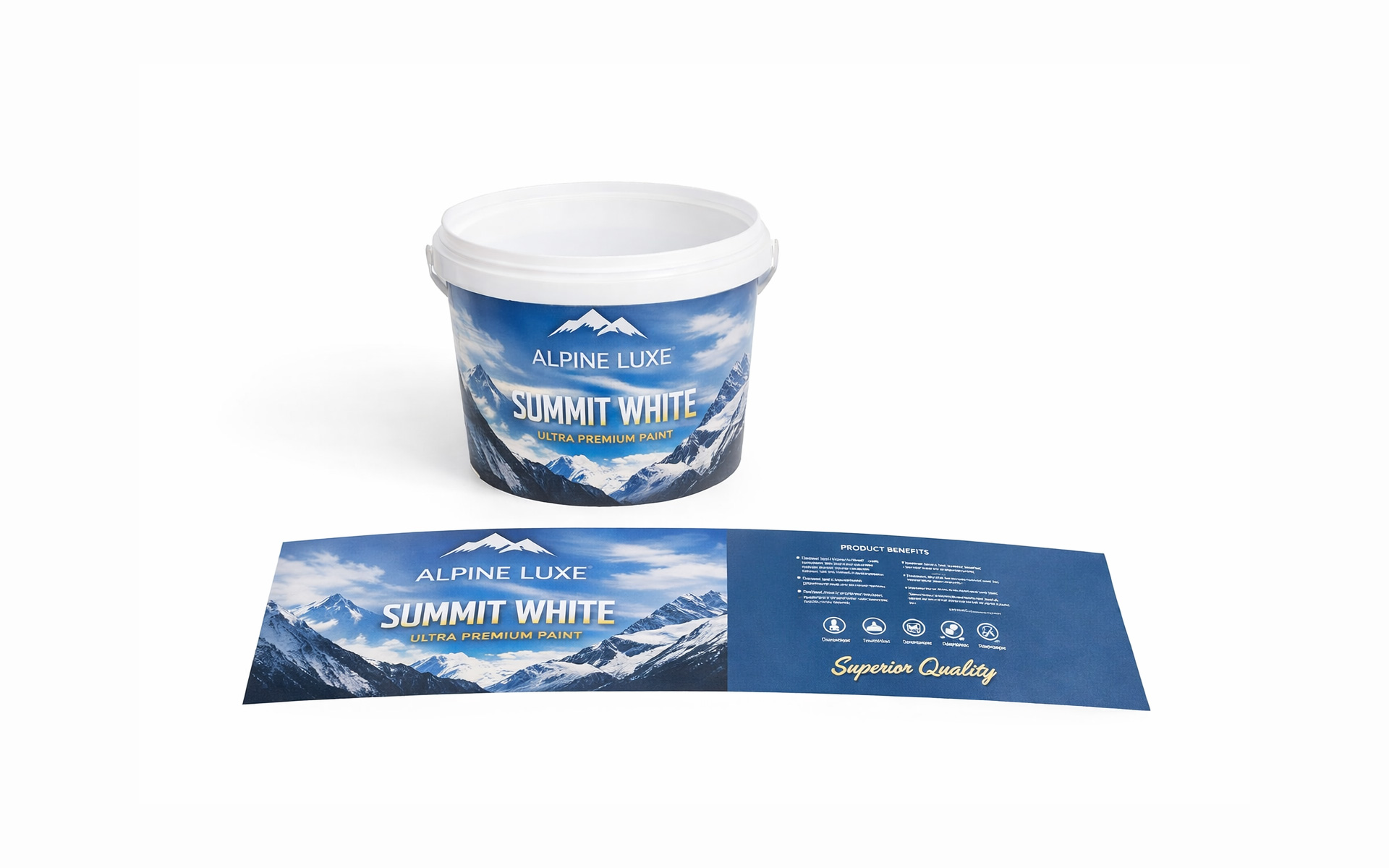
2. The Three Layers of IML Anti-Counterfeiting Defense
IML's anti-counterfeiting logic is fundamentally different. It is not "stuck on" – it is fused with the can body during injection molding. This essential difference creates three layers of defense that deter counterfeiters.
2.1 First Layer: Capital Barrier – Counterfeiters "Can't Afford It"
IML requires specialized molds, with a single mold costing hundreds of thousands of yuan. It also requires in-mold labeling robot systems – from label material selection, printing, and production to labeling equipment and mold structure design – every link demands precision coordination.
This upfront investment creates the first layer of "cost-based anti-counterfeiting." For counterfeiters to replicate an IML paint can, they would not only need to make the can but also replicate the IML mold and automated production line – an investment that the vast majority simply cannot afford.
2.2 Second Layer: Technical Barrier – Counterfeiters "Can't Do It"
IML is an interlinked precision system. From label material selection, printing processes, and mold structure design to injection molding – every step requires high technical expertise and close coordination.
The printing and processing of IML labels are more challenging than traditional labels, and there are very few manufacturers capable of stable IML production. Even if counterfeiters invest in equipment, without a skilled technical team and process experience, they cannot produce qualified IML products.
This creates the second layer of "process-based anti-counterfeiting."
2.3 Third Layer: Physical Anti-Counterfeiting – Counterfeiters "Can't Peel It Off"
This is IML's core, insurmountable defense.
During injection molding, the heat of the molten plastic activates the hot-melt adhesive on the back of the IML label, fusing it with the can body into one piece. The label and the can body are on the same plane, with colorful graphics appearing as if printed directly onto the can surface. The label is tightly and seamlessly embedded into the outer surface of the container, becoming one with the container itself.
There is no "interface" between the label and the can body – you cannot find the edge of the label, and you cannot peel it off.
Once the label is fused with the can body, they cannot be separated. Forcibly tearing it will only damage the can body itself – you cannot obtain a complete label. Even if counterfeiters replicate the shape of the can, they cannot replicate the "label-and-can-as-one" quality.
This creates the third layer of "physical anti-counterfeiting" – and the most robust one.
3. The Practical Advantages of IML Anti-Counterfeiting
With these three layers of defense combined, IML delivers tangible anti-counterfeiting value for paint brands:
Anti-counterfeiting evolves from "surface-level" to "built-in." The label and can body are integrally molded – there is no possibility of "peeling it off and replacing it." Brand logos, product information, and anti-counterfeiting elements are all "grown" into the can body, making it impossible for counterfeiters to fake the product by simply replacing labels.
Exquisite printing that is difficult to replicate. IML labels are vivid and three-dimensional, capable of perfectly reproducing fine details and small text. High-precision printing itself is an anti-counterfeiting barrier – ordinary counterfeit equipment simply cannot achieve this level of detail.
Dual protection for brand and consumer rights. Honokage states that the special process of IML containers "can better prevent counterfeiting, protect the brand's products, and provide consumers with a better experience." When every paint can has an unpeelable "anti-counterfeiting ID," the risk of consumers buying counterfeit products is minimized.
4. FAQ
No. IML labels fuse with the can body during injection molding – the label and can are on the same plane, with no "edge" to lift. Forcibly tearing it will only damage the can body itself, and you cannot obtain a complete label.
The upfront investment is indeed higher. IML requires specialized molds (costing hundreds of thousands of yuan) and in-mold labeling robot systems. However, this investment itself creates the "cost barrier" to counterfeiting – counterfeiters cannot easily replicate the same investment. For brands, this is a one-time investment with long-term anti-counterfeiting benefits.
QR code anti-counterfeiting is "stuck on" – it can be peeled off and copied. IML anti-counterfeiting is "grown into" the can – it cannot be removed or replaced. The two can be used together – printing QR codes on IML labels provides both the physical security of integral molding and the convenience of digital verification.
IML is suitable for injection-molded plastic paint cans, especially large-capacity containers in standard sizes like 20L. For blow-molded containers, factors such as container curvature must be considered. It is recommended to consult with an IML supplier to determine compatibility with your specific product.
Yes. IML labels support holographic and metallic effects, allowing multiple anti-counterfeiting technologies to be integrated into the label. Brands can customize IML labels with advanced anti-counterfeiting features such as micro-text, invisible ink, and optically variable effects.
No. IML labels and the can body use the same PP material. During recycling, no label separation is required – the entire package can be directly shredded and recycled together. IML is not only anti-counterfeiting but also environmentally friendly.
Contact Us
Name*
Telephone*
Region*
Please fill in your request*


