
15 Seconds per Bucket – How IML Makes Paint Can Production "Faster and Better"?
15 Seconds per Bucket – How IML Makes Paint Can Production "Faster and Better"?
In the industrial packaging sector, the 20L plastic paint can is a typical "large" product. Unlike disposable cups or food containers, paint cans have always been known for their "slow" injection molding cycles – thick walls, long cooling times, and limited per-machine output. Under traditional processes, the molding cycle for a 20L can often takes 25 seconds or more.
However, when In-Mold Labeling (IML) technology is combined with high-speed injection molding systems, this number has been compressed to 15 seconds, or even 14.8 seconds.
What does 15 seconds per bucket mean? Approximately 240 units per hour, and over 5,700 units per day per machine. IML has truly made paint can production "faster and better."
Table of Contents
1. The "Iron Triangle" of IML Paint Can Production
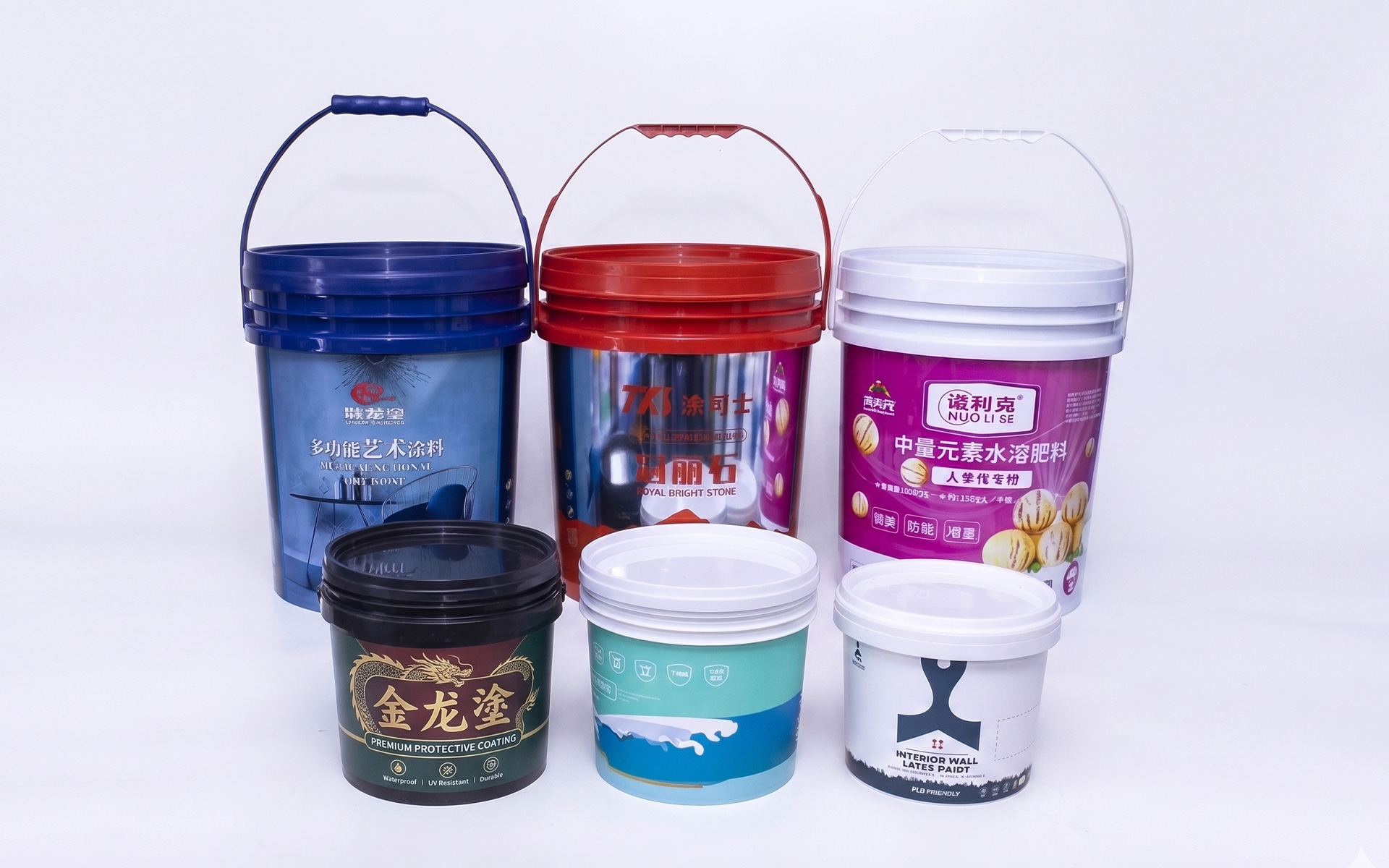
An efficient and stable IML paint can production line requires the precise coordination of three core equipment:
- High-speed injection molding machine: Provides sufficient injection pressure and speed to ensure rapid cavity filling
- IML-specific mold: Integrates label positioning and adsorption systems to keep the label perfectly still during injection
- Side-entry robot: Responsible for precisely placing labels into the mold and removing finished products
The rhythm of these three components determines the production line's cycle time. If any one link "drops the chain," the 15-second cycle becomes impossible.
2. The "Time Code" of 15 Seconds – How Was the Cycle Compressed?
2.1 15 Seconds and 14.8 Seconds – From "Excellent" to "Extreme"
The most mature industry data shows: with a 20L plastic paint can mold paired with a 600-ton high-speed injection molding machine and a side-entry robot, the molding cycle can be shortened to 15 seconds.
More advanced configurations – such as the DKM-650SV servo paint can dedicated machine – have further compressed this number to 14.8 seconds. Output is approximately 240 units per hour, representing an efficiency improvement of over 40% compared to traditional processes.
2.2 High-Speed Injection Molding Machine – The Core Power
The high-speed injection molding machine is the "engine" of this efficiency revolution.
Take the DKM-600HH high-speed injection molding machine as an example. It uses low-inertia, high-precision injection technology, which reduces inertia during injection and effectively shortens the cycle time, with injection speeds reaching up to 800mm/s.
For a "thick-wall" product like the 20L paint can, increased injection speed directly affects the starting point of cooling – the faster the melt fills the cavity, the sooner cooling can begin, and the shorter the overall cycle.
2.3 Side-Entry Robot – The "Quick Draw" of IML
In IML production lines, the robot handles the dual tasks of label placement and product removal.
Side-entry robots, with their shorter motion paths, achieve more stable operation and shorter in-mold time. Compared to traditional top-entry robots, side-entry robots enter from the side of the mold, with shorter travel distances and faster movements, occupying less of the injection cycle.
In actual production, the robot must complete the series of actions – "insert label → retract → wait for mold opening → remove finished product" – in an extremely short time. Within a 15-second cycle, the robot's time window is only a few seconds – speed, precision, and stability are all essential.
2.4 Hot Runner Mold – Saving Time and Material
Paint can IML molds commonly use hot runner systems. Compared to traditional cold runner molds, the advantages of hot runners are straightforward:
- No gate trimming required: The gate separates automatically after molding, eliminating manual gate trimming time
- No material waste: Cold runners generate waste (runner scrap), while hot runners have almost no material loss
- Shortened cycle time: No additional cooling time is needed at the gate area
For large products like 20L paint cans, the efficiency gains from hot runners are substantial.
2.5 Scientific Cooling System – Shortening Cooling Time
In the injection molding cycle, cooling time often accounts for over 70% of the total cycle. Paint cans have relatively thick walls, making cooling time naturally longer – a bottleneck for efficiency.
Advanced IML production lines use scientifically validated cooling system designs, optimizing cooling channel layouts and coolant flow rates to minimize cooling time while ensuring proper product solidification.
3. What Makes It "Better"? – The Quality Advantages of IML Paint Cans
Efficiency is only half of IML's advantage. "Better" is what truly gives brands peace of mind.
Labels never peel off. IML labels fuse with the can body during injection molding – there is no such thing as "peeling." This is especially important for paint cans – warehouse handling, logistics transport, and on-site impacts and friction will not damage the labels.
Graphics remain clear and durable. The ink is sandwiched between the film and the plastic, not directly exposed to air and friction. Compared to traditional heat transfer printing, IML graphics maintain bright colors over a long period without fading.
Uniform wall thickness, meeting strength standards. IML paint cans have high wall thickness uniformity and can meet the requirements of strength testing, seal testing, stacking testing, and drop testing. While maintaining strength, IML can also achieve a degree of thin-walling, saving material usage.
Integrated production, high yield. Heat transfer printing is a two-step process – "make the can first, then print the graphics" – with transfer and secondary processing in between, each step carrying the risk of defects. IML is one-shot molding – when the can is made, the label is already "grown" on it – eliminating intermediate steps and naturally achieving higher yields.
4. FAQ
It is actual production data. IML production lines using 20L plastic paint can molds paired with DKM-600HH high-speed injection molding machines and side-entry robots have already achieved stable 15-second molding cycles in multiple real-world projects. More advanced configurations can even reach 14.8 seconds.
It primarily targets 20L plastic paint cans. This is one of the most common specifications in the industrial packaging sector and the most mature application case for IML technology on large-capacity containers.
Through a side-entry robot. When the injection molding machine opens, the robot enters from the side to precisely place the pre-printed label onto the inner wall of the mold, then the machine closes and injection begins. The entire process is fully automated with no manual intervention.
No. IML molds are designed with electrostatic or vacuum adsorption systems on the inner wall. The label is securely fixed to the mold wall after placement, and the molten plastic will not shift it during injection.
Upfront equipment investment (molds, injection molding machines, robots) is indeed higher, but per-unit cost is significantly lower at large production volumes. Because IML combines labeling and molding into one step, it eliminates the secondary processing steps and labor costs required for heat transfer printing.
It requires a high-speed injection molding machine (such as dedicated 600-ton class models) with high injection speeds (e.g., 800mm/s) and a fast-response control system. Ordinary injection molding machines would struggle to achieve a 15-second cycle while maintaining quality.
Contact Us
Name*
Telephone*
Region*
Please fill in your request*


