
From "Cheap" to "Premium" – How IML Transforms the Visual Appeal of Ice Cream Packaging
From "Cheap" to "Premium" – How IML Transforms the Visual Appeal of Ice Cream Packaging
Walking into the freezer section of a supermarket, the dazzling array of ice cream products can be overwhelming. In the few seconds it takes a consumer to make a purchase decision, the packaging's "visual appeal" often plays a decisive role.
Traditional ice cream packaging, limited by printing processes, suffers from low print resolution, dull colors, blurry graphics, and rough details – giving an overall impression of "cheapness." Today, the emergence of IML (In-Mold Labeling) technology is completely changing this – it elevates ice cream packaging from "just visible" to "mouth-wateringly attractive," sparking a true "visual revolution."
Table of Contents
- 1. The "Visual Dilemma" of Traditional Ice Cream Packaging
- 2. How IML Solves the Visual Challenge – Four Core Advantages
- 3. Classic Case Study: The "Premium" Secret of Magnum Pints
- 4. From "Cheap" to "Premium" – IML's Visual Revolution
- 5. FAQ: Common Questions About IML's Visual Impact on Ice Cream Packaging
1. The "Visual Dilemma" of Traditional Ice Cream Packaging
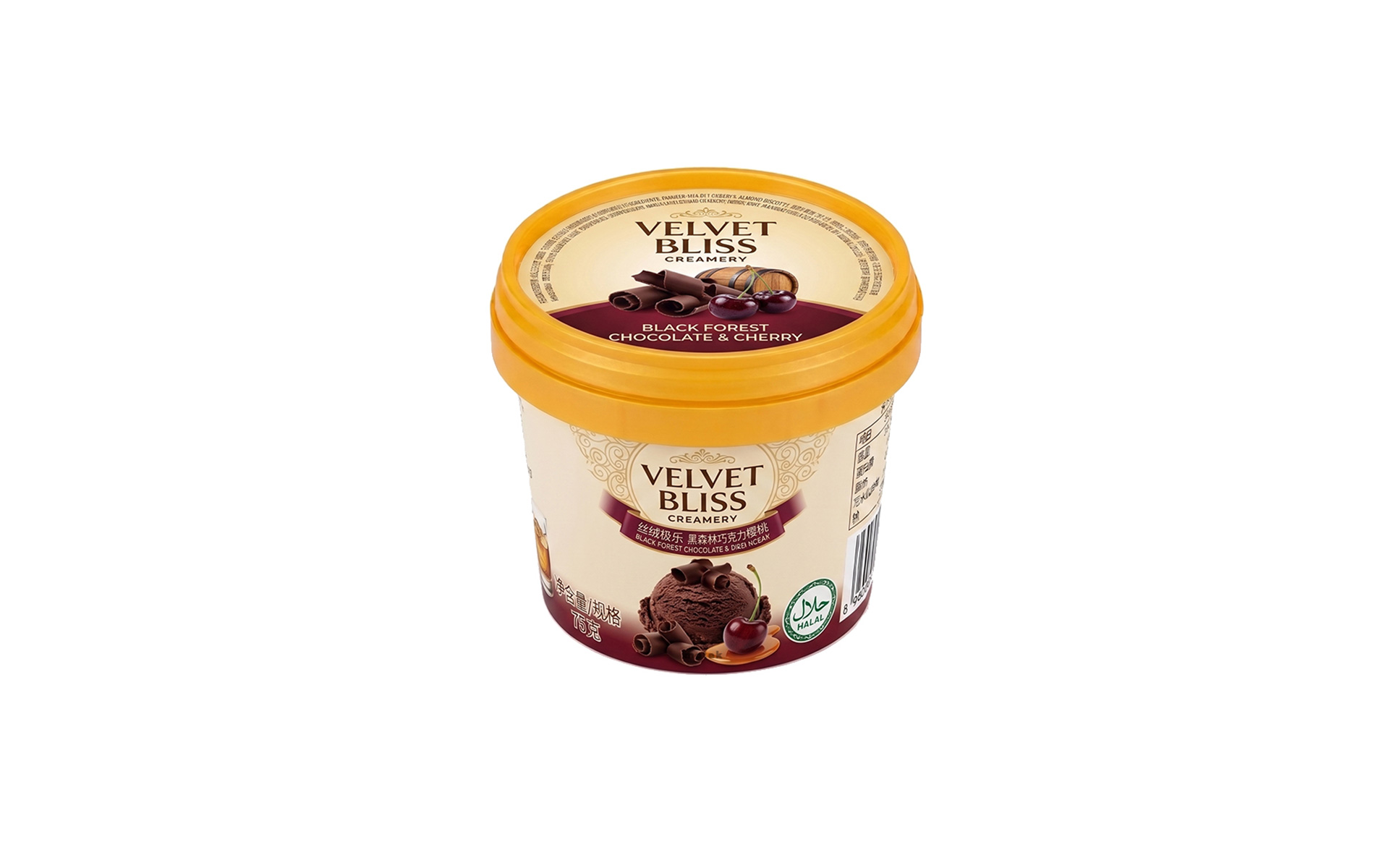
Before IML technology became widespread, ice cream packaging relied mainly on two decoration methods: self-adhesive labels and screen printing.
The biggest problem with self‑adhesive labels is that they are "stuck on" – there is an obvious edge and thickness, making the packaging visually non‑integrated. Worse still, ice cream must be stored in freezers for extended periods, and condensation and frost on the container surface are inevitable. Self‑adhesive labels, affected by moisture, often suffer from edge‑lifting, blistering, and even complete detachment. A label with curled edges immediately drags down the overall quality perception of the product.
Screen printing, although the ink is applied directly onto the container, has limited color expression – it cannot reproduce gradients or fine pattern details. The prints often appear rough and dull. Both traditional methods keep ice cream packaging at a level of "just visible" – far from "enticing."
2. How IML Solves the Visual Challenge – Four Core Advantages
The core principle of IML technology is to place a pre‑printed label into the injection mold and fuse it with the molten plastic during the molding process. This "integrated" process delivers visual improvements that traditional methods cannot match.
2.1 Photo-Quality Print: High Resolution for Accurate Detail Reproduction
One of the most impressive advantages of IML is its ultra‑high print resolution. Advanced IML printing can achieve photo‑quality image output (up to 175 LPI), with registration accuracy as fine as ±0.05 mm, capable of printing complex, multicolour, high‑definition graphics.
This means:
- Tempting fruit images: Every seed on a strawberry and every vein on a lemon slice is clearly visible, as if you could smell the fruit.
- Delicate chocolate textures: The fluidity of chocolate sauce and the crackle of a brittle shell can be reproduced with precision.
- Tiny text remains sharp: Even small type such as nutritional panels (down to 6‑point font) stays crisp and readable.
This photo‑quality print turns ice cream packaging from a "printed item" into a "work of art."
2.2 360° Full Coverage: A Visual Feast from Sidewalls to Lids
Traditional labels can only cover part of the container's surface, but IML enables 360° full‑surface decoration.
This is particularly important in the freezer display scenario. Freezers have a long viewing distance and crowded shelving; consumers usually scan from afar. IML allows the sidewalls and lid to simultaneously display brand and flavour elements, achieving full‑coverage decoration with photo‑quality graphics and consistent series visuals. No matter from which angle a consumer looks into the freezer, the brand is clearly recognisable.
From round to square, from straight‑walled to special shapes, IML can adapt to various container forms. Brand designers are no longer constrained by the shape or placement of labels, allowing full creative freedom to turn every surface of the packaging into a canvas for brand storytelling.
2.3 Rich Surface Finishes: Metallic, Glossy, and Matte Options
Visual appeal is not just about "looking" good – it also includes tactile quality. IML offers a wide range of surface finish options:
- Metallic effect: Creates a luxurious, premium visual impression, ideal for high‑end product lines, making the packaging shine in the freezer.
- Glossy finish: High sheen and rich colour saturation, making the packaging stand out in the freezer aisle.
- Matte finish: Understated and elegant, with a fine touch, conveying a sophisticated, premium brand character.
- Orange‑peel texture: A surface finish that combines texture with cost‑effectiveness, particularly popular in early‑adopter markets such as ice cream.
These varied surface finishes allow brands to create a unique visual and tactile experience tailored to their positioning.
2.4 Premium Appeal That Never Fades: Durability Ensures Lasting Beauty
IML's visual advantage is not just about "looking good when new" – it's about "looking good all the time."
Traditional labels are prone to wear, fading, and peeling during use. In contrast, IML labels are fused with the container, with the graphics sealed beneath the plastic layer, offering excellent abrasion and scratch resistance. Moreover, IML labels are unaffected by humidity and freezing temperatures – they do not edge‑lift, blister, or fade even in the condensation‑prone freezer environment.
This means that an ice cream container with IML packaging maintains its premium appearance from the production line all the way to the consumer's hands.
3. Classic Case Study: The "Premium" Secret of Magnum Pints
When it comes to a prime example of IML transforming ice cream packaging into something truly premium, Magnum Pints is a standout.
In 2017, Magnum launched its new Magnum Pints range (featuring Classic, Almond, and White flavours) using IML packaging. One of the key reasons Magnum chose IML was precisely the premium appeal that IML packaging exudes.
Rahul Rajpal, Magnum's packaging lead, commented: "The quality of IML packaging is first class, which is really important for deep‑freeze products. The IML technology ensures that Magnum Pints remain free of cracks and are perfectly protected against moisture and large fluctuations in temperature."
Even more impressively, Magnum used IML to create a highly creative interactive experience – consumers can "crack" the chocolate shell on the outside of the ice cream by squeezing the sides of the pack. This perfect blend of visual appeal and functional innovation is a testament to the boundless possibilities of IML technology.
4. From "Cheap" to "Premium" – IML's Visual Revolution
Looking back at the evolution of ice cream packaging, we can clearly see a path of "visual upgrading":
- Past: Self‑adhesive labels prone to edge‑lifting, low‑resolution screen printing – "Visible, but cheap"
- Present: IML delivering photo‑quality print, 360° full coverage, and rich surface finishes – "Exquisite and premium"
- Future: Continuous evolution of IML with more creative designs and interactive experiences emerging – "Stunning and limitless"
IML has transformed ice cream packaging from "cheap" to "premium." It is not just a printing process – it is a visual expression of brand value. When a consumer pauses in front of the freezer, a beautifully printed, high‑quality IML ice cream container can, in just a few seconds, convey the message: "This is a trusted, high‑quality brand."
From "just visible" to "mouth‑wateringly attractive," IML has sparked a true visual revolution in ice cream packaging.
5. FAQ: Common Questions About IML's Visual Impact on Ice Cream Packaging
IML can achieve photo‑quality image output (up to 175 LPI) with registration accuracy of ±0.05 mm, far exceeding traditional screen printing and ordinary label printing. Even very small text (as small as 6‑point) remains clear and readable.
Yes. IML enables 360° full‑coverage decoration from sidewalls to lids, ensuring strong brand recognisability even from a distance in the freezer aisle.
IML offers a wide range of finishes including glossy, matte, metallic, orange‑peel texture, and more. Brands can choose the most suitable surface texture according to their positioning and product characteristics.
Because the label is fused with the container during injection molding, the graphics are sealed beneath the plastic layer, providing excellent abrasion and scratch resistance. IML is also unaffected by humidity and freezing temperatures, so it does not edge‑lift, blister, or fade even in condensation‑prone freezer environments. The visual quality remains long‑lasting.
The initial mold investment for IML is relatively high, but it eliminates post‑mould labelling steps. At high volumes, the overall cost is competitive. More importantly, the visual enhancement and brand premium that IML brings often deliver a return on investment far exceeding the cost.
Many international and domestic premium ice cream brands, including Magnum, have already adopted IML packaging. IML is also widely used in yoghurt, dairy, and other product categories.
Yes. IML labels and containers typically use the same polypropylene (PP) material, making them a single‑material package that can be recycled directly without label separation.
Contact Us
Name*
Telephone*
Region*
Please fill in your request*


