
The "Material Code" of Ice Cream Containers – How Does Special Freezer-Grade PP Support IML?
The "Material Code" of Ice Cream Containers – How Does Special Freezer-Grade PP Support IML?
Ice cream sits in a -20°C freezer for months, enduring transport, handling, and shelf stocking. Why do some containers stay perfectly intact while others crack easily? The answer lies in the "material code" of the container.
From a materials science perspective, the combination of special freezer-grade polypropylene (PP) and IML technology is the key to achieving both internal strength and external brilliance in ice cream packaging.
Table of Contents
- 1. The Deep-Freeze Challenge: Why Can't Ordinary PP Handle It?
- 2. Freezer-Grade PP: The "Anti-Freeze Armor" for Ice Cream Containers
- 3. IML Labels: PP Film That "Resonates" with the Container
- 4. Classic Case Study: The Success Story of Blue Bunny
- 5. FAQ: Common Questions About Ice Cream Container Materials
1. The Deep-Freeze Challenge: Why Can't Ordinary PP Handle It?
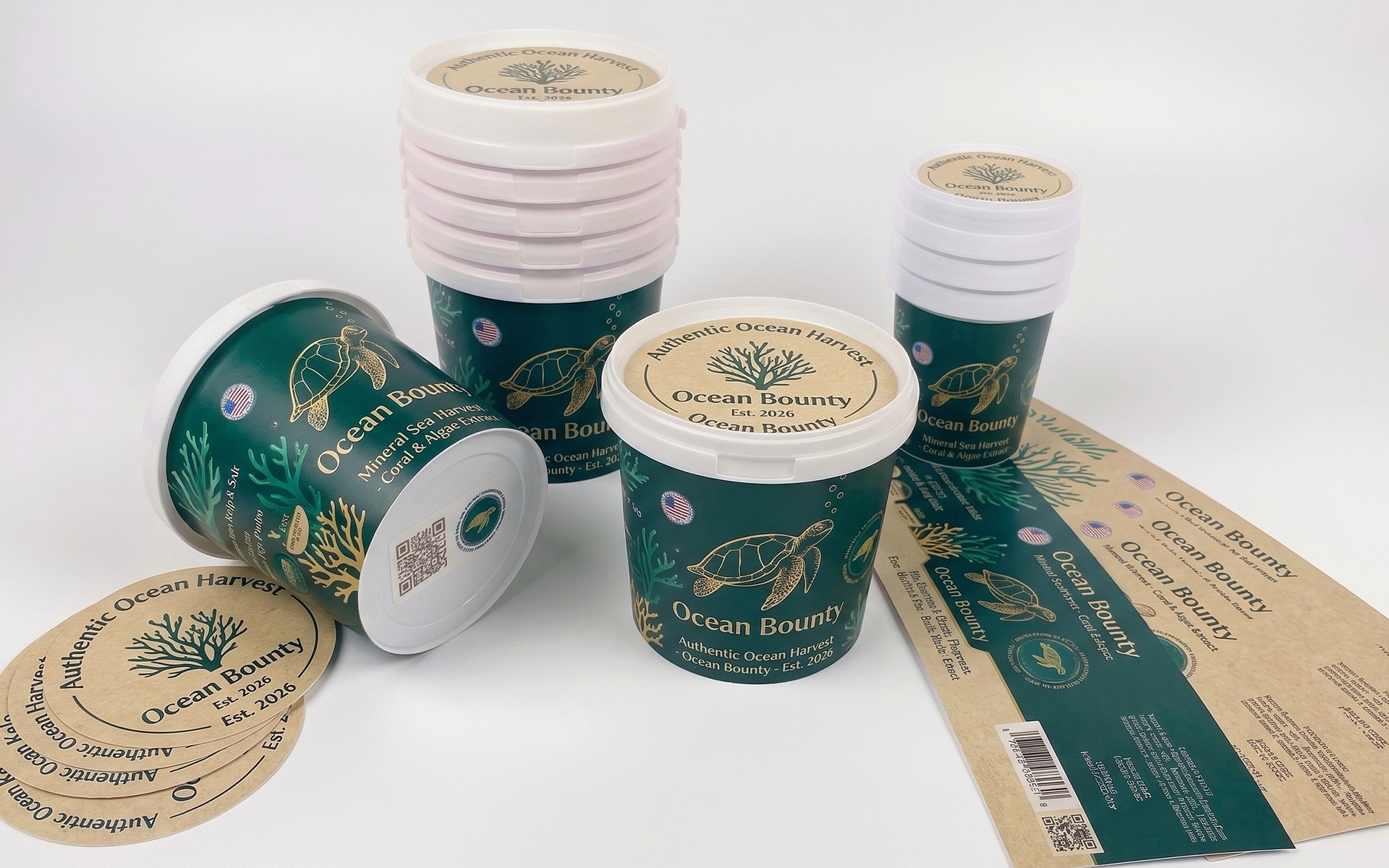
Polypropylene (PP) is a common material for food packaging, but ordinary PP performs well at room temperature. Once it enters a deep-freeze environment below -20°C, the mobility of its molecular chains decreases significantly, and the material shifts from "tough" to "brittle." This means that during handling or stacking, even a slight impact can cause the container to crack, leading to product loss.
2. Freezer-Grade PP: The "Anti-Freeze Armor" for Ice Cream Containers
To solve this problem, material manufacturers have developed special freezer-grade polypropylene resins. Through special copolymerization processes, they introduce impact-modifying components such as "rubber phases" into the PP molecular chain, enabling it to maintain excellent toughness even at low temperatures.
2.1 High Impact Resistance: Withstands "Cold Drops"
The most critical advantage of freezer-grade PP is its outstanding low-temperature impact resistance. Taking the classic Basell Pro‑fax EP390S resin as an example:
- Withstands extreme low temperatures: It can endure impact and drops at -40°C (or even lower) without breaking.
- Performance data: Its falling dart impact strength exceeds 45 ft·lb at -29°C, and its Izod notched impact strength reaches 3.6 ft·lb/in at 23°C.
- Industry benchmark: This material is regarded as an ideal choice for IML applications, perfectly showcasing brand printing quality.
2.2 Designed for IML: Superior Print Quality
Freezer-grade PP typically has a high melt flow rate (MFR) – for example, Pro‑fax EP390S has an MFR of 35 dg/min. High fluidity enables rapid filling of complex molds, accurately replicating fine textures and enabling thin-wall, lightweight production. Additionally, its excellent stiffness and dimensional stability provide a flat, smooth "canvas" for IML labels, ensuring printing precision.
2.3 More Than Just Cold: Also Microwave-Safe
High-quality freezer-grade PP is not only cold-resistant but also withstands microwave heating (up to 120°C or more) and is dishwasher-safe. This means consumers can take the container directly from the freezer and place it in the microwave to defrost or reheat without changing containers, greatly enhancing convenience.
3. IML Labels: PP Film That "Resonates" with the Container
With a sturdy container body, you also need a label that can "live and die" with it – and that is where IML labels come in.
3.1 Same Root, Same Shrinkage Rate for Perfect Adhesion
The most ingenious design of IML labels is that they use the same material as the container – polypropylene (PP). This ensures that during the cooling process after injection molding, the label and the container shrink at exactly the same rate, resulting in perfect adhesion, with no edge-lifting or wrinkling.
3.2 Thickness and Performance: A Durable "Second Skin"
IML labels use PP film typically with a thickness of 40 to 100 microns (µm), with 50–60 microns being a common choice for ice cream packaging. This thickness makes them tough enough to resist scratches while thin enough to fuse seamlessly with the container. The printed side faces inward, merging with the PP resin, and the ink is sealed and protected, never fading.
4. Classic Case Study: The Success Story of Blue Bunny
The case of Wells' Dairy replacing the packaging for its Blue Bunny brand ice cream is a classic example of combining freezer-grade PP with IML technology.
They replaced traditional round paper cartons with elliptical IML PP containers injection-molded using Basell Pro‑fax EP390S resin. The IML labels were printed by Belgian company Verstraete. At extreme temperatures of -40°F (approximately -40°C), the labels and containers did not separate or break. This change was a great success, helping Blue Bunny become the fastest-growing packaged ice cream brand in its category in the United States at that time.
5. FAQ: Common Questions About Ice Cream Container Materials
Ordinary PP homopolymer has restricted molecular chain mobility at low temperatures, causing the material to shift from tough to brittle. Freezer-grade PP, through copolymerization modification, maintains molecular chain flexibility even at low temperatures, thereby retaining impact resistance.
Yes, it is safe. High-quality freezer-grade PP resins (such as Pro‑fax EP390S) comply with the food contact material regulations of both the US FDA and the European Union.
To achieve "synchronous shrinkage." Different materials have different shrinkage rates, which would cause the label to wrinkle or detach. Using the same PP material ensures that the label and container shrink in unison during cooling, achieving perfect integration.
Yes. Since both the container and the label are PP, they form a single-material package. They can be directly fed into recycling systems without separation, making them 100% recyclable.
There are many others, such as LyondellBasell's Moplen EP549U (MFR 70, brittle temperature -45°C), Borealis's transparent freezer PP, and SABIC's high-impact freezer PP, among others.
Contact Us
Name*
Telephone*
Region*
Please fill in your request*


