
How to Enhance the Premium Value of Plastic Tables and Chairs Through IML In-Mold Labels? Differentiated Design Strategies Using Multi-Process Combinations
How to Enhance the Premium Value of Plastic Tables and Chairs Through IML In-Mold Labels? Differentiated Design Strategies Using Multi-Process Combinations
Place two plastic chairs in a courtyard. One is an ordinary white plastic chair. The other is a dark grey chair with a fine brushed metal texture and a brand logo that subtly gleams under the light. Placed side by side, the latter appears to be worth three times as much.
Same material, same structure – the only difference is the surface.
In the category of outdoor plastic tables and chairs, "what it looks like it's worth" often matters more than "what it's actually worth." And IML (In-Mold Labeling) technology is the key tool that transforms plastic from a "cheap material" into a "design medium."
📖 Table of Contents
- 1. First Understand: Why Can IML Create Effects That Don't Look Like Plastic?
- 2. Gradient Printing – From "Monochrome Plastic" to "Colorful Emotion"
- 3. Brushed Metal – Giving Plastic a "Metallic Texture"
- 4. Spot Matte – The "Refined Dialogue" Between Gloss and Matte
- 5. Multi-Process Combinations: A Differentiation Strategy Where 1+1+1 > 3
- 6. FAQ
1. First Understand: Why Can IML Create Effects That Don't Look Like Plastic?
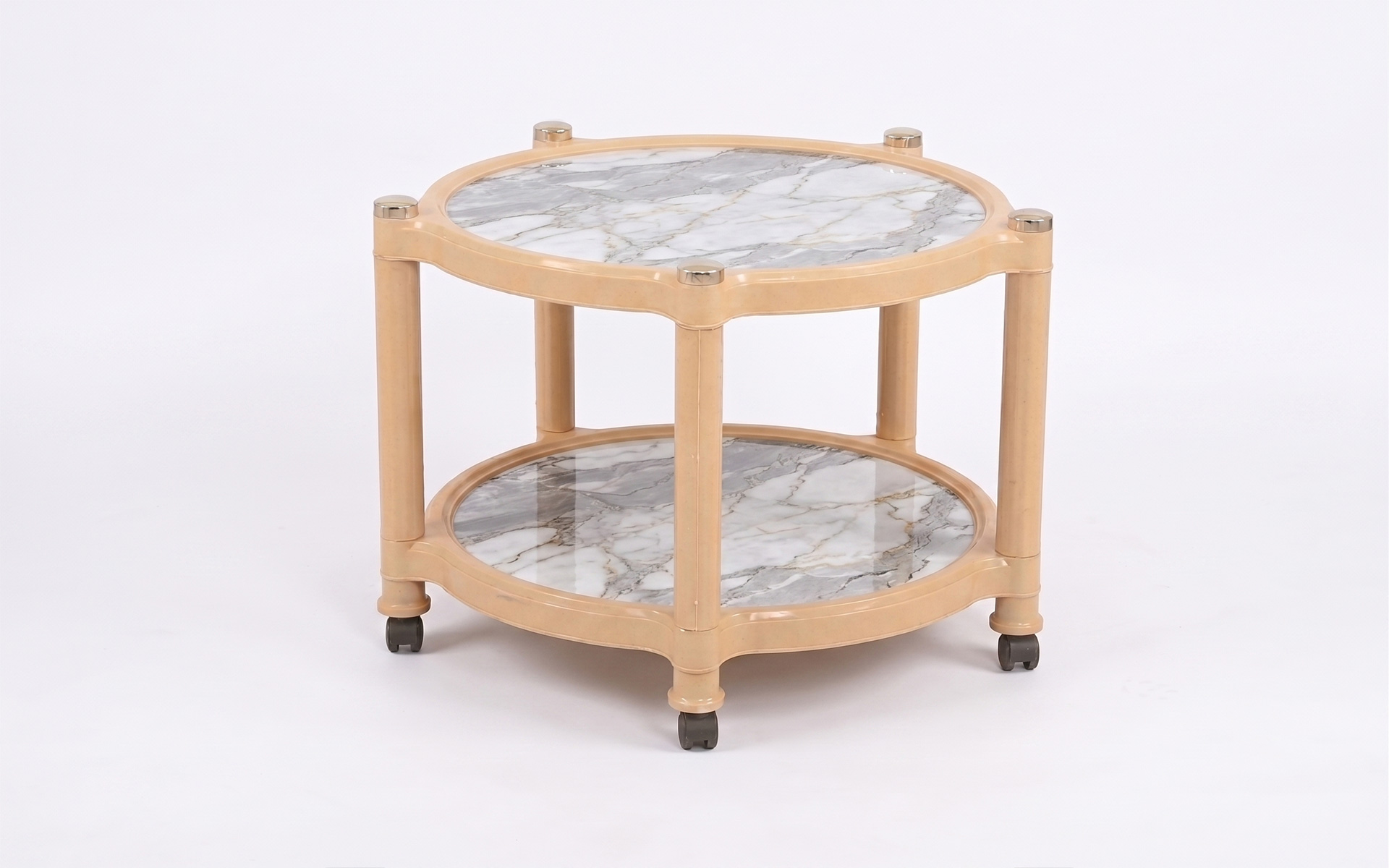
Before discussing specific processes, let's understand a core question: why can IML make plastic tables and chairs shed their "cheap look"?
IML (In-Mold Labeling) works like this: the pattern is first printed on a film, the film is placed into the injection mold, then molten plastic is injected. Under high temperature and pressure, the film fuses with the plastic.
This process determines that the surface structure of an IML product has three layers:
┌────────────────────────────────────────────────────────────┐
│  Surface: Hardened transparent film (protective layer)        │  ← Determines tactile feel and gloss
├────────────────────────────────────────────────────────────┤
│  Middle: Printed pattern layer (color and texture)            │  ← Determines visual effect
├────────────────────────────────────────────────────────────┤
│  Bottom: Plastic substrate (fused with the product)           │  ← Never peels off
└────────────────────────────────────────────────────────────┘
The brilliance of this structure lies in three aspects:
First, the ink never contacts the outside world. The ink is sandwiched between the film and the plastic – it will not oxidize, fade, or wear. Ordinary screen-printed patterns become scratched and worn after a few months; IML patterns remain as vivid as new even after years of outdoor use.
Second, the surface can "customize texture." This transparent film can be finished in high-gloss, matte, frosted, metallic, and other effects. Different surface treatments determine the first visual impression and the tactile psychological experience for the consumer.
Third, patterns can be "infinitely complex." IML supports high resolution, multiple colors, and finely detailed pattern designs – enabling gradients, metallic textures, embossed effects, gloss-matte contrast, and other visual effects.
It is this combination of three layers that makes IML the ideal carrier for achieving "premium" surface effects on plastic tables and chairs – it can make plastic look like metal, like stone, like carefully finished furniture, rather than just "a piece of plastic."
2. Gradient Printing – From "Monochrome Plastic" to "Colorful Emotion"
2.1 What Is Gradient Printing?
Gradient printing achieves a smooth transition of color from one shade to another on an IML label. Unlike the solid color blocks of screen printing, gradients have rich mid-tone transitions and strong visual depth.
2.2 Why Does Gradient Enhance Premium Value?
What is the biggest problem with ordinary plastic tables and chairs? The colors are "too plastic." Solid-color PP injection-molded chairs have monotonous colors with no depth – you can tell at a glance they are "plastic products."
Gradients change this. Gradients from dark grey to light grey, from hazy blue to off-white, from charcoal black to amber – colors themselves carry "emotion" and "story."
In the mid-to-high-end outdoor furniture market, gradients are considered a direct expression of "design sensibility." A chair with a delicate gradient looks like a carefully designed "piece" rather than a mass-produced "commodity."
2.3 Design Pairing Recommendations
| Color Direction | Suitable Style | Visual Effect |
|---|---|---|
| Dark grey → Light grey | Modern Minimalist | Calm, restrained, premium |
| Hazy blue → Off-white | Nordic / Natural | Fresh, soft, approachable |
| Charcoal black → Amber | Light Luxury / Industrial | Warm, substantial, textured |
| Dark green → Grey-green | Natural / Vintage | Steady, organic, enduring |
Design tips:
- Gradient direction should be top-to-bottom or left-to-right, following natural visual reading patterns
- The gradient range should not be too wide, avoiding a "flashy" look that appears cheap
- Darker gradients tend to look more "premium" than lighter ones
3. Brushed Metal – Giving Plastic a "Metallic Texture"
3.1 What Is Brushed Metal?
Brushed metal creates fine linear textures on the IML film, giving the plastic surface a visual effect similar to brushed metal panels.
IML brushed metal effects can be achieved in three ways:
- Printing on the back of the film: visual brushed effect without tactile texture
- Surface brushing on the film: both visual effect and real tactile texture
- Mold brushing: brushing texture achieved through mold surface treatment
3.2 Why Does Brushed Metal Enhance Premium Value?
Metallic texture is a visual symbol of "premium quality." Humans instinctively associate metal with "strong, precise, expensive" – when plastic presents a metallic texture, consumers unconsciously link it with "high quality."
The unique value of IML brushed metal is: it makes plastic look like metal while retaining plastic's lightweight and low-cost advantages. It delivers the visual effect of metal with the practical performance of plastic – something that spraying and electroplating cannot achieve.
IML can achieve high-gloss, metallic textures, and many other visual effects. The "fine hairline sheen emerging from a matte background" that brushed metal surfaces provide is exactly the "restrained premium feel" that mid-to-high-end outdoor furniture needs most.
3.3 Design Pairing Recommendations
| Brushed Type | Visual Effect | Suitable Style |
|---|---|---|
| Straight-line brushing | Clean, crisp, modern | Modern Minimalist, Industrial |
| Random brushing | Rich, natural, not rigid | Naturalist, Nordic |
| Spot brushing | Refined, focal, layered | Light Luxury, Modern |
Design tips:
- Brushed effects on darker substrates are more visible and premium-looking than on lighter ones
- Brushing direction should be consistent, avoiding a messy appearance
- Brushing texture should not be too coarse – overly coarse appears rough
4. Spot Matte – The "Refined Dialogue" Between Gloss and Matte
4.1 What Is Spot Matte?
Spot matte applies a matte finish to specific areas of the IML label (such as the brand logo, decorative lines, or localized pattern elements), creating a gloss-matte contrast with the surrounding glossy areas.
4.2 Why Does Spot Matte Enhance Premium Value?
"Contrast" is one of the sources of visual premium.
If the entire tabletop is glossy, it looks like "a piece of shiny plastic"; if the entire tabletop is matte, it looks like "a piece of matte plastic." But if, on a matte background, the brand logo area has a subtle gloss – the contrast between gloss and matte instantly gives the product a "designed" feel.
The subtlety of spot matte lies in: it does not entirely reject either gloss or matte, but lets them "dialogue" on the same product. This "dialogue" creates visual depth, and visual depth is one of the core elements of "premium feel."
In practical applications, spot matte is particularly suitable for presenting brand logos and product names – the logo area subtly reflects light, contrasting with the "retreating" matte background, making the logo naturally become the visual focal point and greatly enhancing brand recognition.
4.3 Design Pairing Recommendations
| Combination | Visual Effect | Suitable Scenario |
|---|---|---|
| Matte base + Gloss logo | Logo stands out, strong brand presence | Brand identity display |
| Gloss base + Matte decorative lines | Refined, restrained, detailed | Premium product lines |
| Matte main surface + Gloss border | Rich depth, defined boundaries | Tabletops, seat surfaces |
Design tips:
- The spot matte area should not be too large – the essence of "spot" lies in "accent"; large-area use diminishes the refined effect
- The boundary between gloss and matte should be crisp and sharp; blurred boundaries appear poorly made
- The ratio of matte to gloss areas is recommended to be between 1:3 and 1:5
5. Multi-Process Combinations: A Differentiation Strategy Where 1+1+1 > 3
A single process can already enhance product quality, but true "pricing power" comes from combining multiple processes.
5.1 Three Combination Solutions
Combination 1: Gradient + Brushed Metal – Modern Light Luxury
Superimpose gradient colors on a brushed metal base – the dark brushed texture fades upward to a lighter shade – delivering both metallic texture and color depth. This combination suits modern light luxury outdoor tables and chairs, with strong visual impact and high recognizability.
Combination 2: Gradient + Spot Matte – Refined Nordic
On a gradient background, apply spot matte to the brand logo area. The gradient color already provides visual richness, while the spot matte adds tactile and visual "refinement." Suitable for Nordic and naturalist outdoor furniture.
Combination 3: Brushed Metal + Spot Matte – Restrained Premium
Brushed metal provides the basic texture, while spot matte creates gloss-matte contrast on the logo or decorative lines. This combination is not flashy, but enduring – perfect for mid-to-high-end brands pursuing "understated premium."
5.2 Design Principles for Combined Processes
Principle 1: Clear hierarchy. Choose one dominant process (e.g., brushed metal), with others as accents. Do not try to "pile on all the processes."
Principle 2: Serve brand tone. Minimalist brands use gradient + spot matte; industrial brands use brushed metal + spot matte – process selection should serve brand positioning, not "showing off."
Principle 3: Consider the use scenario. Outdoor tables and chairs must withstand sun and rain. Gradient printing and brushed metal inks are protected inside the film, offering far greater durability than surface spraying. Spot matte is also achieved at the film level and will not fail due to outdoor exposure.
6. FAQ
IML brushed metal presents the visual effect and tactile texture of metal on a plastic surface, but it remains plastic underneath – lightweight, corrosion-resistant, cost-effective. It delivers "metallic texture" without the "weight and price of metal."
No. IML ink is sandwiched between the film and plastic, not directly exposed to UV or air. Under normal outdoor conditions, gradients can remain unfaded for years.
Spot matte requires an additional matte treatment step in IML printing, increasing cost – but the increase is far less than post-processing methods like spraying. The exact increase depends on the area and complexity of the matte treatment.
Yes, but with clear hierarchy. For example, brushed metal as the dominant finish, with gradient colors superimposed, and spot matte on the logo area. When using three processes together, design language consistency must be ensured.
IML tables and chairs typically have higher unit prices than ordinary screen-printed or sticker-labeled ones – but the premium potential is also greater. IML's premium surface effects can increase product pricing by 30%-100%, depending on process combination complexity.
Very durable. IML's surface is a hardened transparent film with excellent scratch resistance, abrasion resistance, chemical resistance, and waterproof/moisture-proof performance. In complex outdoor environments with humidity, temperature fluctuations, and sun exposure, IML labels do not deform or fade. Service life is 2-3 times longer than traditional sprayed products.
Contact Us
Name*
Telephone*
Region*
Please fill in your request*


