
In-Mold Labeling vs Traditional Color Printing – The "Aesthetic Revolution" in Cold Drink Cup Packaging
In-Mold Labeling vs Traditional Color Printing – The "Aesthetic Revolution" in Cold Drink Cup Packaging
Before In-Mold Labeling (IML) technology became widespread, most disposable cold drink cups used traditional color printing. The cups had poor texture, low color saturation, and limited printing precision, giving an overall sense of cheapness. When held in hand, the patterns felt as if they were "floating" on the surface. After just a short time, they would begin to fade or scratch, and the brand image suffered significantly.
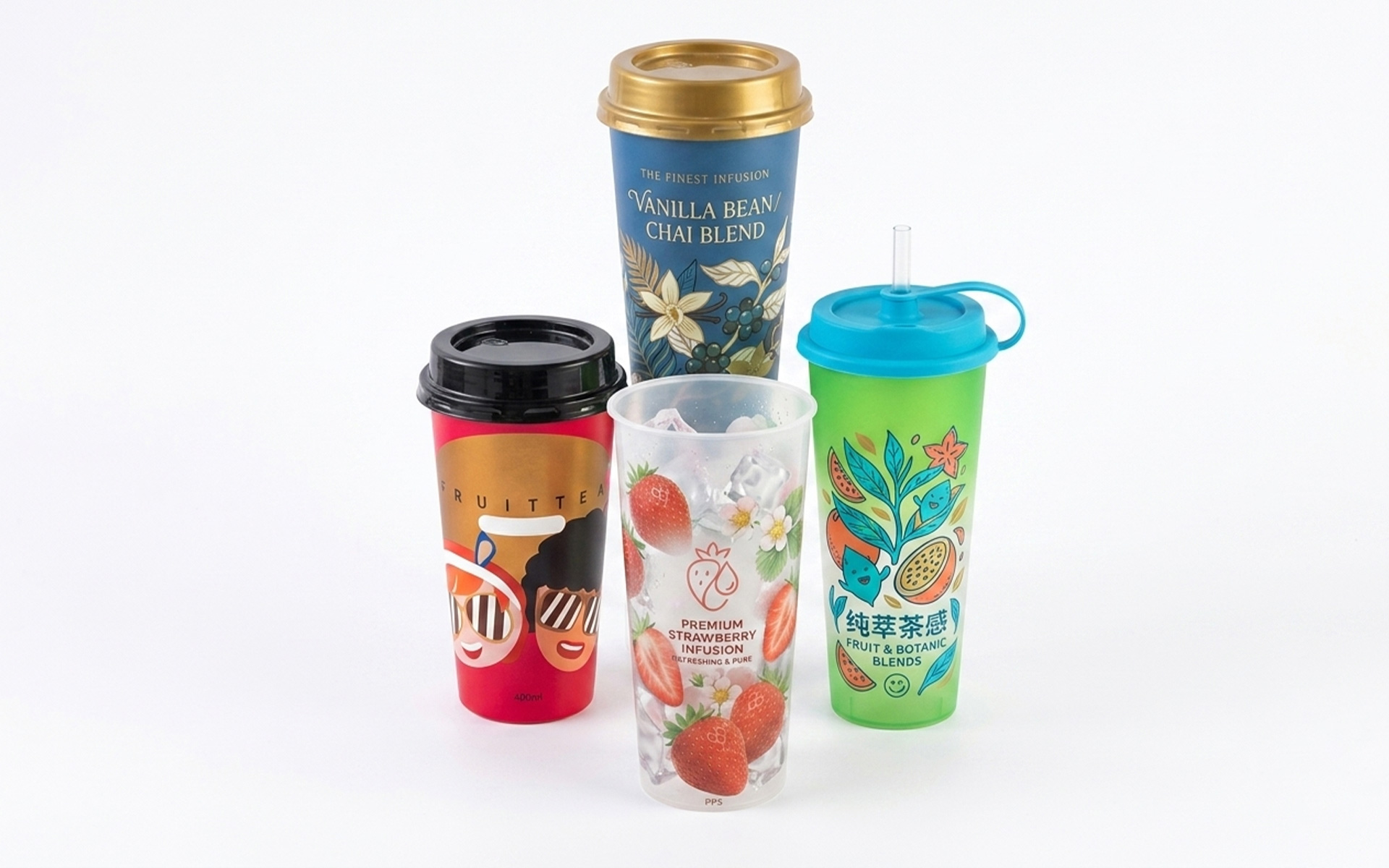
The arrival of IML technology has completely rewritten the "aesthetic rules" of cold drink cup packaging – the label and the cup body become one. The pattern is no longer "stuck on" but "grown into" the surface. From "cheap feel" to "premium feel," IML has led a true "aesthetic revolution" for cold drink cups.
Table of Contents
1. Three "Fatal Flaws" of Traditionally Printed Cold Drink Cups
1.1 Texture "Floats on the Surface," Patterns Are Easily Worn
Traditional color printing applies ink directly onto the cup surface – the pattern "floats" on top. There is no protective film, so the pattern is easily scratched or abraded, leading to color loss and peeling. A light scrape with a fingernail can leave marks on the pattern, and friction between cups during transport gradually blurs the graphics.
Even more critically, this "floating" pattern lacks texture. When you run your fingers over the cup, you can clearly feel the "boundary" between the pattern and the cup body – it immediately gives the impression of being "cheap."
1.2 Limited Color Performance, Lacks Premium Feel
Traditional color printing has inherent limitations in color reproduction – low saturation, few layers, and difficulty rendering complex gradients and fine details. For designs requiring fine brand logo details or rich product imagery, color printing often falls short.
In the tea and coffee markets, a beautiful, refined, premium cup has become a brand "standard." The "roughness" of traditional color printing is increasingly unable to meet brands' visual communication requirements.
1.3 Insufficient Precision – Uneven Walls and Leaky Lids
This is the most overlooked yet most impactful issue for traditional cold drink cups.
If the cup's injection molding precision is insufficient, the wall thickness becomes uneven, leading to cup cracking during use. Another consequence of uneven walls is – poor fit between the lid and the cup body, causing beverage leakage.
For takeaway scenarios, "leakage" is one of the most frequent consumer complaints. Traditional color printing's lack of precision directly affects user experience and brand reputation.
2. How Does IML Transform Cold Drink Cups?
2.1 Integrated Molding – Label and Cup Body "Fuse as One"
IML's process logic is completely different from color printing. It does not print onto the cup after molding – instead, it completes decoration simultaneously with injection molding.
Specifically: a robot places a pre-printed label into the mold, the injection molding machine operates at high speed, and the label and cup body fuse as one under high temperature and pressure. The label and the cup are on the same plane – you cannot feel the label's presence, and the colorful graphics appear as if printed directly onto the cup surface.
The direct result of this integrated molding is – the pattern never peels, never curls, never fades. No matter how long the consumer uses the cup or how much friction it endures, the pattern remains perfectly flat.
2.2 Exquisite Patterns – Large Area, High Saturation, Multi-Color
IML labels handle patterns with greater finesse, enabling large-area, richly colored graphics that offer more possibilities for personalized brand design.
Compared to traditional color printing, in-mold labeling can better reproduce complex images and color effects, making it more conducive to brand visual communication. Whether it's a refined brand logo, a complex gradient, or a large-area product image, IML can accurately reproduce it at high resolution.
Additionally, IML can achieve special effects like holographic and fluorescent finishes, further enhancing the texture and premium feel of product packaging. Beautifully printed IML labels elevate cold drink cups from mere "containers" to "vehicles for brand experience."
2.3 Precision Breakthrough – The "Devil in the Details" at 0.0016mm
In beverage cup applications, two pain points are particularly evident: leakage and cup breakage. Both stem from insufficient precision.
IML technology has achieved a qualitative breakthrough in this regard. With advanced production equipment and processes, IML cold drink cups can achieve precision of 0.0016mm – ensuring uniform wall thickness, a tight lid fit, and no leakage.
What does 0.0016mm mean? It is roughly 1/50 the thickness of a human hair. At this level of precision, the lid and cup body fit perfectly, and consumers no longer need to worry about drinks "leaking all over."
3. IML vs Traditional Color Printing – A Six-Dimension Comprehensive Comparison
| Comparison Dimension | Traditional Color Printing | IML In-Mold Labeling |
|---|---|---|
| Pattern-cup relationship | Ink "floats" on the surface | Label fuses with the cup body |
| Pattern durability | Easily scratched, faded, peeled | Never peels, never fades |
| Color performance | Low saturation, few layers | High saturation, multi-color, special effects |
| Printing precision | Average | 0.0016mm |
| Wall uniformity | Uneven, prone to cracking | Uniform, tight lid, no leakage |
| Texture and quality | Cheap feel | Premium feel |
The three "fatal flaws" of traditional color printing – texture floating on the surface, limited color performance, and insufficient precision – are overcome one by one by IML technology. IML's combined advantages of integrated molding, high-precision printing, and永不褪色 enable cold drink cups to make the leap from "cheap feel" to "premium feel."
4. From "Cheap Feel" to "Premium Feel" – A Revolution in Progress
The "aesthetic revolution" is truly happening in the cold drink cup industry.
Before IML technology emerged, most disposable beverage cups in the tea industry used traditional color printing. In recent years, leading brands have introduced in-mold labeling for cup upgrades, achieving qualitative breakthroughs in aesthetics, precision, and safety.
An even bigger change is in cost. Thanks to advances in production technology, PP in-mold labeled cups are now priced on par with color-printed PP cups. When "premium feel" no longer means "higher cost," the adoption of IML is accelerating.
The improved feel, packaging, and user experience of in-mold labeled cups directly convey brand quality to consumers. Better materials and higher aesthetics leave a positive impression on customers – and can even become a reason for repeat purchases.
From "floating on the surface" to "fused as one," from "easily worn" to "never fades," from "rough and cheap" to "refined and premium" – IML has sparked a true "aesthetic revolution."
5. FAQ
The biggest problem is that the pattern "floats" on the surface – with no protective layer, it is easily scratched, faded, and peeled. Additionally, color printing has limited color saturation and printing precision, resulting in a generally cheap feel.
No. IML labels fuse with the cup body during injection molding – they are not "stuck on" but "grown into" the surface. The pattern never peels, never fades, and never curls.
Advanced IML processes can achieve precision of 0.0016mm. This precision ensures uniform wall thickness, a tight lid fit, and no leakage.
IML uses high-precision printing processes to produce high-saturation, multi-color patterns, and can also achieve special effects like holographic and fluorescent finishes. Traditional color printing has clear limitations in color layering and fine detail.
They used to be, but thanks to advances in production technology, PP in-mold labeled cups are now priced on par with color-printed PP cups. When "premium feel" no longer means "higher cost," IML is becoming the choice of more and more brands.
Very suitable. IML cold drink cups offer high precision (0.0016mm), ensuring tight lids and no leakage. The pattern never peels and remains intact during transport friction. They are also waterproof, oil-proof, and mold-proof, making them perfect for high-frequency takeaway use and long-distance delivery.
Contact Us
Name*
Telephone*
Region*
Please fill in your request*


