
Diverse Packaging Forms of In-Mold Labels for Biscuit Boxes – More Than Just Flat Surfaces
Diverse Packaging Forms of In-Mold Labels for Biscuit Boxes – More Than Just Flat Surfaces
When you pick up a box of biscuits, your eyes are drawn to the exquisite graphics on the packaging – vibrant biscuit photos, appealing brand logos, and clear product information. These patterns appear to "grow" directly from the plastic surface, with no sticker edges or bumps.
This is the magic of In-Mold Labeling (IML).
But if you think IML labels are only for "flat surfaces," you're underestimating the technology. The packaging forms of IML labels on biscuit boxes are far richer than you might imagine – from 360° full-wrap to multi-surface coverage, from rectangular to tapered and other specialty shapes, from flat labels to tamper-evident designs. IML offers biscuit brands an almost limitless canvas for packaging creativity.
📖 Table of Contents
- 1. More Than Just Flat – The Diverse Coverage Forms of IML Labels
- 2. 360° Full-Wrap Labels – Making the Brand "Everywhere"
- 3. Multi-Surface Coverage – Three-Sided, Four-Sided, Five-Sided, Even Eight-Sided
- 4. Specialty Shapes – Rectangular, Tapered, Round, Corrugated Edges
- 5. Lid Design and Tamper-Evident – Safety and Aesthetics Combined
- 6. Five-Sided Printed IML Containers – Let Every Side of the Package "Speak"
- 7. FAQ
1. More Than Just Flat – The Diverse Coverage Forms of IML Labels
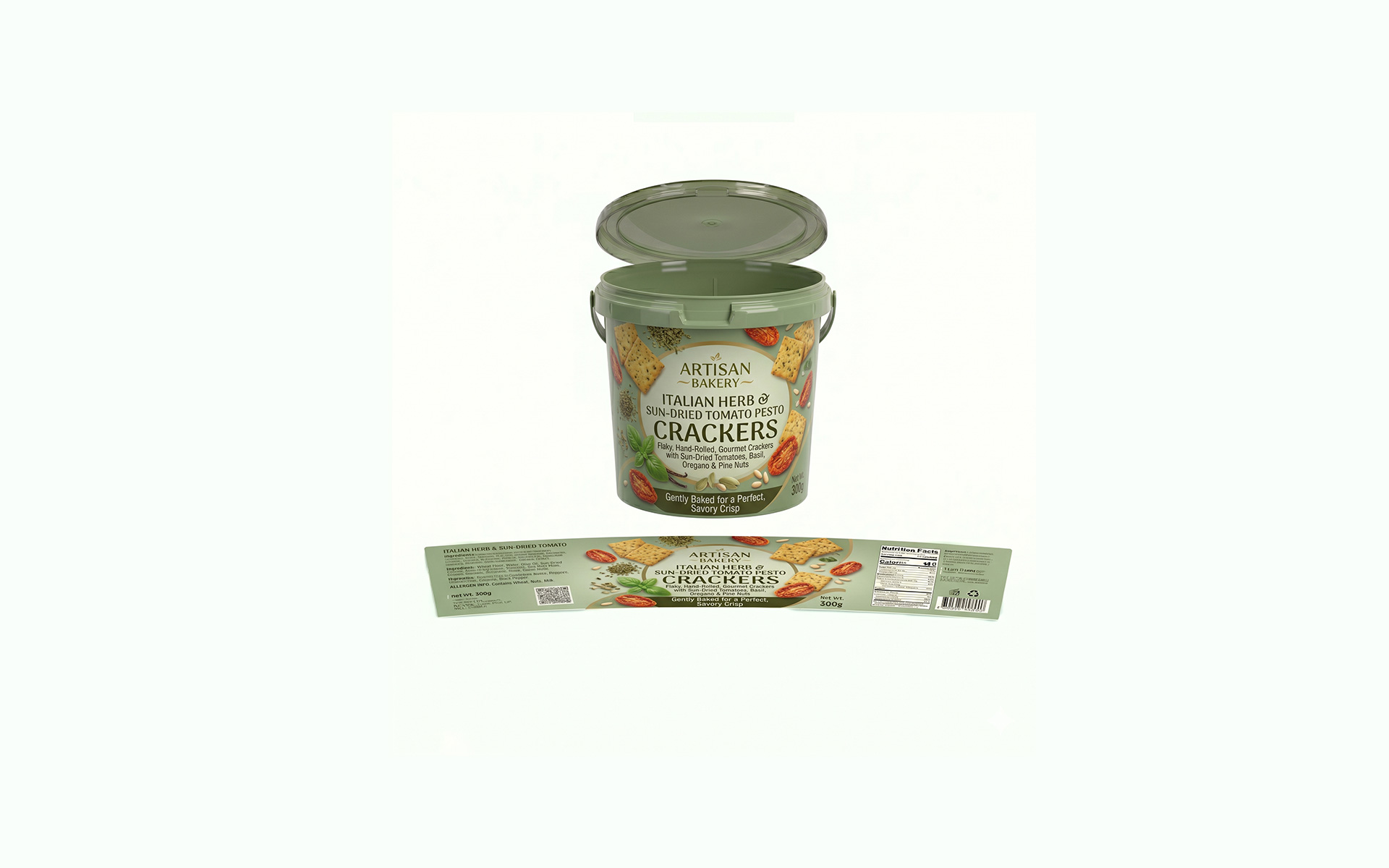
Traditional labels, whether screen-printed or pressure-sensitive stickers, can mostly only cover one or two sides of a product. But IML technology breaks this limitation.
IML labels are fused with the plastic container during injection molding. Because of this, the label can "grow" along with the container's shape, with coverage far beyond flat surfaces. In-mold labeling products come in a wide variety of designs, from flat lids of various shapes to 360° wrap-around labels, and can be designed with 3-sided, 4-sided, 5-sided, or even 8-sided coverage.
This means every side of a biscuit box – front, back, side, and even the bottom – can become a "prime advertising space" for brand display.
2. 360° Full-Wrap Labels – Making the Brand "Everywhere"
360° full-wrap labels are one of the most visually impactful IML packaging forms.
Full-wrap means the label completely encircles the entire circumference of the biscuit box, displaying full brand patterns and product information from any angle. Traditional stickers can only cover one side, but 360° full-wrap labels make every side of the biscuit box a display surface.
Advantages:
- Extremely high shelf recognition: No matter which direction consumers look from, they see the brand information
- Strong visual continuity: Patterns wrap around the entire container, forming a complete visual narrative
- Effective anti-counterfeiting: Full-wrap labels are integrally molded with the container – they cannot be peeled off or replaced
For biscuit brands that need to stand out in highly competitive shelf environments, 360° full-wrap labels are a "winning strategy."
3. Multi-Surface Coverage – Three-Sided, Four-Sided, Five-Sided, Even Eight-Sided
Beyond 360° full-wrap, IML can also achieve multi-surface coverage – depending on the biscuit box's design requirements, covering 3, 4, 5, or even 8 sides.
Three-sided coverage: Common on rectangular biscuit boxes – front and back display brand and product imagery, one side shows product information and nutritional facts, and the other side shows the brand logo or flavor identification.
Four-sided coverage: Covers all four sides of a rectangular box, creating a complete "sleeve" effect – ideal for products that need multi-angle display on the shelf.
Five-sided coverage: Covers the four sides plus the top (or bottom) – allowing brand information to be seen from above and around.
Eight-sided coverage: Suitable for octagonal or other polygonal specialty boxes – turning every face into a brand display window.
IML labels can be made into rectangular shapes with rounded corners, circles, squares, or products with corrugated side edges. The more sides, the greater the brand display space, but the higher the demands on mold design and label positioning accuracy.
4. Specialty Shapes – Rectangular, Tapered, Round, Corrugated Edges
Biscuit boxes come in countless shapes – rectangular, round, tapered, oval, corrugated edges… One of IML's key advantages is its ability to perfectly adapt to various specialty shapes.
Rectangular Boxes
Rectangular is the most common shape for biscuit boxes. IML can cover the four sides, top, and bottom of a rectangle for multi-surface display.
Round/Oval Boxes
Round biscuit tins (such as McVitie's classic round tins) are very popular in the market. IML labels can perfectly conform to round curved surfaces, displaying brand patterns in 360° wrap-around. Honokage's 900ml oval plastic biscuit containers allow both the lid and base to be decorated with IML labels, making them more attractive and appealing.
Tapered Boxes
Wider at the top and narrower at the bottom, tapered designs require higher label conformability. IML film materials have excellent stretchability and can deform along with the container's shape without wrinkling.
Corrugated Edges
IML can also produce products with corrugated side edge patterns. This unique box design makes biscuit boxes more recognizable on the shelf, and IML technology ensures the label perfectly conforms to the corrugated surface.
Key advantage: Because IML labels naturally integrate with the container body and deform along with it, they do not blister or wrinkle, making them particularly suitable for ergonomic specialty-shaped bottles.
5. Lid Design and Tamper-Evident – Safety and Aesthetics Combined
The lid of a biscuit box is often overlooked by brands. But IML changes that – the lid can also become an important platform for brand display.
Lidded IML Biscuit Boxes
IML technology can apply labels to both the container body and the lid simultaneously, achieving visual unity across the entire package. United Biscuits' IML packaging for its Family Circle biscuits uses lids that not only protect the product and ensure a good taste experience but also display enticing biscuit imagery to maximize consumer appeal. The lid is fully resealable, so leftover biscuits don't need to be transferred to another container.
Tamper-Evident Design
Food safety is a top priority in biscuit packaging. IML biscuit boxes can incorporate tamper-evident lid designs – once the lid is opened, it leaves a clear "opened" mark, allowing consumers to determine whether the product is intact.
Honokage's IML biscuit containers feature tamper-evident and resealable characteristics, and can also be equipped with handles upon customer request. Tamper-evident design not only enhances product safety but also strengthens consumer trust in the brand.
6. Five-Sided Printed IML Containers – Let Every Side of the Package "Speak"
"Five-sided printed IML containers" represent another premium application of IML technology on biscuit boxes.
Five-sided printing means the container has IML labels covering five surfaces (four sides + top or bottom). This means:
- From above: The beautiful graphics on the lid attract consumers looking down
- From around: Every side displays brand information and product imagery
- From any angle: The package is a complete "brand display piece"
Five-sided printed IML containers are especially suitable for premium biscuit gift boxes, seasonal limited editions, and gift sets – turning every side into a window for brand-consumer communication.
Application examples:
- Rectangular 1.5L PP biscuit box with tamper-evident lid, using five-sided IML printing
- Temperature resistance range -20°C to 120°C, suitable for various storage environments
- Made from recyclable PP material, hygienic and environmentally friendly
Honokage's IML PP film technology makes biscuit boxes more robust, visually appealing, and durable. The labels are resistant to damage, fading, and peeling, ensuring the biscuit box maintains its attractive appearance throughout its entire service life. This technology also offers significant design freedom, allowing for the application of various colors, patterns, and brand identities.
7. FAQ
IML labels can be designed to cover 3-sided, 4-sided, 5-sided, or even 8-sided products. From simple flat labels to 360° full-wrap wrap-around labels, the coverage range is highly flexible.
Yes. IML labels naturally integrate with the container body and deform along with it, without blistering or wrinkling. Round, tapered, oval, corrugated edge, and various other specialty shapes are all applicable.
Yes. IML technology can apply labels to both the container body and the lid simultaneously. The lid can both protect the product and display brand graphics, enhancing shelf appeal.
A tamper-evident IML biscuit box uses special design that leaves a clear "opened" mark once the lid is opened, allowing consumers to determine whether the product is intact. This is very important for ensuring food safety and building consumer trust.
Yes. IML labels and biscuit boxes typically use the same PP material, so they can be directly shredded and reprocessed together during recycling without label separation. IML labels are hygienic, safe, and reliable.
No. IML labels are fused with the container body during injection molding – they will not warp, peel, fall off, or become damaged. The labels have vivid colors, smooth feel, and fine graphics. The ink is sandwiched between the film and the plastic, so it will not fade.
Contact Us
Name*
Telephone*
Region*
Please fill in your request*


