
Application of Dry Lamination in the Production of In-Mould Labels
Application of Dry Lamination in the Production of In-Mould Labels
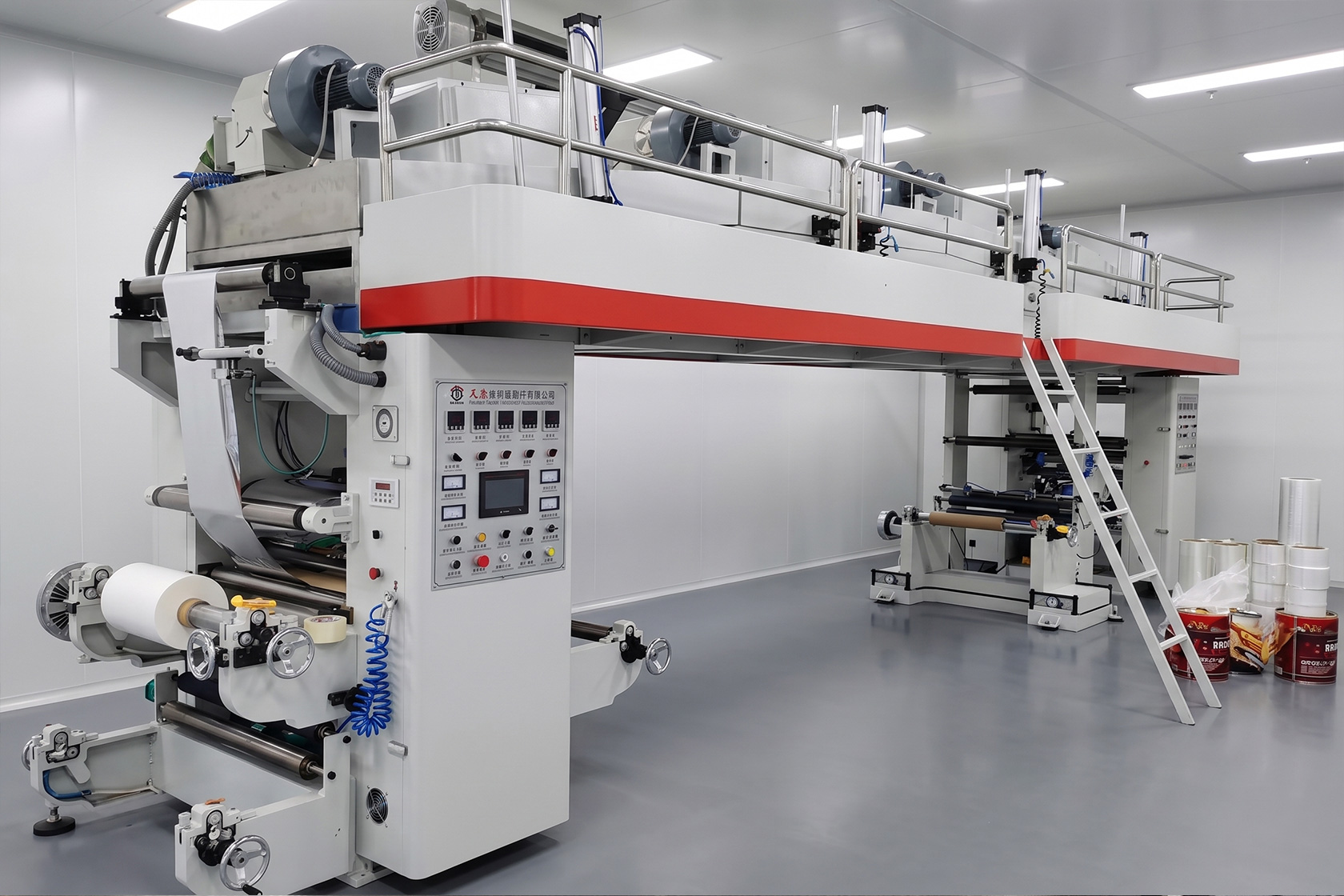
In the manufacturing of in‑mould labels (IML), multi‑layer lamination processes are the core technological pathway to achieve functional labels. Among these, dry lamination – thanks to its high material flexibility, strong interlayer adhesion, and ability to handle thermally incompatible materials – has become an indispensable method for producing high‑performance, heterogeneous‑structure IML labels. Especially when combining high‑performance materials such as PET or fluoropolymers with polyolefin heat‑seal layers, dry lamination is often the only feasible process. This article systematically introduces the principles, key control parameters, typical applications, advantages & disadvantages, and environmental upgrading directions of dry lamination in IML production.
1. Basic Principle and Process Flow of Dry Lamination
Dry lamination is a technology that bonds two or more substrates together through adhesive coating → drying → hot pressing → curing. The term “dry” means that the solvent (or water) in the adhesive is removed by heating before the substrates enter the nip rollers, so that the adhesive is applied in a solid or semi‑solid state to achieve initial bonding.
1.1 Typical Process Flow
A dry lamination line typically consists of: first substrate unwind → coating unit → drying tunnel → second substrate unwind → hot pressing unit → cooling unit → rewind.
The detailed steps are:
Coating: Adhesive (usually solvent‑based polyurethane or acrylate) is uniformly applied onto the first substrate (e.g., PET film) using a gravure or anilox roller. Typical dry coating weight ranges from 2–6 g/m², depending on substrate roughness and bond strength requirements.
Drying: The coated substrate passes through a multi‑zone drying tunnel (50–120°C gradient) with hot air to thoroughly evaporate organic solvents (e.g., ethyl acetate, methyl ethyl ketone), leaving a dry adhesive layer. Tunnel length is typically 8–12 m, with precise control of air velocity and temperature to avoid blistering or incomplete drying.
Lamination: The dried first substrate is brought together with a second substrate (e.g., PE film) between a heated nip roll (60–100°C) and a rubber pressure roll. Heat activates or melts the adhesive layer, which wets the second substrate under pressure to form an initial bond.
Curing: The wound laminate is placed in a curing oven (constant 40–60°C, controlled humidity) for 24–72 hours, allowing the isocyanate and hydroxyl components of the adhesive to fully crosslink, achieving final peel strength.
Cooling and rewinding: After curing, the laminate is cooled to room temperature and rewound for storage or further processing.
1.2 Key Process Parameters
| Parameter | Typical Range | Impact |
|---|---|---|
| Coating weight | 2–6 g/m² (dry) | Too low → poor strength; too high → cost increase & migration risk |
| Drying tunnel temperature | 50–120°C (zoned) | Too low → solvent residue; too high → film deformation |
| Line speed | 100–300 m/min | Affects productivity and drying completeness |
| Nip roll temperature | 60–100°C | Affects initial tack and bond strength |
| Curing conditions | 40–60°C, 24–72 h | Determines final crosslinking degree and heat/chemical resistance |
2. Typical Applications of Dry Lamination in IML
The core value of dry lamination is the ability to firmly bond two or more materials that have large melting point differences, different polarities, or cannot be co‑extruded. In IML, two typical applications stand out:
2.1 PET/PE Composite IML Labels
Background: PET film offers high transparency (>90% light transmittance), high surface hardness (up to 3H), excellent heat resistance (-40 to 150°C), and good chemical resistance, making it an excellent printing surface for IML labels. However, PET and PE (the most common container material) have very different melting points (PET ~255°C, PE ~120–130°C) and different polarities, so they cannot be co‑extruded directly. Their thermal shrinkage rates also differ significantly, leading to delamination if co‑extruded.
Dry lamination solution: PET film (printed or unprinted) is laminated with a PE film via dry lamination. The PE layer melts under in‑mould heat and fuses homogeneously with the PE container; the PET layer provides a stiff, wear‑resistant, high‑gloss printing surface. To withstand the high temperatures of IML, the adhesive must resist degradation or loss of bond strength at short‑term temperatures above 150°C. High‑temperature‑resistant two‑component polyurethane adhesives are typically used, achieving peel strengths of 3–5 N/15mm after proper curing.
Applications: High‑transparency “no‑label look” cosmetic bottles, wear‑resistant laundry detergent bottles, PET containers for hot‑fill foods, etc.
2.2 Fluoropolymer / Polyolefin Composite IML Labels
Background: Fluoropolymer films such as PTFE, PVDF, and FEP have extremely low surface energy (PTFE ~18 mN/m), outstanding chemical resistance, wide temperature resistance, and non‑stick properties, making them ideal surface layers for extreme‑environment IML labels. However, fluoropolymers hardly bond with any material by heat fusion, and their low surface energy prevents wetting by common adhesives.
Special dry lamination solution: A two‑step approach of surface treatment + special adhesive is required. First, the fluoropolymer film surface is treated by plasma treatment or sodium‑naphthalene chemical etching to introduce polar groups, raising surface energy to a coatable level. Then, a fluorine‑modified polyurethane adhesive or epoxy‑fluorocarbon hybrid adhesive is applied, dried, and hot‑pressed with a polyolefin film (PE or PP). The resulting structure is: PTFE (non‑stick / chemical resistant layer) → adhesive layer → PE (layer for fusion to container). Such IML labels can be used for containers holding aggressive chemicals, outdoor storage tank identification, etc.
3. Advantages and Disadvantages of Dry Lamination
3.1 Advantages
Wide material selection: Virtually any two films (paper, aluminum foil, PET, PA, PE, PP, fluoropolymer, etc.) can be laminated, unrestricted by melting point, polarity, or thermal stability.
High bond strength: Fully cured two‑component polyurethane adhesives provide very high peel strength and resistance to water, oil, and chemicals.
Allows functional coatings: Before lamination, the coating station can apply primers or functional coatings (e.g., UV blocking, anti‑static, anti‑microbial), enabling integration.
Mature process, widely available equipment: Dry lamination has been used in flexible packaging for decades; equipment investment and maintenance are relatively manageable.
Suitable for small batches, many varieties: Changing material combinations is convenient, ideal for customised mid‑to‑high end IML labels.
3.2 Disadvantages
Environmental concerns with solvent‑based adhesives: Traditional dry lamination uses large amounts of organic solvents (ethyl acetate, MEK, etc.), emitting VOCs. Solvent recovery or incineration equipment (RTO) is expensive.
Higher cost than co‑extrusion: Adhesive cost (approx. 10–30 CNY/kg), solvent cost, energy consumption (drying tunnel), and curing time are all higher than co‑extrusion.
Risk of residual solvent: If drying is inadequate, trace solvents may remain in the laminate, posing migration risks for food or pharmaceutical packaging.
Relatively lower productivity: Limited by coating/drying speed and curing waiting time; line speeds are generally lower than co‑extrusion.
Limited heat resistance of common adhesives: Ordinary polyurethane adhesives lose strength above 100°C; high‑temperature grades are needed for IML.
Difficult recycling of heterogeneous laminates: PET/PE composites are hard to separate, not mono‑material, and have low recycling value.
4. Environmental Upgrades: Solventless and Waterborne Lamination
To address the environmental pressure of solvent‑based dry lamination, the industry has developed two alternative technologies that are gradually gaining traction in IML.
4.1 Solventless Lamination
Uses 100% solids two‑component polyurethane adhesive. The adhesive is coated at room temperature and immediately pressed; curing occurs via chemical reaction – no drying tunnel needed. Zero VOC emissions, low energy consumption, and high line speeds (up to 400 m/min). However, initial equipment investment is higher (dedicated solventless coating head and mixing system), and the adhesive’s short open time requires precise operation. In IML, solventless lamination is already used for PET/PE, BOPP/PE, etc., but for fluoropolymers surface pre‑treatment is still required.
4.2 Waterborne Lamination
Uses waterborne polyurethane or acrylic adhesives, with water as diluent. After coating, low‑temperature drying (60–90°C) removes water – no organic solvent emissions. Waterborne lamination offers slightly lower bond strength than solvent‑based and has poorer wetting on non‑polar materials (e.g., PE, PP); corona treatment or primer is usually needed. In IML, waterborne lamination is mainly used for PE/PE or PP/PP homogeneous structures; its use for heterogeneous structures like PET/PE is limited.
5. Quality Control Points for Dry‑Laminated IML Labels
To ensure stable performance in subsequent printing, die‑cutting, and in‑mould processing, the following quality indicators must be monitored:
| Parameter | Test Method | Acceptance Criterion (typical) |
|---|---|---|
| Peel strength | 180° peel (T‑peel) | ≥2.5 N/15mm (PET/PE) |
| Total solvent residue | Gas chromatography | ≤5 mg/m² (food grade) |
| Heat resistance | 150°C / 1 min hot press | No blistering, no delamination |
| Appearance | Visual + magnifier | No spots, bubbles, wrinkles |
| Thickness uniformity | Online thickness gauge | Tolerance ≤ ±5% |
6. Conclusion
Dry lamination, with its wide material compatibility and high bond strength, occupies an irreplaceable position in IML production. It is especially the only or optimal solution for structures that cannot be co‑extruded, such as PET/PE and fluoropolymer/polyolefin composites. Although solvent‑based dry lamination faces environmental and cost challenges, the technology is evolving toward greener, more efficient directions with the maturation of solventless and waterborne systems.
For IML manufacturers, mastering the process window, adhesive selection strategy, and quality control system of dry lamination is a key capability for expanding premium product lines and meeting diverse customer needs. As mono‑material packaging becomes a long‑term trend, dry lamination will continue to play its irreplaceable bridging role in recyclable designs (e.g., peelable laminates) and functional integration (e.g., RFID interlayer lamination).
Contact Us
Name*
Telephone*
Region*
Please fill in your request*


