
Application of PE+PP Composite Film in In-Mould Labeling
PE+PP Composite Film: The Ideal Solution for High-Performance In-Mould Labeling on PE Containers
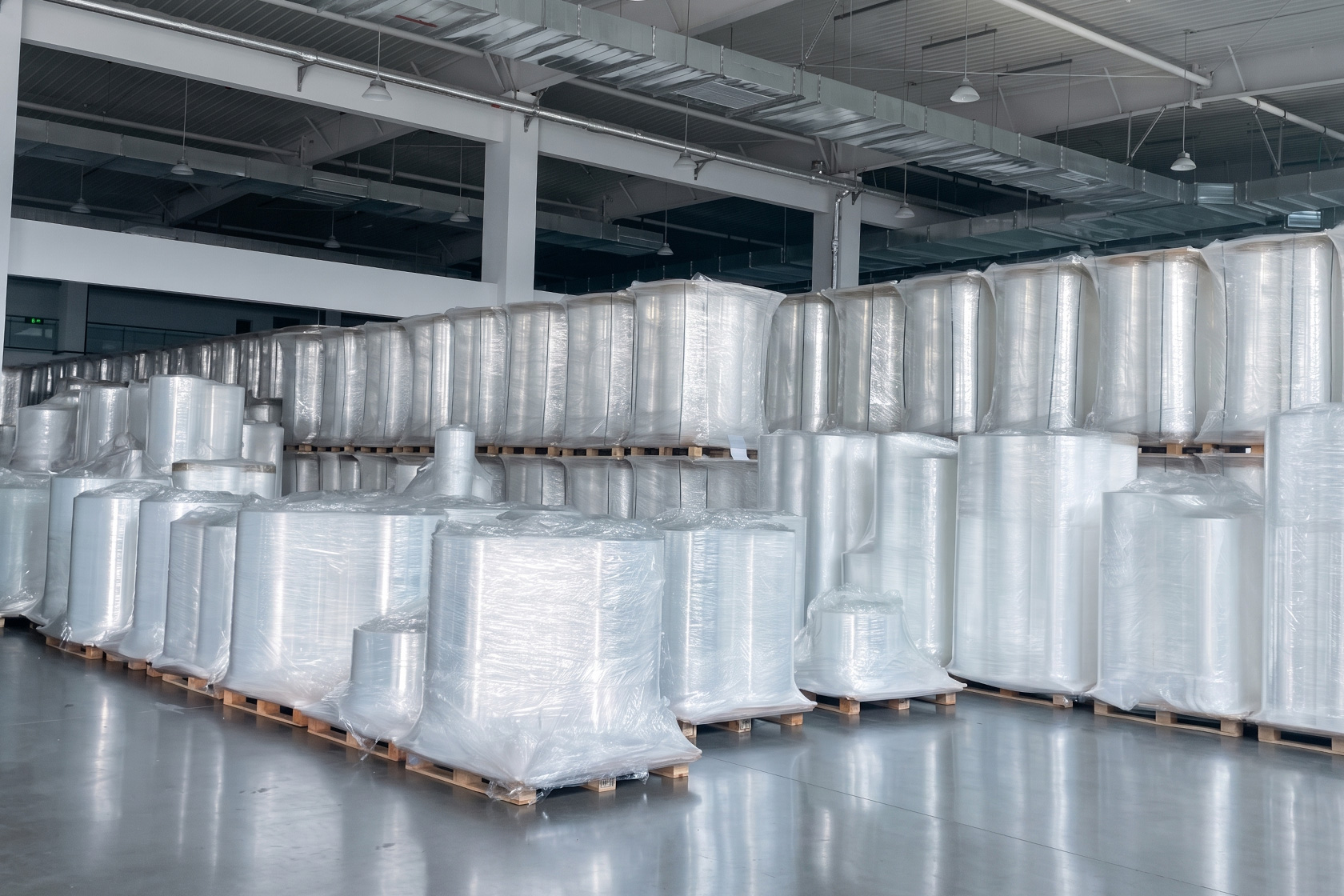
In-mould labeling (IML) embeds a pre-printed label into a plastic container during the forming process, fusing the label with the container surface. In practice, single materials often fail to meet all performance requirements simultaneously: polyethylene (PE) film offers good compatibility with PE containers and recyclability, but suffers from poor printability and low stiffness; biaxially oriented polypropylene (BOPP) film provides excellent print quality and high stiffness, yet exhibits shrinkage mismatch with PE containers (orange peel effect) and cannot be homogeneously recycled. To resolve this conflict, PE+PP composite film has emerged – through co-extrusion or multi-layer lamination, combining the advantages of PE and PP. It has become the mainstream solution in IML that balances performance and compatibility.
1. Structure and Design Philosophy of PE+PP Composite Film
PE+PP composite film typically adopts a two-layer or three-layer co-extruded structure:
Printing surface layer (top): Made of PP or BOPP. PP offers high surface energy, excellent smoothness and gloss. After corona treatment, it provides outstanding printability, enabling high‑precision, high‑saturation graphics.
Adhesive/compatible layer (bottom): Made of PE. PE has the same chemical composition as PE containers, allowing perfect fusion with the bottle body under in‑mould heat, forming a strong integrated bond.
Middle layer (optional): A tie resin (e.g., maleic anhydride grafted polypropylene) may be added as a compatibiliser to prevent delamination between the PP and PE layers; recycled or filler materials can also be included to adjust cost.
This “PP top + PE bottom” structure enables excellent performance throughout the entire lifecycle – printing, labeling, and recycling.
2. Key Advantages of PE+PP Composite Film in IML
2.1 Best of both worlds: PP printability + PE compatibility
The most outstanding advantage of PE+PP composite film is complementary performance:
Print quality comparable to BOPP: The PP top layer provides high gloss, low haze, and strong ink adhesion, delivering vibrant colours and fine halftones to meet premium packaging aesthetics.
Perfect fusion with PE containers: The PE bottom layer melts under in‑mould heat, forming a homogeneous weld with the PE bottle. The bond is strong, and the label does not lift or curl.
Elimination of orange peel effect: Because the bottom PE layer shrinks at the same rate as the PE container, the entire label shrinks synchronously with the bottle, resulting in a smooth, wrinkle‑free surface – completely solving the orange peel effect seen with BOPP labels on PE containers.
2.2 Good processability and stiffness
The PP top layer provides sufficient stiffness, making PE+PP composite film perform stably during high‑speed printing, die‑cutting and automatic labeling:
Accurate registration on rotary presses without stretching or deformation;
Labels maintain their shape after die‑cutting with clean edges;
During automatic labeling, even with a longer pre‑feed length, the label does not droop – positioning is accurate and downtime is reduced.
In contrast, pure PE film, due to its low stiffness, often suffers from tension fluctuations and label shrinkage during high‑speed processing. PE+PP composite effectively overcomes this weakness.
2.3 Environmentally favourable for recycling
Although PE+PP composite itself is a mixture of two polyolefins, it is more recycling‑friendly than heterogeneous BOPP/PE structures:
Both label and container are polyolefins (PE+PP), with similar overall densities. They can be granulated together without separation in the recycling stream; the recyclate can be used as low‑grade polyolefin products (e.g., flower pots, pipes).
The IML process uses no adhesive, avoiding the problem of adhesive residue contaminating recyclate as with pressure‑sensitive labels.
For an “all‑PE container + PE+PP label” combination, the PP content is low (label mass is a small fraction of the container), which has limited impact on recyclate properties, and is therefore accepted by most recyclers.
Some high‑end PE+PP composite films have been certified by Plastic Recyclers Europe as “compatible with the PE recycling stream”.
2.4 Wide application adaptability
PE+PP composite film can be used on various PE containers (HDPE, LDPE, LLDPE), including blow‑moulded bottles, injection‑moulded pails, and thermoformed containers. Because its shrinkage rate matches that of PE substrates, the label lies flat regardless of container shape – cylinders, boxes, or curved/irregular bottles. By adjusting the thickness ratio of PP to PE layers, the balance between stiffness and flexibility can be customised to suit different production lines.
3. Technical Limitations and Challenges of PE+PP Composite Film
3.1 Corona treatment still required before printing
Although the PP top layer is easier to print than pure PE, untreated PP still has a relatively low surface energy (approx. 30 mN/m). Corona treatment must be applied to raise the surface tension above 42 dynes/cm to ensure good ink adhesion. Corona effects decay over time and generate static electricity, requiring anti‑static measures. This adds process control complexity.
3.2 Recycling is not fully closed‑loop
Strictly speaking, PE+PP composite is not a “mono‑material”. In highly demanding closed‑loop recycling systems (e.g., bottle‑to‑bottle recycling for food contact), PP impurities can affect the purity and mechanical properties of the recycled PE. For brands pursuing the highest level of recyclability certification, pure PE labels are still preferred. However, in most industrial recycling scenarios, small amounts of PP are considered acceptable.
3.3 Higher cost than pure PE film
Due to the co‑extrusion process and the use of two resin types, the production cost of PE+PP composite film is higher than that of pure PE film. For low‑end packaging (e.g., industrial chemical pails) where print quality is not critical, pure PE film still has a price advantage. PE+PP composite is positioned more for the mid‑to‑high end market.
3.4 Interlayer adhesion must be strictly controlled
PP and PE are thermodynamically incompatible polymers. Direct co‑extrusion tends to cause delamination. Therefore, a compatibiliser layer (usually maleic anhydride grafted polypropylene) or special co‑extrusion technology must be used. If process control is inadequate, the label may delaminate during printing, die‑cutting or in‑use, leading to scrap.
4. Application Areas and Typical Scenarios
PE+PP composite film IML labels currently offer the most balanced performance for PE container IML and are widely used in the following fields:
| Application Area | Typical Products | Reasons |
|---|---|---|
| Daily chemicals | Laundry detergent bottles, body wash bottles, dishwashing liquid bottles | High print quality, flat adhesion on PE bottles, water and chemical resistance |
| Food packaging | Cooking oil pails, soy sauce bottles, jam jars | Food contact compliant, oil and moisture resistance, strong shelf appeal |
| Chemicals / lubricants | Engine oil pails, antifreeze pails, paint pails | Oil and solvent resistance, no orange peel on large labels, abrasion resistant |
| Pharmaceuticals / nutraceuticals | Liquid medicine bottles, supplement jars | Barcodes print clearly, integrated label/container won’t detach easily |
| Personal care | Shampoo bottles, conditioner bottles | High‑gloss label enhances brand perception, conforms to curved bottles |
In the above applications, PE+PP composite film has gradually replaced pure PE film and BOPP film as the preferred IML material for PE containers.
5. Improvement Directions and Future Trends
5.1 Develop peelable PE+PP composite labels
To meet higher‑grade closed‑loop recycling (e.g., food‑grade rPE), some research institutions and companies are developing peelable PE+PP composite labels. The concept is to create a weak interface between the PP top layer and the PE bottom layer, allowing the label to be separated from the bottle under specific conditions (e.g., hot water immersion, mechanical冲击) – thereby enabling closed‑loop recycling of pure PE bottles.
5.2 Increase post‑consumer recycled (PCR) content in the PP layer
To reduce carbon footprint, label manufacturers are trying to add post‑consumer recycled polypropylene to the PP top layer. This requires solving issues of impurities, odour, and printability. Some products already achieve 20–30% PCR content in PE+PP composite films.
5.3 Thinner and lighter films
By optimising co‑extrusion processes and material formulations, the overall thickness of the composite film can be reduced (from typical 80–100 μm to 50–70 μm) while maintaining performance. This reduces material usage, lowers cost, and increases production efficiency.
5.4 Functional coatings
Applying functional coatings on the PP top layer – such as high‑barrier coatings (oxygen barrier), UV‑resistant coatings, scratch‑resistant coatings, or antimicrobial coatings – expands the application of IML labels in special environments (e.g., outdoor storage tanks, medical packaging).
5.5 Simplified alternative: PE+PP blended monolayer film
Some manufacturers are developing PE+PP blended monolayer film – instead of a layered structure, PE and PP resins are physically blended and extruded as a single layer. Although performance is slightly lower than multi‑layer co‑extruded products, the process is simpler and cheaper, suitable for high‑volume applications with moderate print quality requirements.
Conclusion
PE+PP composite film, through clever structural design, combines the excellent printability and stiffness of polypropylene with the good compatibility and recyclability of polyethylene. It successfully resolves the long‑standing trade‑off between print quality and container compatibility in IML. Today, it has become the most balanced and widely used material solution for PE container IML.
Although challenges remain in pure PE closed‑loop recycling and cost, advances in co‑extrusion technology, compatibilisers, and recycling systems will continue to expand the market share of PE+PP composite film in daily chemical, food, and chemical packaging. For brands that demand high‑quality printing while also valuing environmental responsibility and recycling efficiency, PE+PP composite is currently the most cost‑effective choice.
Contact Us
Name*
Telephone*
Region*
Please fill in your request*


