
Extrusion Lamination Process in the Production of In-Mould Labels
Extrusion Lamination Process in the Production of In-Mould Labels
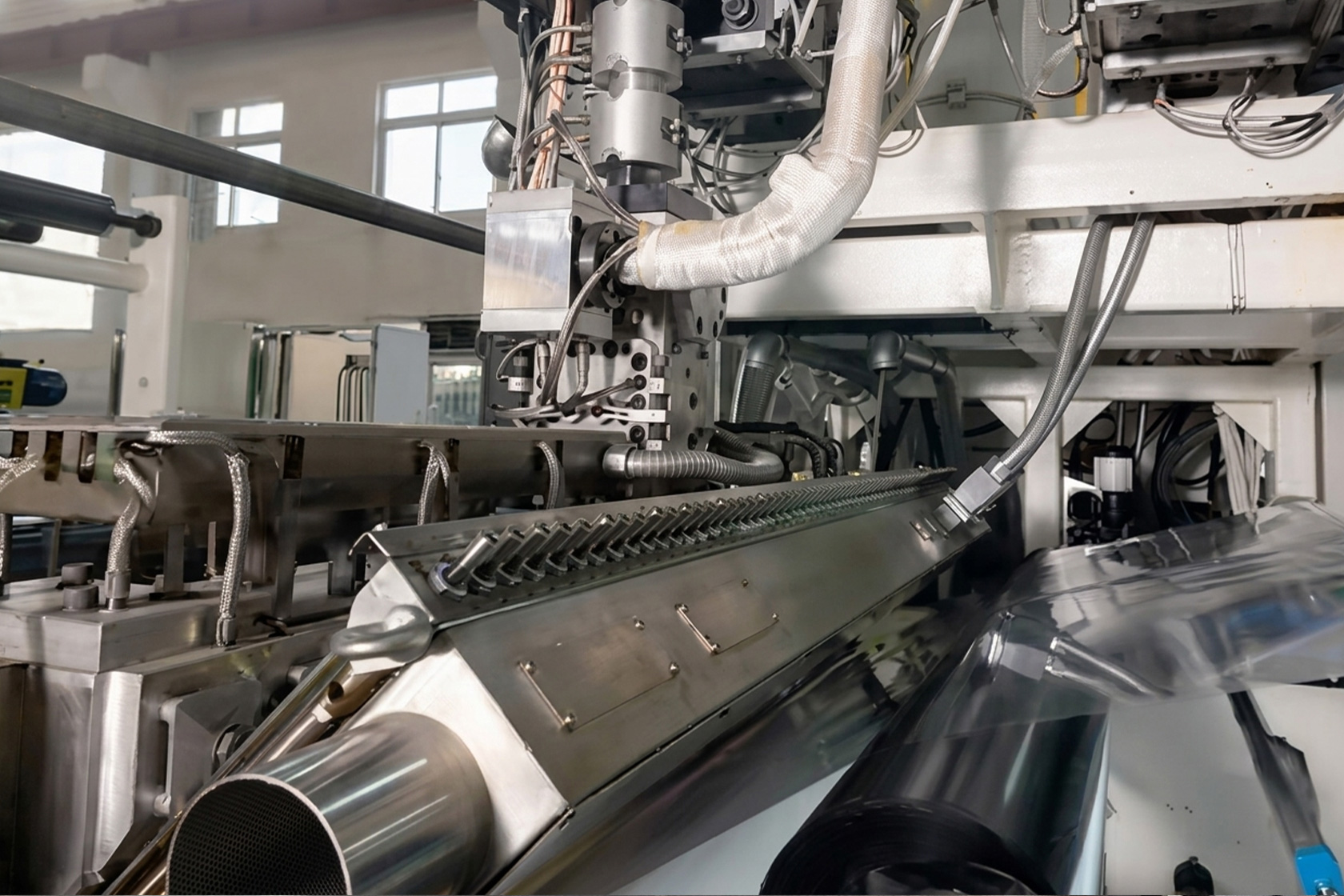
In the multi-layer lamination technology system for in‑mould labels (IML), extrusion lamination is a highly efficient process that combines bonding and functional layer construction. Unlike dry lamination, which relies on solvent‑based adhesives, extrusion lamination uses molten resin directly as the bonding medium. While bonding two substrates, the extruded resin layer itself can also serve as a heat‑seal layer or functional layer. This process offers outstanding advantages such as solvent‑free operation, environmental friendliness, and a wide adjustable range for adhesive layer thickness. It is particularly suitable for curtain coating (extrusion coating) on the back of IML labels and for paper/plastic lamination. This article systematically introduces the extrusion lamination process in IML production, covering its principles, key control parameters, typical applications, advantages and disadvantages, and development trends.
1. Basic Principle and Process Flow of Extrusion Lamination
1.1 Principle
The core of extrusion lamination is to melt and plasticise a thermoplastic resin (e.g., LDPE, LLDPE, EVA, PP) in an extruder, extrude it through a flat die (T‑die) into a thin molten film, and immediately laminate it between two substrates or directly onto one substrate against a nip roll. The film is rapidly cooled and solidified by a chill roll, forming a strong composite structure. In this process, the extruded resin layer plays two roles simultaneously:
Adhesive function: The molten resin wets the substrate surfaces and, after cooling, forms mechanical anchoring or heat‑fusion bonding, adhering the two substrates together.
Functional function: The resin layer itself can act as a heat‑seal layer (e.g., the back adhesive layer of an IML label), a barrier layer (e.g., moisture or oxygen barrier), or a toughening layer.
1.2 Typical Process Flow (Three‑layer Lamination)
Taking the commonly used “BOPP/PE curtain coating” structure for IML labels as an example:
First substrate unwinding: A pre‑printed BOPP film (or PET film) is unwound and guided into the laminating nip.
Resin extrusion: PE or EVA resin is melted in a single‑screw extruder (heating zones 150–280°C, depending on the resin) and extruded through a T‑die into a molten film of uniform width. The molten film thickness is controlled by the die lip opening and extrusion speed.
Second substrate unwinding: A second substrate (e.g., PE film or paper) is unwound and brought together with the molten film and the first substrate at the laminating nip.
Lamination pressing: All three layers pass between a cooling chrome roll (internally cooled with water) and a rubber pressure roll. The molten film wets the surfaces of both substrates under pressure and is simultaneously cooled and solidified by the chill roll.
Cooling and winding: The laminated film is further cooled on additional cooling rolls, then optionally edge‑trimmed, thickness‑measured, corona‑treated, and finally wound.
1.3 Single‑layer Curtain Coating (Extrusion Coating) Process
When only a single layer of molten resin needs to be applied to one substrate (e.g., curtain coating on the back of an IML label), the process is called extrusion coating. The flow is simpler: substrate unwinding → extrusion of molten film → pressing against a nip roll (without a second substrate) → cooling and winding. The curtain coating layer directly serves as the heat‑seal/adhesive layer of the label.
1.4 Key Equipment Components
Extruder: Typically single‑screw, L/D 25–32, with a hopper, heating/cooling systems.
T‑die: Width matched to product width, die lip opening adjustable (0.5–2 mm) to ensure uniform molten film thickness.
Chill roll set: Chrome‑plated or ceramic‑coated surface, internally circulated cooling water (10–30°C). The surface speed determines the lamination line speed.
Rubber pressure roll: Provides uniform nip pressure, with a high‑temperature‑resistant surface.
Unwind/wind units: Equipped with tension control, edge guiding, and static eliminators.
2. Key Process Parameters and Control Points
| Parameter | Typical Range | Impact on Lamination Quality |
|---|---|---|
| Melt temperature | LDPE 150–220°C; PP 220–280°C | Too low: poor melting, weak bonding; too high: thermal degradation, odour |
| Die lip opening | 0.5–2 mm | Affects initial melt film thickness; must match draw ratio |
| Air gap (die to nip distance) | 50–150 mm | Affects melt oxidation and bond strength; larger gap improves oxidation (for LDPE) but delays cooling |
| Line speed | 50–250 m/min | Higher speed improves productivity but requires adequate cooling |
| Chill roll temperature | 15–30°C | Too low: rapid crystallisation reduces bond strength; too high: insufficient cooling, film sticking |
| Nip pressure (linear) | 20–60 kg/cm | Too low: bubbles, weak bond; too high: substrate deformation |
| Resin layer thickness | 5–50 μm (typical 10–25 μm) | Affects heat seal strength, cost, and stiffness |
Key Control Points:
Air gap control: If the air gap is too long, the molten film may over‑oxidise or cool excessively, reducing adhesion. If too short, the film may not flatten properly, causing streaks. For LDPE lamination, an air gap of about 100 mm is often used to promote ozone oxidation, increasing polarity and improving adhesion to substrates.
Chill roll surface finish: A high‑gloss roll produces a glossy coating; a matte roll produces a matte finish. For curtain coating on the back of IML labels, a high‑gloss roll is often used to obtain a smooth adhesive surface.
Corona treatment: Where the curtain‑coated surface requires further printing or higher surface tension, a corona treater can be installed after the chill roll.
3. Typical Applications of Extrusion Lamination in IML
3.1 Curtain Coating – Back Heat‑Seal Layer for IML Labels
This is the most core application of extrusion lamination in the IML field. IML labels require a heat‑seal layer on the back (the side that contacts the container) that can melt under in‑mould heat and bond with the container. The conventional approach is to co‑extrude the structure directly, but for certain constructions (e.g., PET facestock or paper facestock) where co‑extrusion of a heat‑seal layer is impossible, curtain coating becomes the ideal choice.
Process example: Production of “printed PET film + LDPE curtain coating” IML labels.
Substrate: Pre‑printed PET film (thickness 20–50 μm).
Curtain coating resin: LDPE or EVA. LDPE has a low melting temperature (approx. 105–115°C) and good flowability, suitable for high‑speed curtain coating. EVA offers a lower heat‑seal temperature and better flexibility.
Coating thickness: 10–20 μm. Too thin leads to insufficient heat seal strength; too thick increases cost and makes the label stiffer.
Post‑treatment: After curtain coating, the film is wound, then slit and die‑cut. When such a label is used on a PET container, the LDPE layer melts under in‑mould heat and bonds with the PET container (the bond strength is not as high as PE/PE homogeneous fusion, but sufficient for most applications).
Advantages: Compared with dry lamination, curtain coating is solvent‑free, has zero VOC emissions, offers uniform adhesive layer thickness with a wide adjustable range (5–50 μm), and is lower in cost.
3.2 Paper/Plastic Lamination – Paper‑Based IML Labels
Paper‑based IML labels were one of the earliest types used, but due to poor moisture resistance and recycling difficulties, they are now less common. They still find use in some low‑end or dry‑environment packaging. Extrusion lamination can bond a PE layer to the back of paper, giving the paper the ability to heat‑seal under in‑mould conditions.
Process example: Production of “coated paper + curtain coated PE” IML labels.
Substrate: Printed coated paper or art paper.
Curtain coating resin: LDPE or HDPE (HDPE provides higher stiffness).
Coating thickness: 20–30 μm.
Function: The PE layer melts in the mould, penetrates the paper fibres, and adheres to the PE or PP container. Because paper is highly moisture‑absorbent, such labels are not suitable for humid environments or refrigerated packaging.
Current status: The market share of paper‑based IML labels has shrunk to less than 5%, largely replaced by PE, BOPP, and PET film labels. Nevertheless, extrusion lamination can still be used to produce specialised structures (e.g., paper/aluminium/plastic) for functional labels.
3.3 Aluminium Foil/Plastic Lamination (Limited Application)
For IML labels requiring high barrier properties (moisture and oxygen barrier) – e.g., for certain pharmaceutical or nutraceutical packaging – extrusion lamination can be used to bond a PE layer to aluminium foil. The aluminium foil acts as the barrier layer, PET as the printing layer, and PE as the heat‑seal layer. Aluminium foil cannot be co‑extruded with PE; extrusion lamination is an effective method.
4. Advantages and Disadvantages of Extrusion Lamination
4.1 Advantages
Solvent‑free, environmentally friendly: No organic solvents, no VOC emissions, complying with increasingly stringent environmental regulations.
One‑step, high efficiency: Bonding and functional layer coating are completed in a single process; no curing wait time (dry lamination requires 24–72 hours of curing).
Wide adjustable range for adhesive layer thickness: From 5 μm to 50 μm or even thicker, accommodating different heat seal strength requirements.
Relatively low cost: Resin prices are generally lower than two‑component polyurethane adhesives, and no solvents are required.
Rich resin selection: A wide variety of thermoplastic resins can be used: LDPE, LLDPE, MDPE, HDPE, EVA, PP, ionomers (e.g., Surlyn®), etc.
Suitable for high‑speed production: Line speeds can exceed 250 m/min.
4.2 Disadvantages
Selective substrate compatibility: Not suitable for all material combinations. For very low‑polarity substrates (e.g., PTFE) or poorly heat‑resistant substrates, molten resin may not wet properly.
Lower bond strength than dry lamination: Primarily physical fusion, no chemical crosslinking. For applications requiring high peel strength (e.g., large heavy‑duty packaging), dry lamination is superior.
Risk of thermal damage: Molten resin temperatures are high (above 200°C), which can cause shrinkage, deformation, or discolouration of heat‑sensitive substrates (e.g., certain films, paper).
Difficult edge and thickness uniformity control: Die flow channel design, extrusion rate fluctuations, and air gap variations all affect thickness tolerances.
Higher initial equipment investment: Requires a large extruder, T‑die, and chill roll set – though still lower than a biaxial orientation line.
5. Comparison of Extrusion Lamination, Dry Lamination, and Co‑extrusion
| Process | Bonding Medium | Environmental Friendliness | Bond Strength | Material Compatibility | Typical Application |
|---|---|---|---|---|---|
| Extrusion lamination | Molten resin | Excellent (solvent‑free) | Medium | Wide, but limited by wettability | Curtain coating, paper/plastic, aluminium/plastic |
| Dry lamination | Solvent‑based or solvent‑free adhesive | Solvent‑based poor, solvent‑less good | High (chemical crosslinking) | Very wide | Heterogeneous materials (PET/PE, fluoropolymers) |
| Multi‑layer co‑extrusion | Heat fusion | Excellent | Very high (homogeneous fusion) | Limited by melting point/rheology | Similar or compatible materials (PE/PP co‑extrusion) |
In IML production, the three processes each have their place:
Co‑extrusion is used for homogeneous or compatible material combinations (e.g., PE/PP co‑extrusion) – the most environmentally friendly and with the strongest interlayer bond.
Dry lamination is used for incompatible heterogeneous materials (e.g., PET/PE, fluoropolymer/polyolefin), trading some environmental friendliness for material flexibility.
Extrusion lamination serves as a compromise: environmentally friendly, suitable for paper/plastic, PET/PE, etc., but with lower bond strength than dry lamination.
6. Future Trends of Extrusion Lamination in IML
Upgrading to eco‑friendly materials: Development of bio‑based polyethylene (Bio‑PE) or biodegradable resins (PLA) for curtain coating layers to increase the renewable content of IML labels.
Thinner layers and material reduction: Through precision dies and closed‑loop control systems, reducing curtain coating thickness from 15–20 μm to 5–10 μm to save material costs.
In‑line functional coating integration: Adding a gravure coating unit to the extrusion lamination line for in‑line application of primers or functional coatings (e.g., anti‑static, anti‑fog), achieving “curtain coating + coating” in one pass.
Use in recyclable mono‑material packaging: Extrusion lamination can bond the same material (e.g., PE/PE) through a molten resin layer, avoiding contamination from heterogeneous adhesives and helping to achieve a closed‑loop recycling for all‑PE IML labels.
7. Conclusion
The extrusion lamination process, with its solvent‑free, environmentally friendly, efficient, and thickness‑adjustable characteristics, plays an irreplaceable role in IML production. Especially for curtain coating (back heat‑seal layer) and paper/plastic lamination, extrusion lamination is the preferred process for constructing functional layers and achieving interlayer bonding. Although its bond strength is not as high as dry lamination and its material compatibility is narrower, against the background of tightening environmental regulations and rising cost pressures, extrusion lamination is being increasingly adopted by label converters.
Correctly selecting the resin type (LDPE, EVA, PP, etc.), optimising air gap and cooling parameters, and controlling thickness uniformity are key to producing high‑quality IML labels. With advances in bio‑based resins and thinning technologies, extrusion lamination will play an even greater role in the green manufacturing and lightweight development of future IML labels.
Contact Us
Name*
Telephone*
Region*
Please fill in your request*


