
How to Spot a Good Label at a Glance – A Guide to Quality Inspection for IML Flower Pots
How to Spot a Good Label at a Glance – A Guide to Quality Inspection for IML Flower Pots
When you pick up an IML flower pot, the pattern looks beautiful, the colors are bright, and the surface feels smooth and seamless. Everything seems perfect. But are you sure it is a good IML flower pot?
The difference between a high‑quality IML flower pot and a poor one is not on the surface, but in the details. The gap between an excellent label and a defective pot could be just 0.1mm – but you can tell which one is superior at a glance.
Below, we will guide you through six key dimensions – registration accuracy, bubbles, edge lifting, adhesion, color difference, and die‑cutting deviation – so you can quickly tell good IML quality from bad.
📖 Table of Contents
- 1. Registration Accuracy: “Do the patterns align?”
- 2. Bubbles: “Is the surface clean?”
- 3. Edge Lifting: “Are the edges tightly bonded?”
- 4. Adhesion: “Does the label grip firmly?”
- 5. Color Difference and Print Quality: “Are the colors accurate?”
- 6. Die‑Cutting Deviation: “Are the dimensions precise?”
- 7. Quick Quality Checklist
1. Registration Accuracy: “Do the patterns align?”
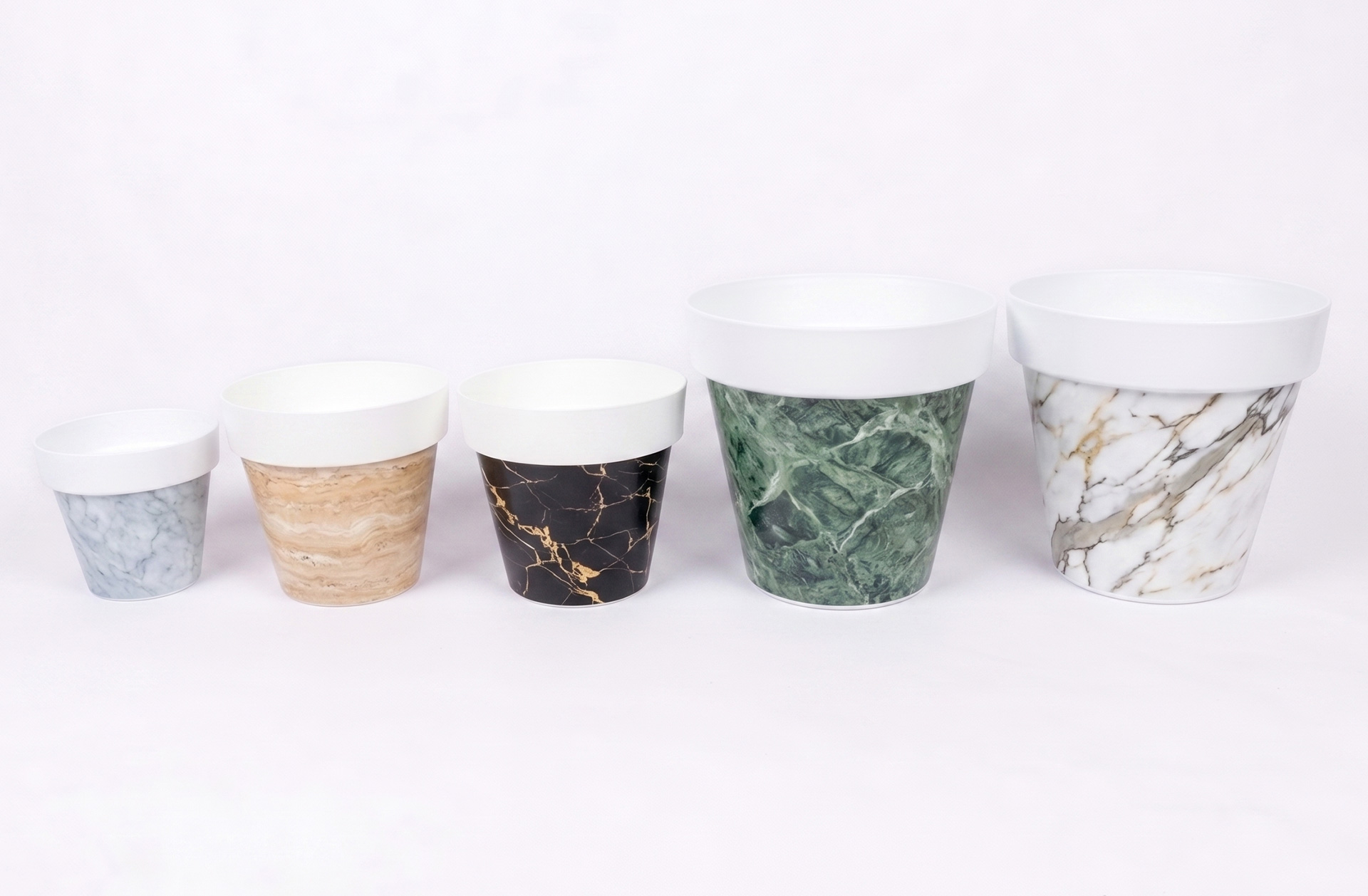
Registration accuracy refers to the degree of alignment between different colors in multi‑color printing.
If registration is inaccurate, you will see misalignment, ghosting, or white gaps at the edges of patterns – for example, a thin white line between the outline of a flower and its filled color, or blurred text edges.
What a good label should have: Registration accuracy should be controlled within ≤0.15mm, and for high‑end products even ≤0.1mm. At this level, no color shift is visible to the naked eye, and pattern edges are sharp and clear.
How to check: Find an area with small text or fine pattern lines on the pot. Look closely. If the text edges are clean and sharp – no "rough edges" or "ghosting" – the registration is good. If the pattern looks "fuzzy" or there are noticeable gaps between colors, that is a red flag.
Consequences of poor registration: During IML injection molding, the label fuses permanently with the container. If the label itself has registration errors, the pattern will be permanently misaligned after molding – this defect cannot be fixed in later steps.
2. Bubbles: “Is the surface clean?”
The one thing an IML flower pot surface should never have is bubbles.
Bubbles are one of the most common defects in IML production. If air remains trapped between the label and the mold, the finished label surface will show raised circular or oval bumps.
How bubbles form:
- Inadequate air evacuation when the label is fixed in the mold
- Uneven hot stamping causing label deformation
- Poor mold venting system design
What a good label should have: The entire pot surface should be smooth and uniform, with no raised or sunken bubble marks. When you run your hand over the surface, it should feel completely flat.
How to check: In a well‑lit environment, tilt the pot at different angles and observe the surface. If you see any round bumps or indentations, those are bubbles. Some bubbles are very small and only visible under side lighting – so side‑light inspection is the most effective way to spot them.
It is worth noting that one of IML's key advantages is "no bubbles" – the label conforms to the container shape without blistering or wrinkling. So if you see bubbles, it indicates poor process control at the factory.
3. Edge Lifting: “Are the edges tightly bonded?”
Edge lifting means the label edges are lifting away from the pot surface.
A good IML label should have edges that are perfectly flush with the pot surface – you should not feel any seam or step. The label and the pot are on the same plane; you cannot sense the label's presence.
How edge lifting occurs:
- The label was not securely fixed in the mold and was displaced by melt flow during injection
- The label did not conform perfectly to the mold cavity
- The pot shape is poorly designed, or the draft angle is insufficient
What a good label should have: The label edges and the pot surface are one seamless unit. When you slide your finger over the pot surface, you should not feel the label boundary at all.
How to check: Gently run your finger along the label edge – from the pot surface toward the label direction, not from the label outward. If your finger detects a "step" or "bump", the label edge has not fully fused. In worse cases, you can actually lift the label edge with your fingernail – such a product should be rejected outright.
Traditional externally applied labels are stuck on with adhesive, and their edges tend to lift. IML labels are "grown into" the pot – they should never have edge lifting.
4. Adhesion: “Does the label grip firmly?”
Adhesion is the most critical performance indicator for IML. A good IML label should be "impossible to peel off without destroying the pot" – the label and the plastic substrate have fused under high temperature and pressure. The only way to separate them is to break the pot itself.
How to test adhesion:
Cross‑hatch test (tape test): Use a cutter to make a grid pattern on the label surface, apply tape over it, and then peel the tape off quickly. Observe whether the ink or coating has come off. A high‑quality product should show no delamination or peeling.
Tape peel test: Apply standard adhesive tape to the label surface, press it flat, and then pull it off rapidly. Check whether the label has detached or ink has transferred to the tape.
Ink layer adhesion strength: According to industry standard BB/T 0053-2023, the ink layer adhesion of IML labels should be no less than 85%.
How to check (simple methods) :
- Fingernail scratch test: Scratch the label surface firmly with your fingernail. If it leaves a mark or ink comes off, the ink layer strength is insufficient.
- Tape test: Take a piece of transparent tape, stick it firmly onto the label surface, and pull it off quickly. Observe whether any ink or label fragments have come off onto the tape. If so, the adhesion is unqualified.
- Bend test: Gently bend the edge of the pot (being careful not to break it) and observe whether the label shows any cracking or separation.
Important note: An IML label is nearly impossible to peel off after application. If you can easily "peel" the label off, it is not genuine IML – it is just an ordinary sticker pretending to be IML.
5. Color Difference and Print Quality: “Are the colors accurate?”
IML uses CMYK four‑color printing. A good label should have colors that are vivid, uniform, and accurate.
Causes of color difference:
- Incorrect ink formulation or poor ink adhesion
- Insufficient ink adhesion during printing
- Dark pot substrate without a white base layer
What a good label should have: Colors that are bright and saturated, with no color variation between products in the same batch. The industry standard for color difference is generally ΔE≤1.5.
How to check: Place multiple pots from the same batch side by side for comparison. If the colors are noticeably different, the printing quality control is inadequate. If large color blocks look uneven or have light‑dark stripes, there are problems with ink adhesion or printing process.
Special note: If the pot substrate itself is dark in color, a good label will include a double white backing layer in the pattern design to prevent the label colors from appearing dull. If you find the label colors look dim or greyish, the manufacturer may have cut corners on this step.
6. Die‑Cutting Deviation: “Are the dimensions precise?”
Die‑cutting deviation refers to the difference between the actual label dimensions and the design dimensions.
Signs of die‑cutting deviation:
- The label is off‑center on the pot
- White edges are exposed – the pot substrate color shows through
- Labels overlap or have excessive gaps
What a good label should have: The label should be centered and straight on the pot, with neat edges and no exposed substrate or overlapping.
How to check:
- Look from the front: is the label centered on the pot? If it is visibly shifted left, right, up, or down, the die‑cutting or label placement precision is insufficient.
- Check the label edges for exposed substrate color. If a dark pot has a light‑colored label, exposed white edges will be very obvious.
- For labels that wrap around the pot, check the seam – is there a gap or overlap?
The industry standard for die‑cutting deviation requires a maximum edge parallelism deviation of ≤0.1mm per metre. If you can see any deviation with the naked eye, it is not acceptable.
7. Quick Quality Checklist
With the checklist below, you can quickly assess the quality of an IML flower pot in under 2 minutes:
| Check Item | ✅ Good Label | ❌ Poor Label | Inspection Method |
|---|---|---|---|
| Registration | Pattern edges sharp, no ghosting | Color misalignment, blurred edges | Look closely at small text or thin lines |
| Bubbles | Surface smooth and flat | Raised round bumps or indentations | Tilt the pot under side lighting |
| Edge lifting | Edges flush with pot surface | Edges lifted, feels like a step | Run finger over label edge |
| Adhesion | Fingernail won't scratch it, tape won't pull it off | Scratches easily, tape pulls off | Fingernail scratch + tape test |
| Color difference | Vivid colors, consistent across batch | Dull colors, uneven shades | Compare multiple pots side by side |
| Die‑cutting deviation | Centred, neat edges | Off‑centre, exposed substrate, gaps | Observe label position from front |
Final conclusion: A good IML flower pot should have beautiful patterns, a flat surface, seamless edges, vivid colors, and precise label positioning. If the product fails on any of the above dimensions, either the process control is inadequate, or it is not truly IML at all.
Contact Us
Name*
Telephone*
Region*
Please fill in your request*


