
Why Are Most IML Flower Pots Made with PP Material? A Look at Label Substrate Selection
Why Are Most IML Flower Pots Made with PP Material? A Look at Label Substrate Selection
If you have paid attention to IML flower pots on the market, you may have noticed one pattern: the vast majority of IML flower pot labels are made of PP (polypropylene) material. This is no coincidence – it is the optimal solution developed through years of collaboration between materials science and production processes.
To understand this "why," we first need to look at what materials are used for IML labels.
📖 Table of Contents
1. What Are the Common Substrates for IML Labels?
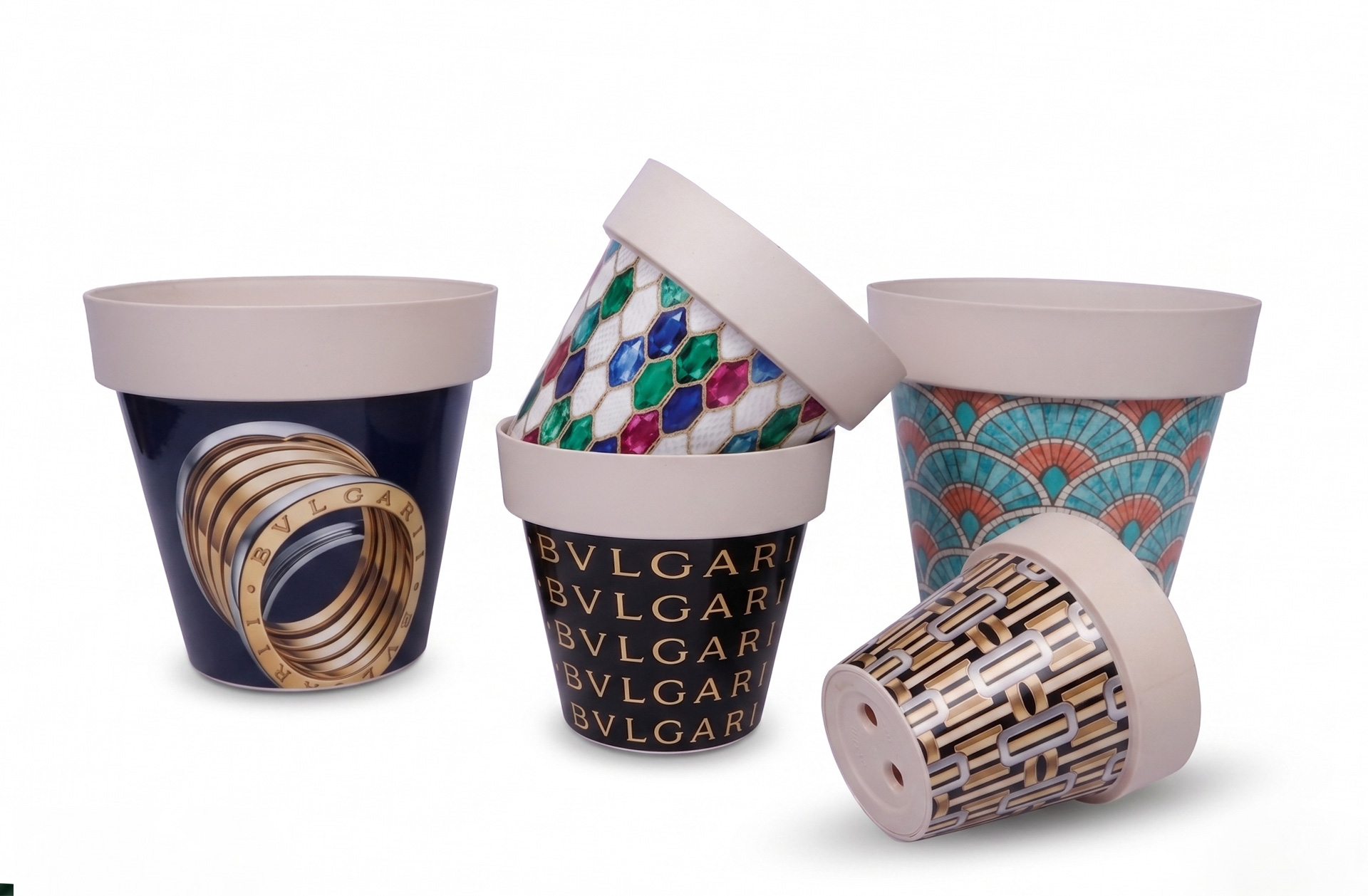
IML label materials fall into two main categories: paper‑based and film‑based. Paper‑based labels deform when exposed to moisture and are difficult to recycle, so they have been gradually replaced by film materials. Today, the mainstream IML label substrates are almost all plastic films.
Common film substrates include:
| Material | Characteristics |
|---|---|
| PP (Polypropylene) | Best stiffness, dimensional stability, good printability |
| PE (Polyethylene) | Softest, good toughness, but poor printability |
| BOPP (Biaxially Oriented Polypropylene) | Coated surface, good printability, but prone to deformation in large‑area applications |
| PE+PP Composite | Combines properties of both, smooth surface, excellent visual effect |
In terms of physical properties: PE is the softest, PP/PE is in the middle, and PP has the most stiffness. This "stiffness" difference is exactly the key to understanding why PP is the preferred choice for flower pot IML.
2. Why Is PP the Top Choice for Flower Pot IML?
2.1 Material Compatibility: PP Pots with PP Labels – A Perfect Match
The vast majority of plastic flower pots are themselves injection‑molded from PP (polypropylene). PP offers a combination of strength, toughness, and weather resistance, making it ideal for flower pots that need to withstand long‑term outdoor exposure.
The core requirement of the IML process is: the label material must be "compatible" with the container material – preferably using the same material. When both the label and the pot are PP:
- They fuse perfectly during injection molding, becoming one seamless unit
- The finished product does not deform or wrinkle due to inconsistent shrinkage rates
- The entire product has a mono‑material structure and is 100% recyclable
If the label is PE and the pot is PP, problems arise. When the container material is PE and the IML label material is PP, "their shrinkage rates are different," and the label surface will develop an "orange peel effect" after application. The same applies in reverse – material mismatch makes it difficult to ensure product quality.
In short: PP pots with PP labels expand and contract together, ensuring product stability.
2.2 Stiffness: The Key to Automated Production
Flower pot IML production uses fully automated assembly lines – robotic arms pick labels from the magazine and place them into the mold cavity, all at high speed.
During this process, the label goes through a series of actions: picking, transferring, placing into the mold, and vacuum/electrostatic fixation. If the label is too soft (like PE), it tends to curl, deform, or misalign during high‑speed transfer, leading to increased scrap rates.
PP, however, is the stiffest IML label material. Sufficient stiffness keeps the label flat and resistant to deformation on the automated line, allowing the robotic arm to pick and place it accurately every time. This is crucial for achieving high efficiency and low scrap rates in industrial production.
2.3 Print Quality: Superior Color Performance
Flower pots are displayed on shelves for people to see – beautiful patterns are a basic requirement.
PP labels have a smooth surface and good printability, delivering vivid colors and sharp patterns. The ink in IML is encapsulated between the film and the resin, so the colors remain bright and fade‑resistant over time.
In contrast, PE materials require corona treatment for printing, have poorer printability, and are prone to deformation after hot stamping. For flower pots that demand visual quality, PP is clearly the better choice.
2.4 Weather Resistance: Flower Pots Must Withstand Sun and Rain
The usage scenario of flower pots dictates that they need to withstand long‑term outdoor exposure – sunlight, rain, temperature changes, chemical corrosion from soil and fertilizers…
PP itself has excellent resistance to water, oil, acids, and alkalis, as well as strong resistance to humidity and temperature changes. The IML process encapsulates the ink between the film and the resin, giving the label excellent scratch and abrasion resistance.
Although PE has good flexibility, its stiffness and heat resistance are inferior to PP. For flower pots that need to maintain their appearance over time, PP is more reliable.
2.5 Environmental Recycling: Mono‑Material Is the Trend
Environmental sustainability is one of the most important issues in the packaging industry today.
When the label and the pot use the same PP material, the entire product can go directly into the recycling stream without the need to separate the label. The Association of Plastic Recyclers (APR) has recognized IML as the "preferred" labeling method for PP and HDPE containers, because the label is fused with the container wall.
If the label is PE and the pot is PP, additional steps are required to separate the different materials during recycling, increasing costs and technical complexity. In the face of increasingly stringent environmental regulations worldwide, the mono‑material approach is clearly the smarter choice.
3. Where Are PE Labels Used?
PE labels are not bad – they are simply suited for different applications.
PE is the most flexible, making it suitable for containers that need to be squeezed (such as tubes and squeeze bottles for personal care products). Additionally, if the container itself is made of PE (such as certain PE blow‑molded bottles), using PE labels is also reasonable – because the same material compatibility principle applies.
But for injection‑molded rigid PP flower pots, PP labels are the best partner.
4. FAQ
Yes, as long as the flower pot itself is made of PP material. Since the vast majority of plastic flower pots on the market are PP, PP labels are broadly applicable. If you have pots made of other materials (such as PE), you should choose matching labels.
The label and the pot will have different shrinkage rates, leading to an "orange peel" effect – the label surface will become wrinkled or uneven, seriously affecting appearance and adhesion. Material mismatch may also cause the label to peel off.
BOPP is a type of PP. It offers good printability due to its coated surface, but it is prone to deformation in large‑area applications. For curved flower pot surfaces, standard PP labels with better conformability are generally preferred.
A simple method: try to tear the label with your fingers. If it tears easily with a sharp "pop," it is likely PP. If it stretches and does not tear easily, it is likely PE. Additionally, PP has higher stiffness and feels "crisper," while PE feels softer.
Using the same material ensures consistent shrinkage rates, avoiding deformation caused by differential expansion. More importantly, mono‑material products are 100% recyclable without the need for separation – a critical advantage under increasingly strict environmental regulations.
Yes, but there are many grades of PP with different flow properties and shrinkage rates. It is recommended to work with your IML supplier to select PP grades that are compatible with both the label film and the pot substrate for optimal results.
Material costs vary with market conditions, but the cost of PE and PP labels is generally comparable. The cost of the label itself is only part of the overall product cost – the more important factors are production efficiency, scrap rate, and product quality. Therefore, the "appropriate" material is more important than the "cheaper" one.
IML flower pots using PP labels are fully compliant with the current trend toward mono‑material packaging. When both label and pot are PP, the entire product can be directly recycled. Many certifications, such as BRC, FDA, and ISO 14001, recognize the environmental and quality advantages of IML.
PP has good heat resistance (melting point around 160‑170°C). IML flower pots with PP labels can generally withstand temperatures up to about 100°C in normal use. However, direct contact with open flames or prolonged exposure to temperatures above the heat deflection temperature is not recommended.
For flower pots, PP offers the best overall balance. If you have special requirements, you can consider:
- PET labels: For special optical effects, but PET and PP have different shrinkage rates, requiring careful mold design
- PE labels: Only recommended when the pot itself is PE
- Specialty films: For applications requiring high‑temperature resistance or special surface textures, consult your supplier
5. Summary
The reason why flower pot IML uses PP material almost exclusively comes down to five core factors:
- Material compatibility: PP pots with PP labels ensure consistent shrinkage and no deformation
- Excellent stiffness: PP has the best stiffness, ideal for high‑speed automated production
- Superior print quality: High surface smoothness delivers better color performance
- Strong weather resistance: Withstands sun, rain, and temperature changes, maintaining appearance over time
- Environmental recyclability: Mono‑material structure enables 100% recycling
In short: PP labels are not just "coincidentally" suitable for flower pot IML – they are the answer specifically designed for it.
Contact Us
Name*
Telephone*
Region*
Please fill in your request*


