
In-Mold Labels vs Traditional Labels – Why Cheese Packaging "Changed Its Mind"?
In-Mold Labels vs Traditional Labels – Why Cheese Packaging "Changed Its Mind"?
Walk into the dairy section of any supermarket, and you'll see dozens of cheese products vying for consumer attention. Their packaging varies widely: some labels are already curling at the edges, some graphics look blurry and unclear, and some have started to bubble under the assault of condensation… while others appear as if the graphics have "grown" directly onto the container surface – smooth, flat, and vividly colored, as if born together with the container.
Behind this difference lies a battle between two completely different labeling technologies.
In the field of cheese packaging, where aesthetics, durability, and safety are all paramount, more and more brands are shifting from traditional labels to In-Mold Labeling (IML) technology. European cheese manufacturer Hochland is perhaps the most typical example.
Table of Contents
1. The "Three Sins" of Traditional Labels in Cheese Packaging
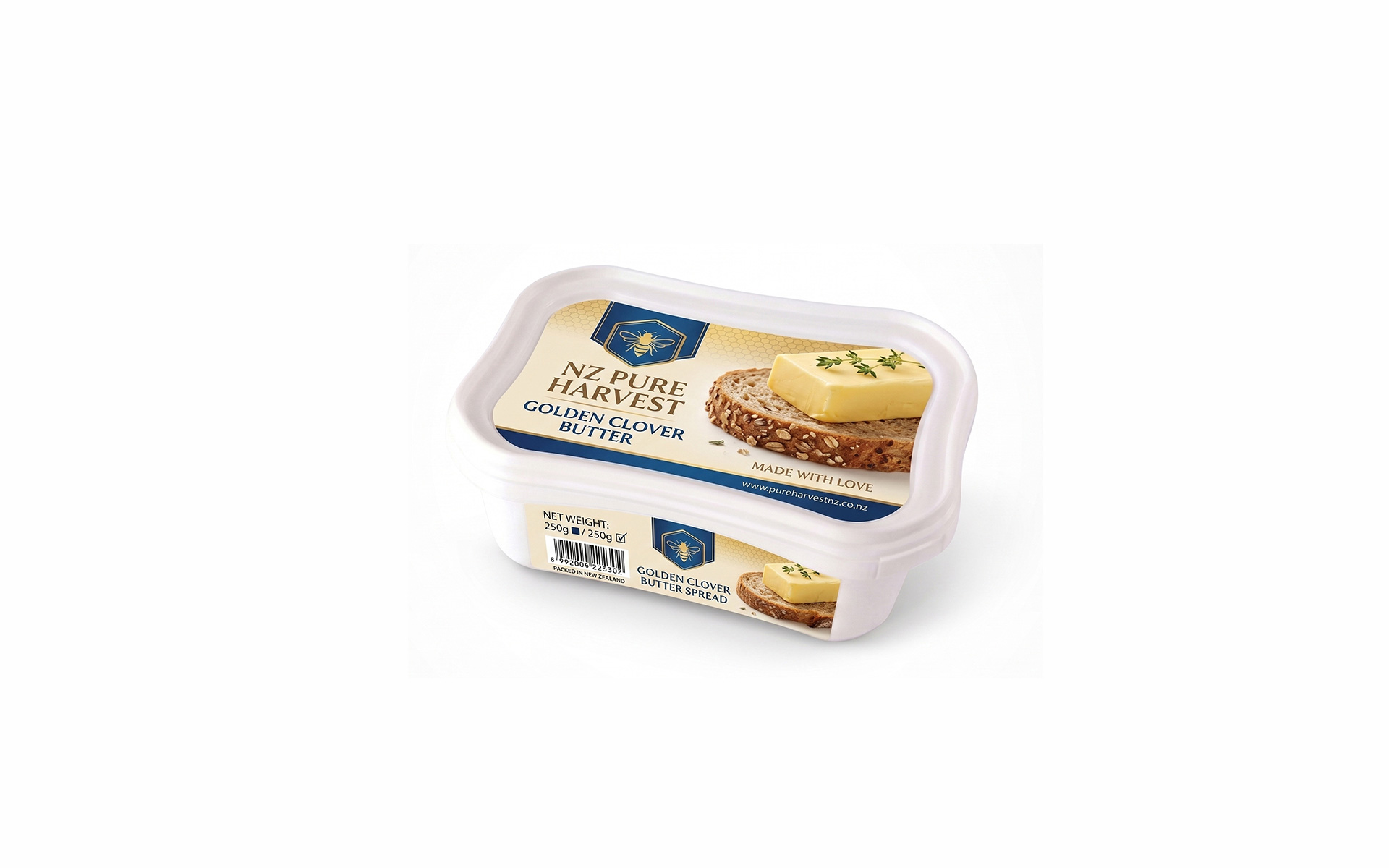
1.1 Pressure-Sensitive Labels – The "Fragile Product" in Refrigerated Environments
Pressure-sensitive labels are the most common traditional solution in cheese packaging. Their working principle is simple: a layer of adhesive is applied to the back of the label, which is then stuck onto the already-formed container surface.
But that's precisely where the problem lies.
Cheese products require a full cold chain for transportation and storage. In refrigerated environments, condensation inevitably forms on the packaging surface. Once the adhesive layer of a pressure-sensitive label becomes damp, its adhesion drops sharply. The result is: label edges curling, surface blistering, and in severe cases, the entire label peeling off.
For cheese brands, a curling label sends the message that "this product is not fresh" and "this brand is not meticulous." The first impression on the shelf is often ruined right there.
1.2 Heat-Shrink Labels – The "Victim" of Temperature Fluctuations
Heat-shrink labels are another common decorating method. They use the property of film shrinking when heated to "hoop" the label around the container.
It sounds good in theory, but in practical application, heat-shrink labels have two fatal weaknesses:
First, uneven shrinkage causes wrinkles. During the heat-shrink process, if heat distribution is uneven, the label can develop wrinkles, shifting, or insecure edges – issues that directly affect the product's appearance.
Second, temperature changes cause deformation. Cheese products go from cold storage to the shelf, and from the shelf to the consumer's refrigerator, experiencing multiple temperature changes. The shrinkage rate of heat-shrink labels is not synchronized with the thermal expansion rate of the container, and repeated thermal cycling creates fine wrinkles and residual stress on the label.
1.3 Direct Screen Printing – The "Double Shortcoming" of Color and Wear Resistance
Screen printing applies ink directly onto the container surface. Its advantages are simplicity and low cost, but in cheese packaging, screen printing's shortcomings are very obvious:
Limited color expression. Screen printing struggles to achieve fine gradients and high-resolution images. For brands that need to showcase appetizing cheese product photography, screen printing's "roughness" simply cannot meet the requirements.
Poor wear resistance. Screen-printed ink is exposed on the surface and is easily scratched during transportation, stacking, and daily use. Food packaging requires ink to be resistant to abrasion (no fading after 50 eraser rubs), and screen printing often falls short in this regard.
2. IML In-Mold Labels – The "All-Rounder" for Cheese Packaging
Compared to traditional labels, IML (In-Mold Labeling) technology works on a completely different principle: the label is not applied after the container is formed, but fuses with the container at the same time it is formed.
During the injection molding process, the pre-printed label is placed against the inner wall of the mold, and molten plastic is injected, bonding with the label under high temperature and pressure. When the mold opens, a fully decorated container is born.
2.1 Integral Molding, Never Peels Off
This is the most essential difference between IML and traditional labels.
Traditional pressure-sensitive labels rely on adhesive to stick to the surface, with the risk of adhesive aging and moisture-induced failure. IML labels, however, fuse with the container during injection molding – no adhesive layer, no concept of "peeling."
The label will not curl, bubble, shift, or become damaged. From factory to consumer, the label and container are "born together, die together."
2.2 Photo-Quality Graphics, 360° Full Coverage
IML uses high-precision printing to achieve photo-quality image reproduction – vivid colors, realistic patterns, and rich detail.
More importantly, IML technology can cover the entire surface of both the container and its lid. Whether it's the side walls, bottom, or lid, seamless decorative effects can be achieved.
2.3 Waterproof and Moisture-Proof, Worry-Free Cold Chain
IML labels offer excellent water resistance, moisture resistance, and low-temperature performance. In refrigerated and frozen environments, IML labels do not curl, bubble, or peel due to moisture, unlike pressure-sensitive labels.
The label and container are integrally molded, with no "edge gaps" for moisture to penetrate. For cheese products that spend their entire lifecycle in the cold chain, this is a decisive advantage.
3. Hochland's Path to "Changing Its Mind" – From Post-Mold Labels to IML
The transformation story of European cheese manufacturer Hochland perfectly illustrates why cheese packaging "changed its mind."
Hochland's Streichfein cheese series is one of its best-selling products, offering four flavors: Gouda, Mild Gouda, Emmenthal, and Maasdam. The company wanted to strengthen its brand presence on the shelf and clearly differentiate the flavors through new packaging design.
Before the transition, Hochland used thermoformed containers with post-mold labels – the traditional labeling solution we discussed earlier.
But soon, Hochland was impressed by IML technology's "excellent reproduction quality and overall design." IML could cover the entire surface of both the container and the lid, creating dazzling visual effects.
Ultimately, Hochland decided to fully transition to IML technology.
Results after the transition:
- Four flavors, four colors: Hochland used vibrant green, blue, red, and orange to correspond to the four flavors, allowing consumers to identify them at a glance
- Lifestyle imagery: The label showcases usage scenarios of cheese as part of a healthy meal
- Stylish container design: The narrow-bottom, wide-rim design is both user-friendly and provides a large label display area
A Hochland spokesperson commented: "RPC Bramlage-Wiko has provided a solution that increases the visibility of Streichfein's high-quality products. The container's stylish design provides an ideal basis for showcasing dazzling IML designs and achieving excellent overall product impact."
From thermoformed containers with post-mold labels to injection-molded containers with full IML decoration – Hochland's choice is a microcosm of the cheese packaging industry's shift from traditional labels to IML.
4. FAQ
The bonding method is completely different. Pressure-sensitive labels are "stuck on" after the container is made, relying on adhesive; IML labels are "fused with" the container during injection molding. Therefore, IML labels do not curl, peel, or bubble, and their service life is as long as the container itself.
Exceptionally well. IML labels offer excellent water resistance, moisture resistance, and low-temperature performance. In refrigerated and frozen environments, the label does not curl, bubble, or peel due to condensation. This is one of IML's most outstanding advantages over pressure-sensitive labels in cheese packaging.
Before switching to IML, Hochland used thermoformed containers with post-mold labels. Impressed by IML technology's excellent reproduction quality and overall design, they fully transitioned to IML.
IML technology can cover the entire surface of both the container and its lid. Whether side walls, bottom, or lid, seamless full-coverage decoration can be achieved.
IML can achieve photo-quality image reproduction – vivid colors, realistic patterns, and rich detail. Hochland's Streichfein cheese packaging is a classic example, using four vibrant colors to differentiate flavors, combined with lifestyle imagery, creating a dazzling visual effect.
Contact Us
Name*
Telephone*
Region*
Please fill in your request*


