
More Than Just Packaging – How IML Becomes a "Strategic Weapon" for Cheese Brands?
More Than Just Packaging – How IML Becomes a "Strategic Weapon" for Cheese Brands?
Walk into any supermarket dairy section, and dozens of cheese, yogurt, and butter products compete for space in a limited refrigerated area. Consumers spend only two or three seconds scanning the shelves. In that fleeting moment, packaging is the brand's most direct spokesperson.
Traditional packaging design is often limited by process constraints – blurry graphics, dull colors, and susceptibility to wear, making it difficult to stand out on the shelf. The emergence of In-Mold Labeling (IML) technology has completely changed this landscape. It elevates packaging from a mere "protective shell" to a "strategic weapon" – a key tool for brands to win at the point of sale and achieve premium pricing.
Table of Contents
1. Photo-Quality Graphics: From "Acceptable" to "Stunning"
Traditional packaging often falls short in print quality – insufficient color saturation, blurry image details, and a cheap feel. The most intuitive breakthrough of IML technology is its ability to deliver photo-quality high-definition printing.
Take U.S. dairy brand Hiland Dairy as an example. This farmer-owned dairy company fully converted its cottage cheese, sour cream, and dip product lines to IML packaging in 2024. Previously, their packaging design was "limited to more basic styles." The "photo-quality images and exciting graphics" enabled by IML technology transformed the product's appearance.
Hiland Dairy's Marketing Manager Sarah Carey captured the key insight: "Consumers want products that look as good as they taste. This new printing technology allows Hiland Dairy to present our brand in a more modern and beautiful way."
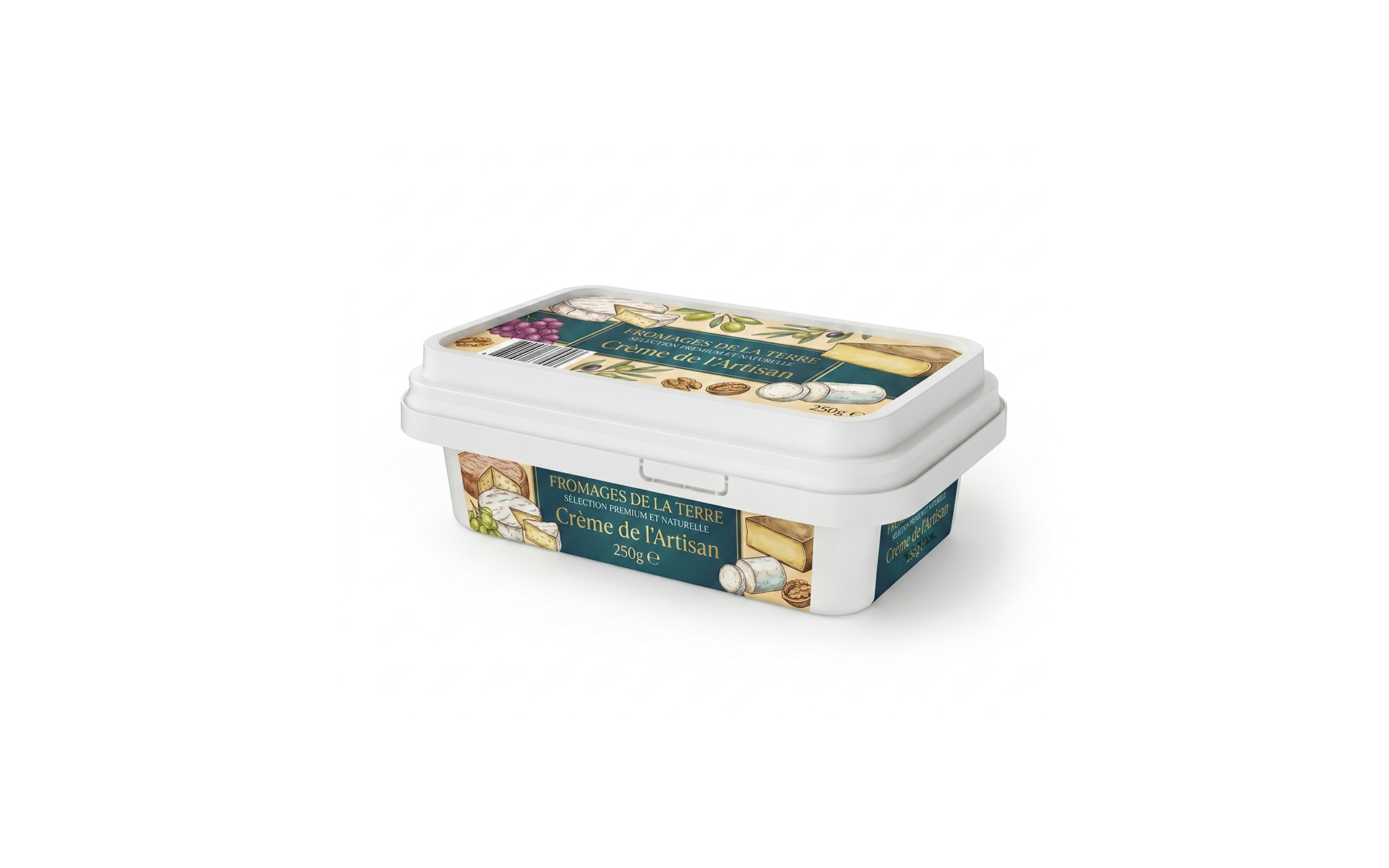
In the yogurt category, high image quality and 360° visibility help with differentiation and premium display. IML allows cheese brands to stand out on the shelf – no longer "blending in," but capturing consumer attention instantly with vibrant colors, rich details, and premium visual quality.
2. 360° No Dead Angles: Making the Brand Ubiquitous
Traditional labels typically cover only one side of a container, leaving brand information easily hidden on crowded shelves. IML is fundamentally different – the label fuses with the container during injection molding, enabling full coverage from bottom to lid and from front to back.
Hiland Dairy upgraded its yogurt series to IML packaging in 2025, covering 7 low-fat and 7 fat-free flavors. Marketing Manager Sarah Carey stated: "The refreshed packaging allows consumers to easily find their favorite flavors on the shelf."
IML's 360° full coverage means:
- From any viewing angle, consumers receive the complete brand message
- Color coding can easily differentiate flavors, reducing choice complexity
- Label and container are integrally molded – no seams, no edges, a seamless visual effect
In the highly competitive dairy category, IML turns every surface of the brand into a "prime advertising space."
3. Beauty and Substance: Great Looks, But Also Great Performance
IML is not just about "looking good" – it simultaneously addresses traditional packaging pain points in durability and food safety.
Waterproof and moisture-proof, worry-free cold chain: IML labels are moisture-resistant and cold-resistant, preventing curling, bubbling, or peeling in refrigerated and frozen environments. Hiland Dairy's new packaging features a moisture-resistant, durable surface finish that better protects product integrity.
Barrier protection, extended shelf life: IML packaging can also incorporate UV and oxygen barrier layers, optimizing product freshness and extending shelf life.
Never wears, consistent brand image: IML ink is sandwiched between the film and the plastic – it will not fade, scratch, or peel. From factory to consumer, the brand's "appearance" remains consistently impeccable.
4. Sustainable Competitiveness: Environmental Friendliness Is Also a Brand Advantage
As consumers become increasingly environmentally conscious, packaging sustainability itself is a form of brand competitiveness. IML has natural advantages in this area:
- Mono-material, 100% recyclable: IML labels and containers use the same PP material. During recycling, no label separation is required – the entire package can be directly recycled.
- Reduced waste, lower labor costs: IML combines labeling and molding into one step, eliminating traditional post-labeling processes.
- Aligned with circular economy principles: Hiland Dairy explicitly stated that IML packaging "reduces waste, promotes recycling, and aligns with the company's circular economy goals."
As Sarah Carey put it: "Our commitment to sustainability extends to our packaging."
5. FAQ
IML labels fuse with the container during injection molding – they are not "stuck on." Traditional pressure-sensitive labels rely on adhesive on the surface, with risks of peeling, curling, and fading. IML structurally eliminates these issues entirely.
Yes. The photo-quality graphics, 360° full coverage, and long-lasting durability delivered by IML significantly enhance the product's perceived value and brand premium capability. On the shelf, products that "look more premium" often command higher prices from consumers.
Hiland Dairy converted its cottage cheese and sour cream product lines to IML packaging in 2024, and fully upgraded its 14-flavor yogurt series in 2025. Its marketing manager stated that the new packaging "allows consumers to easily find their favorite flavors on the shelf" and "reinforces the brand's commitment to high-quality products."
Yes, very much so. IML labels and containers use the same PP material. During recycling, no label separation is required – the entire package can be directly recycled. Hiland Dairy explicitly stated that its IML packaging is "100% recyclable."
IML has higher upfront mold and equipment investment, making it more suitable for medium-to-large batch production. However, for products pursuing brand differentiation and a premium image, the shelf impact and brand premium that IML delivers often cover the initial investment costs.
Contact Us
Name*
Telephone*
Region*
Please fill in your request*


