
The Two Faces of Orange Peel Film: BOPP’s Decorative Texture vs. Shrinkage Mismatch
The Two Faces of Orange Peel Film: BOPP’s Decorative Texture vs. Shrinkage Mismatch
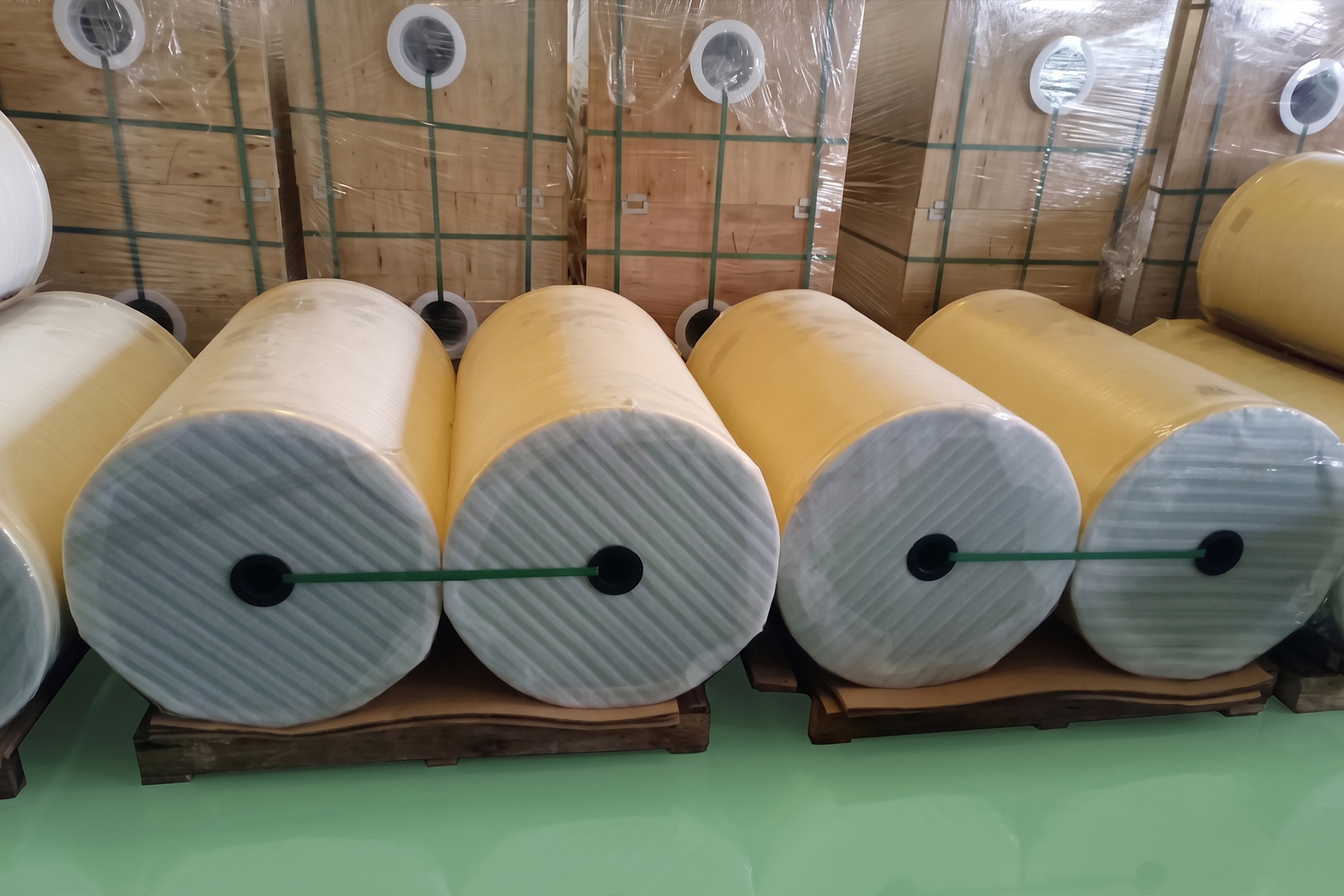
The term “orange peel film” refers to two distinctly different material phenomena in the field of in‑mould labeling (IML), both of which coincidentally center on polypropylene (PP) or biaxially oriented polypropylene (BOPP). Understanding from only one angle can easily lead to conceptual confusion. This article clarifies the relationship between orange peel film and PP/BOPP materials from two dimensions: “orange peel film as a decorative texture” and “orange peel effect as a process defect”.
1. Two Meanings of “Orange Peel Film”
1.1 Meaning One: Deliberately Designed Orange Peel Texture Film
In commercial practice, “orange peel film” primarily refers to a film product whose surface has been embossed to create an orange‑peel‑like textured finish. This texture is a decorative surface structure deliberately designed by the designer, intended to give the label a unique tactile and visual experience.
For example, HARDVOGUE’s orange peel film is described as a matte‑textured BOPP film with a distinctive orange peel texture, providing an appealing tactile and visual effect. It offers durability, gloss, printability, moisture resistance, chemical resistance, and abrasion resistance. This orange peel film is explicitly suitable for in‑mould labeling (IML), premium labels, and cosmetic packaging. Its surface finish supports matte or metallic effects, and it is tear‑resistant and highly durable, adding a unique luxury feel to packaging.
On the Chinese market, similar products exist. Zhejiang Jinyan Printing Co., Ltd. offers a “7‑micron orange peel in‑mould label” suitable for PP containers, which after injection moulding produces an orange peel gloss effect. The ink is printed on the film surface, withstanding strong friction and scratching, and after moulding it can also achieve a matte transparent effect. On platforms like Alibaba, manufacturers also wholesale multi‑layer opaque orange peel IML films for plastic oil pail packaging. These are made of BOPP, use a multi‑layer co‑extrusion process, have a thickness of 125 microns, and offer good moisture resistance.
1.2 Meaning Two: Orange Peel Defect Caused by Shrinkage Mismatch
The other meaning of “orange peel film” refers to a process defect phenomenon – when the shrinkage rates of the IML label material and the container material do not match, the label surface after application exhibits fine, irregular wrinkles that visually resemble orange peel. In the industry, this is commonly called the “orange peel effect”.
It is important to emphasize that this “orange peel” is not designed but is a defect to be avoided. When it occurs, the label material blamed for “causing orange peel” is typically PP or BOPP film.
Based on the above analysis, the relationship between “orange peel film” and PP/BOPP can be summarised as:
| Meaning of Orange Peel Film | Core Material | Intent | Cause |
|---|---|---|---|
| Orange peel decorative film | BOPP | Deliberate decoration | Embossing / cavitation |
| Orange peel defect | PP / BOPP | Unintended defect | Shrinkage mismatch between label and container |
2. Meaning One: Orange Peel Texture Film as a Decorative Effect
2.1 Material Basis: BOPP Film
From a materials perspective, “orange peel film” is essentially a BOPP (biaxially oriented polypropylene) film with a specific surface structure. BOPP, after biaxial orientation, offers high transparency, high gloss, high stiffness, and good mechanical strength. Its surface can be corona treated to reach 40–42 dynes/cm, providing good ink adhesion. On the basis of a smooth surface, additional physical or chemical processes give it an orange‑peel texture.
2.2 Texture Realisation: Embossing and Cavitation
The main processes for achieving orange peel texture are as follows:
2.2.1 Embossing
Laser embossing technology forms regular or random concave‑convex patterns on the film surface, giving the label an orange‑peel‑like visual appearance. This embossed texture not only provides a unique tactile feel and appearance but also plays an important air‑release function during in‑mould labeling on flat bottles – air can escape through the interconnected small patterns, preventing bubbles and wrinkles between the label and the container. Patent literature also records the use of laser embossing technology to process an embossed layer on the outer side of the label stock, enhancing the decorative value and aesthetic appeal of injection‑moulded plastic products. The depth of the embossed texture (i.e., the intensity of the orange peel) and its density can be adjusted by modifying the engraving depth of the embossing roll, lamination pressure, and temperature, to match different visual effect requirements.
2.2.2 Cavitated (Micro‑void) Structure
A more advanced and patented way to achieve orange peel effects comes from “cavitated” BOPP films. According to technical notes from IML Labels, their “cavitated” BOPP film has a sponge‑like structure. During in‑mould injection, the film collapses under heat and pressure, changing its surface smoothness and producing a unique orange peel effect. This effect relies on a large number of pre‑distributed micron‑sized voids (voids) inside the film. Under the high temperature and pressure of the mould, these voids shrink, causing the originally relatively smooth surface to form a uniform dimpled texture. Cosmo Films also offers an orange peel IML label solution for the label market using BOPP film with a density as low as 0.55. This low density indicates that the film contains a large number of micro‑voids, achieving lightweighting while giving the finished product a unique surface texture. This material also has good recycling compatibility with polypropylene containers – it can be ground and recycled together with them.
2.3 Functional Value: More Than Just Aesthetics
The core value of orange peel texture film lies in its “multi‑functional” capability – simultaneously meeting requirements for decoration, air release, scratch resistance, and recyclability:
Decoration & anti‑counterfeiting: The unique orange peel texture gives the label excellent tactile feel and visual identity, significantly enhancing packaging quality while also increasing the difficulty of counterfeiting, providing a certain anti‑counterfeiting function.
Air release function (anti‑bubble): For flat bottles (e.g., large flat sidewalls of lubricating oil pails), smooth surface materials tend to trap air during blow moulding, leading to bubbles and wrinkles. The interconnected texture of orange peel film allows gases to escape smoothly – this is one of the fundamental reasons for the large‑scale adoption of orange peel texture films on flat containers.
Printability & abrasion resistance: Orange peel film also offers good printability. Ink adheres to the film surface, and the surface texture provides some protection against friction and scratching, making the label more durable during shelf display and transportation.
Fingerprint resistance & anti‑blocking: The textured orange peel surface naturally reduces direct contact area, making it less likely to retain full fingerprints from everyday touch. Additionally, when labels are stacked, the concave‑convex contact surfaces reduce blocking, making it easier for automatic production lines to separate and pick up individual labels.
2.4 Main Application Areas
Orange peel BOPP films are widely used in in‑mould labeling across the following scenarios:
| Application Area | Typical Products | Reasons for Use |
|---|---|---|
| Food packaging | Yogurt cups, ice cream tubs, biscuit tins | Unique tactile feel elevates food grade; stable in ambient and refrigerated conditions |
| Daily chemicals | Shampoo bottles, body wash bottles, laundry detergent bottles | Anti‑slip and scratch resistance meet daily use and shelf durability requirements |
| Industrial containers | Paint pails, coating pails | Large flat areas require good air release to prevent bubbles and wrinkles |
| Personal care | Cosmetic bottles, skincare tubes | Luxury matte feel enhances brand texture and aligns with premium positioning |
| Chemical products | Engine oil pails, lubricant pails | Orange peel film offers some chemical resistance |
| Alcoholic beverages | Beer bottle labels, vodka bottle labels | Unique surface texture serves as a differentiation element, enhancing shelf visibility |
It is worth noting that the primary target container material for orange peel texture film is polypropylene (PP). When a PP container is paired with such a BOPP film label, both materials are polypropylene, their shrinkage rates are similar, achieving good adhesion and facilitating subsequent recycling – the label and container can be ground together without separation, forming an all‑PP mono‑material packaging solution.
3. Meaning Two: Orange Peel Effect as a Process Defect
The root cause of the orange peel effect is shrinkage rate mismatch between the label material and the container material. When the two shrink to very different extents during cooling inside the mould, the label surface becomes wrinkled with an orange‑peel appearance.
3.1 Core Cause: Shrinkage Rate Mismatch
Most plastic films shrink when heated, but different films have different shrinkage rates. Plastic bottle bodies also shrink during cooling. When the label’s shrinkage rate and the bottle body’s shrinkage rate are inconsistent, the bottle body deforms. If this deformation is transmitted back to the label (which has fused with the bottle), the label surface develops fine, irregular wrinkles, creating an “orange peel” appearance.
Regarding specific material combinations, extensive industry literature documents the following:
When the container material is PE (polyethylene) and the IML label material is PP or BOPP, due to different shrinkage rates, the container surface exhibits an orange peel effect after labeling. PE shrinkage is approximately 1.5–2.5%, while PP/BOPP shrinkage is only 0.5–1.5% – a difference of 1% or more. Over a large container of several tens of centimeters, this dimensional difference is enough to create visible wrinkles on the label surface.
The classic problem scenario is PE container + PP/BOPP label. Conversely, if a PE label is used on a PE bottle, the materials are identical and shrinkage rates are similar, so no orange peel deformation occurs.
For PP container + BOPP label, both container and label are polyolefins with similar shrinkage systems, and the thermal expansion and cooling shrinkage behaviour of BOPP labels and PP containers is well matched, so orange peel does not occur.
3.2 Why PP/BOPP “Must” Be the Protagonist of the Orange Peel Defect?
The reasons are not complicated:
PE containers dominate blow moulding. A large number of laundry detergent bottles, lubricating oil pails, shampoo bottles, etc. on the market are made of PE.
BOPP labels, with their excellent printability, high gloss, and stable forming, have always been a preferred material for high‑brand‑positioning label designs.
However, when the two are combined, the inherent shrinkage difference between PE and PP at the material level is almost impossible to eliminate completely.
The label material blamed for “causing orange peel” is usually PP/BOPP, while PE has become a solution for avoiding orange peel problems because of its material consistency with PE bottles. PE’s shrinkage rate is naturally closer to that of PE bottles, so the problem does not arise. Nonetheless, PP/BOPP’s long‑term popularity in other aspects (print quality, cost, supply stability) has not been shaken by this defect, but the role of “orange peel label material” has become highly associated with PP/BOPP.
3.3 Solution: PE+PP Composite Film
To solve the orange peel problem between BOPP and PE containers, the industry has developed a mature material solution – PE+PP composite film (also called PP+PE film). This material is uni‑directionally stretched, requires corona treatment on the surface, has good printability and stable tension. Its greatest advantage is that after application, the label surface is smooth, does not deform, and provides a good visual effect – no orange peel appears. The typical structure is “PE bottom layer + BOPP top layer”: the top layer carries the high‑quality printing, the bottom layer fuses with the PE bottle body, and a compatibiliser layer (maleic anhydride grafted polypropylene) is often added between them to prevent delamination. Through this composite structure, the shrinkage rate is dominated by the bottom PE layer, which matches the PE bottle body, eliminating the orange peel problem at its source.
4. Summary: Orange Peel Film
| Comparison Aspect | Orange Peel Decorative Film | Orange Peel Defect |
|---|---|---|
| Core material | BOPP | BOPP / PP |
| Cause | Embossing / cavitation | Shrinkage mismatch (PE container + PP label) |
| Intent | Deliberate decorative texture | Unintended defect |
| Visual effect | Uniform, controlled, pleasant feel | Irregular wrinkles, uneven bumps |
| Application scenario | PP containers; flat large‑area labels requiring slip/scratch resistance | Wrong material combination (PP/BOPP label on PE container) |
| Industry attitude | Accepted, promoted, branded | Avoided, prevented, optimised via material matching |
Ultimately, “orange peel film” represents a comprehensive interplay of materials, processes, and aesthetics. When understood as a man‑made texture based on PP/BOPP, formed by embossing or cavitation, it is a unique feature within the IML product portfolio – providing a fine tactile feel, distinctive aesthetics, and practical air‑release function, widely used in daily chemical, food, chemical, and alcoholic beverage packaging. When understood as an irregular surface defect caused by mismatch between label and container materials, it is a “classic lesson” of incompatibility between PP and PE in the IML process, reminding the industry to pay attention to shrinkage consistency when selecting label materials for a given container.
Understanding the difference and relationship between the two helps material engineers, brand operators, and packaging practitioners make prudent choices in practice: When an orange peel effect is desired, choose a specially processed orange peel BOPP film and pair it with a PP container. When an orange peel defect is to be avoided, ensure that the shrinkage rates of label and container match, or use a PE+PP composite film to circumvent the problem.
Contact Us
Name*
Telephone*
Region*
Please fill in your request*


