
Matte, Frosted, and Spot UV – Which IML Finish Best Suits Different Styles of Plastic Leisure Tables and Chairs?
Matte, Frosted, and Spot UV – Which IML Finish Best Suits Different Styles of Plastic Leisure Tables and Chairs?
In the design of plastic leisure tables and chairs, surface texture often determines the perceived value at first glance – the same shape, with different surface finishes, can be either a mass-market commodity or a "design piece" with a premium markup.
IML (In-Mold Labeling) technology has freed plastic furniture surface decoration from the monotony of screen printing and the cheap look of stickers. Among IML's many surface effects, matte, frosted, and spot UV are the three most representative finishes. Each delivers a distinct visual language and tactile experience, and each suits a completely different design aesthetic.
📖 Table of Contents
1. First Understand the Core Logic Behind IML Surface Effects
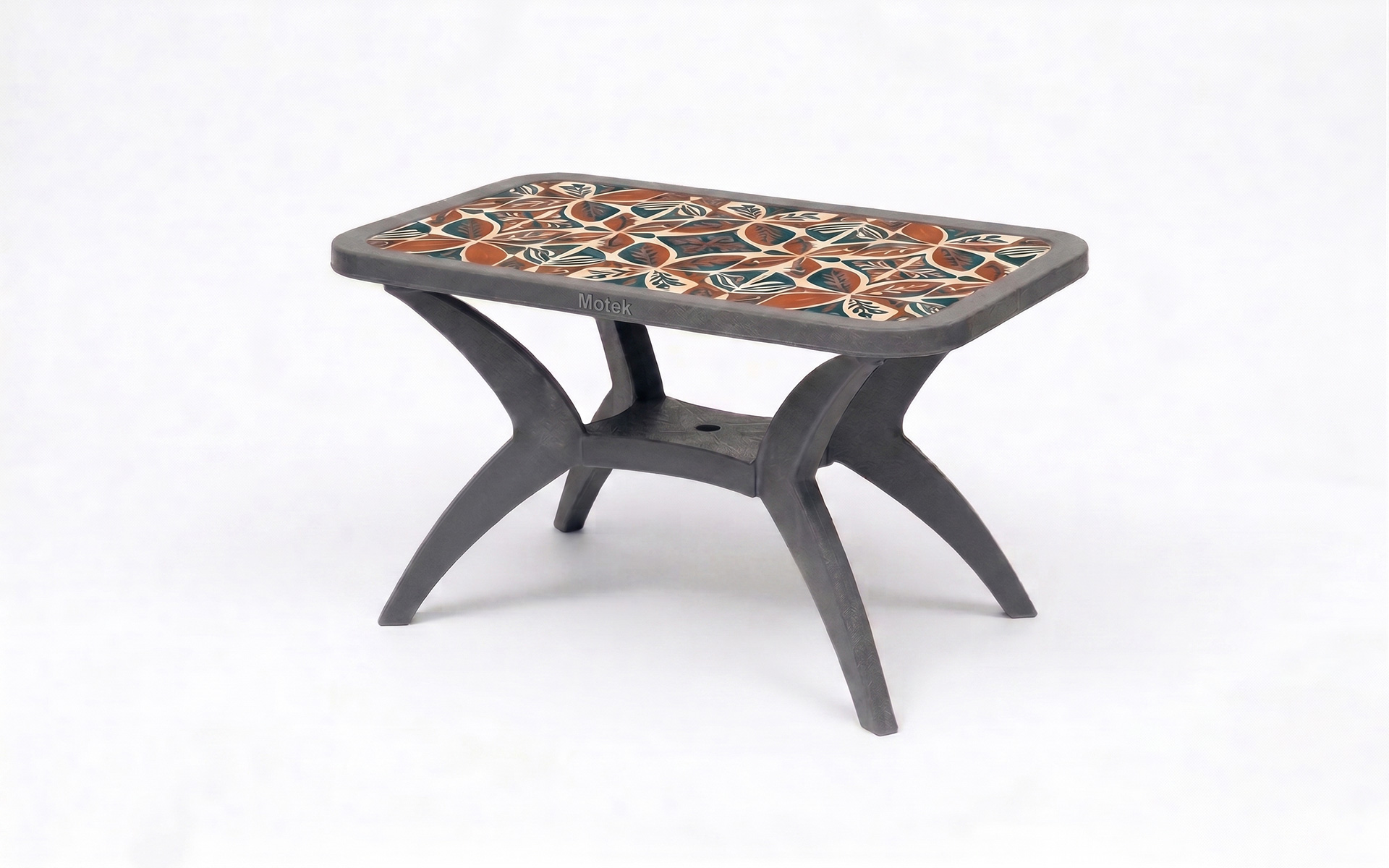
Before discussing the three finishes, it's important to understand a core fact: IML surface effects are not "applied" on top – they are "grown" out of the product itself.
The IML process fuses the decorative film with the plastic during injection molding, so patterns, textures, and local gloss or matte effects are "grown into" the product. An IML label has three layers: the surface is a hardened transparent film, the middle is the printed pattern layer, and the back is the substrate layer fused with the plastic. Because the ink is sandwiched between the film and the plastic, the pattern never contacts the outside world – it is wear-resistant, scratch-resistant, and fade-proof.
Matte, frosted, and spot UV are achieved by different treatments of this surface transparent film – matte uses sandblasting or chemical etching of the mold surface to create a micro-diffuse reflective structure; frosted relies on micro-particle textures in the film itself; spot UV applies and cures UV varnish on specific areas.
These different treatments result in different visual impressions and tactile experiences.
2. Matte: The "Premium Base" of Minimalist Style
2.1 Visual and Tactile Experience
Matte surfaces are achieved through sandblasting or chemical etching of the mold, creating a micron-level diffuse reflective structure. Light does not reflect specularly but scatters in all directions, presenting a soft, non-glare, misty visual quality.
Tactilely, matte surfaces have a fine damping feel – not cold or slippery, but with a warm "skin-friendly" quality. At the same time, matte surfaces effectively hide fingerprints and minor scratches – for daily-use furniture, this means they stay cleaner and look newer longer.
2.2 Suitable Style: Minimalist / Nordic / Wabi-Sabi
Matte is the standard language of minimalist design.
Minimalism emphasizes "less is more" and values the authenticity of materials and the tranquility of space. The understated, restrained quality of matte surfaces aligns perfectly with minimalist aesthetics. A matte white plastic chair in an all-white space doesn't compete for attention but naturally exudes quality.
Nordic style also favors matte – natural, warm, non-glare. Matte surfaces combined with light colors (off-white, light grey, oatmeal) create a cozy, inviting atmosphere. Wabi-sabi goes a step further – the "unpolished" rustic quality of matte surfaces resonates with the wabi-sabi philosophy of finding beauty in imperfection.
2.3 Material and Design Pairing
- Color recommendations: Light colors (white, off-white, light grey, oatmeal) best express matte quality; dark matte (black, charcoal) suits more modern and industrial spaces
- Shape recommendations: Clean, simple geometric forms pair perfectly with matte surfaces
- Suitable scenarios: High-end home showrooms, minimalist residences, Nordic-style cafes, boutique concept stores
3. Frosted: The "Texture Champion" of the Insta-Style Trend
3.1 Visual and Tactile Experience
Frosted effects in IML are achieved through micro-particle textures on the film surface. Unlike matte, frosted has a more pronounced granular feel, visually presenting a delicate matte crystalline quality with a translucent, hazy aesthetic.
Tactilely, frosted surfaces have a distinct fine grainy feel – your fingers encounter uniform friction resistance as they glide across. This tactile experience is more "present" than matte, inviting touch. At the same time, frosted surfaces achieve a super-textured feel with excellent wear and scratch resistance.
3.2 Suitable Style: Insta-Style / Modern Minimalist / Youth-Oriented Commercial Spaces
The Insta-style aesthetic is about simplicity and atmosphere, using clean lines or graphics to construct the entire visual story. It draws from Nordic natural style but is younger and more fashion-forward than pure Nordic.
Frosted surfaces hit the Insta-style sweet spot – non-reflective, understated, detailed, and textured. The low-reflection quality makes it especially photogenic (no glare to ruin shots), which is one of the most important "social media attributes" for Insta-style products.
3.3 Material and Design Pairing
- Color recommendations: Muted tones (hazy blue, dusty pink, sage green, oatmeal) pair perfectly with frosted surfaces; pure white, pure black, and low-saturation colors also work well
- Shape recommendations: Curved, rounded-edge forms soften the "coolness" of frosted and add approachability
- Suitable scenarios: Trendy cafes, concept boutiques, guesthouses, youth-oriented co-working spaces, home decor blogger photo sets
4. Spot UV: The "Refined Accent" of Vintage Commercial Style
4.1 Visual and Tactile Experience
Spot UV applies UV varnish to specific areas of the IML label (such as brand logos, decorative lines, or localized pattern elements) and cures it. The cured UV layer forms a high-gloss, raised three-dimensional effect, creating a striking gloss-matte contrast with the surrounding matte or frosted areas.
Visually, spot UV areas look like a layer of "crystal" over the pattern – glossy, three-dimensional, and with varying reflective effects under different lighting angles. Tactilely, UV areas have a noticeably raised three-dimensional feel, allowing fingers to clearly perceive pattern boundaries and contours.
4.2 Suitable Style: Vintage Commercial / Light Luxury / New Chinese Style
The "refinement" and "sense of ceremony" of spot UV make it particularly suited for commercial spaces that need to convey quality and style.
Vintage commercial style pursues "texture with a story" – aged but not broken, refined but not flashy. Spot UV as an "accent" on a matte or frosted base creates exactly this "understated refinement." In a vintage café, a logo with slight raised spot UV catching the light conveys sophistication without any unnecessary decoration.
Light luxury and New Chinese style also suit spot UV – the metallic sheen of UV effects echoes metal frames and brass hardware finishes.
4.3 Material and Design Pairing
- Application areas: Brand logos, product names, decorative lines, localized highlight areas of patterns
- Design principle: "Less is more" – the essence of spot UV lies in being "spot" – overusing it diminishes the refined effect
- Color recommendations: Gold or silver UV effects on dark matte backgrounds create the strongest visual impact
- Suitable scenarios: Vintage cafes, light-luxury restaurants, boutique hotel lobbies, New Chinese tea spaces, premium office reception areas
5. How to Choose – A Quick Reference Table
| Comparison Dimension | Matte | Frosted | Spot UV |
|---|---|---|---|
| Visual effect | Soft misty, non-reflective | Fine crystalline, translucent | High-gloss raised, gloss-matte contrast |
| Tactile experience | Fine damping, warm skin-friendly | Distinct grainy, friction resistance | Raised three-dimensional, clear boundaries |
| Fingerprint resistance | ⭐⭐⭐⭐⭐ Excellent | ⭐⭐⭐⭐ Good | ⭐⭐ Fair (glossy shows prints) |
| Scratch/wear resistance | ⭐⭐⭐⭐ Good | ⭐⭐⭐⭐⭐ Excellent | ⭐⭐⭐ Fair (UV layer is more brittle) |
| Suitable style | Minimalist, Nordic, Wabi-Sabi | Insta-Style, Modern Minimalist | Vintage Commercial, Light Luxury, New Chinese |
| Typical scenarios | High-end homes, boutique stores | Trendy cafes, guesthouses | Vintage restaurants, hotel lobbies |
| Cost positioning | Medium | Medium-High | Higher (additional process steps) |
6. FAQ
Matte is a diffuse reflection effect achieved through mold surface treatment, with a fine, warm tactile feel. Frosted is a crystalline texture achieved through micro-particle patterning on the film itself, with a distinct grainy tactile sensation. In simple terms: matte is like "silk," frosted is like "fine sand."
In the IML process, spot UV is integrally formed with the film – it is not sprayed or applied afterwards, so it will not peel or flake. However, the UV layer is more brittle than matte or frosted surfaces and may crack under extreme impact.
Yes. Spot UV itself is a combined finish – applying spot UV highlights on a matte or frosted base. This "gloss-matte contrast" effect offers more depth and refinement than any single finish alone.
Frosted is the most suitable. Frosted surfaces are wear-resistant, scratch-resistant, weather-resistant, and do not show fingerprints or stains. Matte is the next best choice. Spot UV, due to its glossy nature, tends to show dirt and is not recommended for high-frequency outdoor use.
Yes. IML supports small-batch customization, but spot UV requires additional UV coating and curing steps, making the per-unit cost significantly higher than matte or frosted for small runs. Evaluate based on budget and design requirements.
Spot UV has the highest cost – it requires additional UV coating and curing steps beyond standard IML printing. The cost difference between matte and frosted is minimal, depending on the specific mold surface treatment process.
Contact Us
Name*
Telephone*
Region*
Please fill in your request*


