
Large-Area IML Labeling for Thickened Outdoor Plastic Tables and Chairs – How to Avoid Label Wrinkling, Bubbling, and Other Injection Molding Defects?
Large-Area IML Labeling for Thickened Outdoor Plastic Tables and Chairs – How to Avoid Label Wrinkling, Bubbling, and Other Injection Molding Defects?
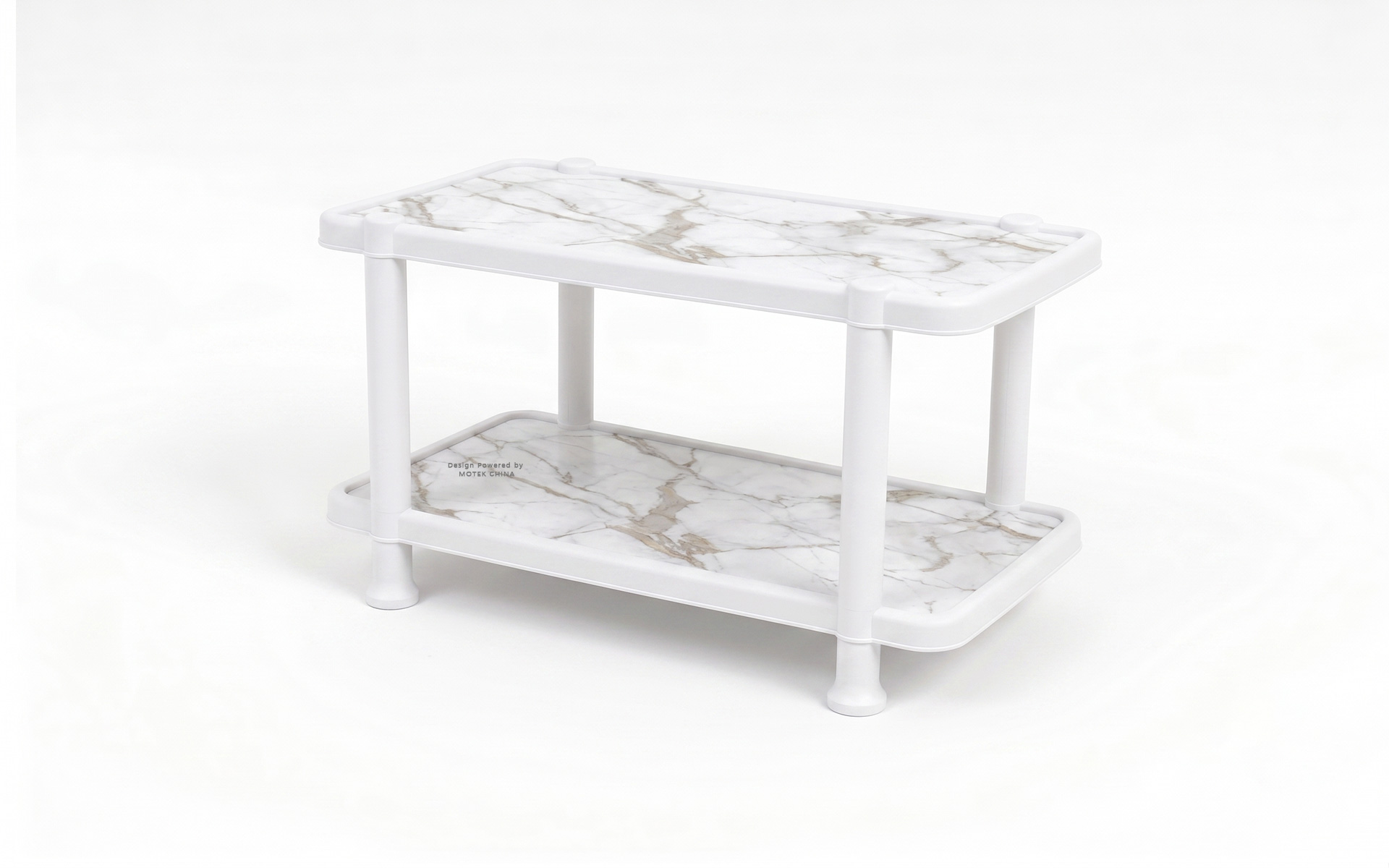
Outdoor plastic tables and chairs have one fundamental difference from storage containers and flower pots: large surface area, large flat surfaces. A tabletop might be 60cm × 120cm, a seat surface 40cm × 40cm – the label coverage area can be several times or even dozens of times larger than that of a storage container.
The larger the area, the greater the difficulty of IML (In-Mold Labeling).
For ordinary small containers, the label is only palm-sized, and even if there are minor process deviations, wrinkles and bubbles are not very noticeable. But for outdoor tables and chairs, the label is "large-format" – any tiny defect will be magnified. A tiny wrinkle on the label could be a conspicuous "scar" on the tabletop; a pinhole-sized bubble could become an obvious blister under light.
For large-area IML labeling on thickened outdoor tables and chairs, label wrinkling and bubbling are the two most common injection molding defects. This article systematically explains the key points for avoiding production issues in large-area in-mold labeling from four dimensions: label stiffness, mold venting design, injection pressure, and robotic label placement position.
📖 Table of Contents
- 1. Why Is Large-Area IML More Prone to Problems?
- 2. Label Stiffness – Choosing the Right Thickness Is the First Defense Line
- 3. Mold Venting Design – The Natural Enemy of Bubbles
- 4. Injection Pressure and Speed – The Power of Gentleness
- 5. Robotic Label Placement Position – A Millimeter Off Leads to a Thousand Miles of Error
- 6. FAQ
1. Why Is Large-Area IML More Prone to Problems?
Before understanding the specific avoidance methods, it is essential to clarify a fundamental question: why does larger area make IML more difficult?
First, a larger area for trapped air. If air remains between the label and the mold cavity wall, it gets compressed during injection and forms bubbles or blisters on the label surface after molding. A small label with a little trapped air might just show a tiny spot; a large label with trapped air could cause an entire area to bulge.
Second, a longer melt flow path. During injection, the molten plastic enters the cavity from the gate and must flow across the entire back of the label. The longer the flow path, the more severe the temperature and pressure drop at the melt front, and the higher the risk of uneven flow – excessive or insufficient localized pressure can both cause label wrinkling.
Third, greater label self-weight. Large-area labels have significant weight. If stiffness is insufficient, the label tends to curl, sag, or deform during robotic transfer and placement into the mold. Once the label is not flat when placed in the mold, wrinkling is inevitable after injection.
Fourth, greater challenges for electrostatic adsorption. IML injection molding generally uses electrostatic label attraction – because injection pressure is high, vacuum suction can easily be broken through. But large-area labels require stronger electrostatic adsorption to adhere firmly to the mold cavity wall. If electrostatic adsorption is insufficient, the label is highly prone to shifting and wrinkling under the high-pressure, high-temperature impact of injection.
With these fundamental reasons understood, the avoidance points for the four dimensions below become much clearer.
2. Label Stiffness – Choosing the Right Thickness Is the First Defense Line
2.1 Insufficient Stiffness Causes the Label to Be "Limp"
Label stiffness, simply put, is the label's resistance to bending. The higher the stiffness, the "stiffer" the label; the lower the stiffness, the "limper" the label.
Among IML label materials, PP (polypropylene) offers the highest stiffness, while PE is the most flexible. For large-area outdoor table and chair labels, PP is the first choice – it keeps the label flat during robotic transfer and in the mold, resisting curling and deformation.
Blow-molding labels generally have higher stiffness, with embossed or matte surfaces on the back to facilitate air evacuation. But injection-molding labels, due to high injection pressure, do not require back embossing – air can be evacuated through electrostatic adsorption. Large-area labels follow the same principle – choose high-stiffness PP film with electrostatic adsorption to keep the label flat against the cavity wall before injection.
2.2 Thickness Recommendations for Large-Area Labels
IML label thickness typically ranges from 50 to 400 microns (μm). For large-area outdoor table and chair labels, 100-150μm thicker specifications are recommended.
Why do large-area labels need to be thicker?
- Anti-curling: thicker labels have higher stiffness, resisting curling and sagging during robotic transfer and placement
- Anti-stretching: thicker labels resist deformation from the impact force of molten plastic during injection
- Anti-wrinkling: thicker labels stay flatter in the mold, reducing wrinkling risk
Special note: thickened outdoor tables and chairs typically have greater wall thickness (3-5mm or more), requiring longer filling pressure and holding pressure during injection. Thicker labels better withstand these process conditions and are less likely to be displaced or wrinkled.
Film size control is equally critical. Generally, the film size should be 0.02-0.03mm smaller per side than the final part size. This ensures the film can be easily placed into the cavity while also fully expanding during injection.
3. Mold Venting Design – The Natural Enemy of Bubbles
3.1 Large-Area Labels Have a Higher Risk of "Trapped Air"
Bubbles (blisters) are one of the most common defects in IML labels. The trapped-air risk for large-area labels is much higher than for small labels – because the contact area between the label and the mold wall is larger, making trapped air harder to evacuate completely.
If the mold venting system is not properly designed, air gets compressed between the label and the mold wall during injection, forming raised circular bubbles or blisters on the label surface after molding. For large flat products like outdoor tables and chairs, bubbles severely affect product appearance quality and brand image.
3.2 Three Practical Key Points for Venting Design
Key Point 1: Venting must be smoother than for ordinary molds
Because the film covers the mold cavity surface, IML mold venting must be smoother than for ordinary molds. The depth, width, and position of vents must be specifically designed – you cannot simply copy the venting scheme of a standard injection mold.
Key Point 2: Use insert gaps for venting
The core should be assembled from multiple inserts wherever possible, using the gaps between inserts for venting, with the bottom of the inserts as hollow as possible. This design provides more air evacuation channels, particularly suitable for large flat products.
Key Point 3: Focus on film edges and corners
Vents must be placed at film edges, corners, rib areas, and other locations where air is most likely to be trapped. For large-area flat labels on outdoor tables and chairs, label edges and four corners are the critical areas for venting – these are the most likely spots for trapped air and bubbles.
4. Injection Pressure and Speed – The Power of Gentleness
4.1 Large-Area Labels Cannot Withstand "Violent Injection"
Injection pressure and speed are key factors affecting IML label quality. For large-area labels, "gentleness" is more important than "violence."
Uneven pressure causes wrinkling: if pressure distribution is uneven during injection, the label surface receives uneven stress, causing wrinkles.
Excessive speed can displace the label: if injection speed is too fast, the high-speed molten plastic impacts the label surface, potentially shifting or wrinkling the label.
Excessive slowness causes incomplete filling: if injection speed is too slow, the melt cools before reaching the end of the cavity, resulting in incomplete filling and insufficient bonding between the label and substrate.
4.2 Recommended Injection Strategy
Use multi-stage injection control
IML injection is recommended to use multi-stage control:
- First stage: slow low speed – let the plastic contact the film edge first and advance smoothly, preventing the film from being displaced
- Second stage: medium speed filling – ensure smooth melt flow, with the melt evenly covering the back of the label
- Third stage: low speed to holding pressure – avoid excessive holding pressure that causes edge compression whitening or wrinkling
Holding pressure should not be too high
Excessive holding pressure can compress and deform the label. Holding pressure should be set just enough to prevent product shrinkage and ensure dimensional stability – do not blindly increase pressure to "fill more."
Temperature slightly lower than ordinary injection
Temperature settings should be based on the plastic material, recommended to be 5-10°C lower than ordinary injection to prevent high temperatures from damaging the ink, causing yellowing or ink wash-off.
Sufficient cooling time
Cooling time must be sufficient to ensure the product solidifies before mold opening, preventing the film from being pulled and deformed during ejection.
5. Robotic Label Placement Position – A Millimeter Off Leads to a Thousand Miles of Error
5.1 Large-Area Labels Require Higher Positioning Accuracy
In IML production, the robot is responsible for taking labels from the magazine and precisely placing them into the mold cavity. For small labels, a 1-2mm position deviation might be acceptable; but for large-area labels, a 1mm deviation can cause pattern misalignment, exposed white edges, or even label interference with the mold causing wrinkling.
Label transfer from robot to mold must be accurate to within 0.4mm. Large-area labels require positioning accuracy that is at least as high.
5.2 Key Control Points for Label Placement Position
Positioning accuracy control
The robot must ensure the label is placed in the correct position. It is recommended to use dual-axis servo robots combined with vacuum adsorption and electrostatic systems to achieve precise label alignment and positioning.
For large-area outdoor table and chair labels, high-load servo robot systems are recommended, capable of three-axis movement at high speed and ultra-high precision. Large-area labels are heavier, and ordinary robots may not have enough capacity or positioning accuracy.
Electrostatic adsorption assisted positioning
During robot placement, applying static electricity to the back of the label through electrostatic generators and discharge needles improves adhesion precision and achieves accurate positioning without shifting.
Regular calibration
Over time, minor positional deviations can develop between the robot and the mold, requiring regular calibration. Especially for large-area labels, even a 0.5mm deviation can cause quality issues.
6. FAQ
100-150μm PP film labels are recommended. Too thin (e.g., 50-70μm) lacks stiffness and is prone to curling during robotic transfer and in the mold; too thick (e.g., over 200μm) may increase injection difficulty. 100-150μm is the "sweet spot" balancing stiffness and processability.
Check electrostatic adsorption first. If electrostatic adsorption is insufficient, the label cannot firmly adhere to the mold cavity wall and is highly prone to shifting and wrinkling under high-pressure, high-temperature injection impact. Next, check if injection temperature is too high or too low, and whether injection pressure is uniform.
Over 90% of bubbles are caused by poor mold venting. Check if vents are clear, with special attention to label edges and four corners. IML mold venting must be smoother than ordinary molds. Also check if electrostatic adsorption is properly applied – if the label does not adhere tightly to the mold wall, air is likely to be trapped.
Significantly. Excessive injection speed causes high melt impact force that can displace or wrinkle the label; insufficient speed causes the melt to cool before reaching the cavity end, resulting in incomplete filling. Multi-stage injection control is recommended – slow start, medium-speed filling, slow holding pressure.
It requires higher positioning accuracy and greater load capacity. Dual-axis servo robots are recommended, with positioning accuracy within 0.4mm. Large-area labels have significant self-weight, so high-load servo robot systems are recommended.
Two main reasons: first, poor mold venting – air gets compressed between the label and mold wall; second, insufficient electrostatic adsorption – the label does not adhere tightly to the mold wall, leaving trapped air. Large-area labels amplify the risk of both issues.
The film size should be 0.02-0.03mm smaller per side than the final part size. This ensures the film can be easily placed into the cavity while also fully expanding during injection.
Contact Us
Name*
Telephone*
Region*
Please fill in your request*


