
Dark Plastic Drawer Panels – Key Design Points for IML Label White Base Layer, Solving Issues of Blurry Text and Dull Colors
Dark Plastic Drawer Panels – Key Design Points for IML Label White Base Layer, Solving Issues of Blurry Text and Dull Colors
On dark drawer panels, the biggest challenge with IML labels has never been "whether it can be printed"—it's whether the colors are right and the text is clear after printing.
The same colorful pattern, when printed on a white panel, appears vibrant and saturated. On a dark panel, it immediately looks "two shades darker." This is not an ink issue—it's a base layer issue.
For IML labels on dark substrates, a white base layer (white ink underlay) is a mandatory design step. But how much white base to apply, where to apply it, and where not to—every decision directly affects the final product's appearance and yield rate.
📖 Table of Contents
- 1. Why Must a White Base Layer Be Used on Dark Substrates?
- 2. White Base Coverage Range – How Much? Where?
- 3. Registration Accuracy – The "Alignment" Logic Between White Base and Color
- 4. Design Taboos for Gradient Backgrounds
- 5. Three Major Risks of Large-Area Thick White Base and How to Avoid Them
- 6. FAQ
1. Why Must a White Base Layer Be Used on Dark Substrates?
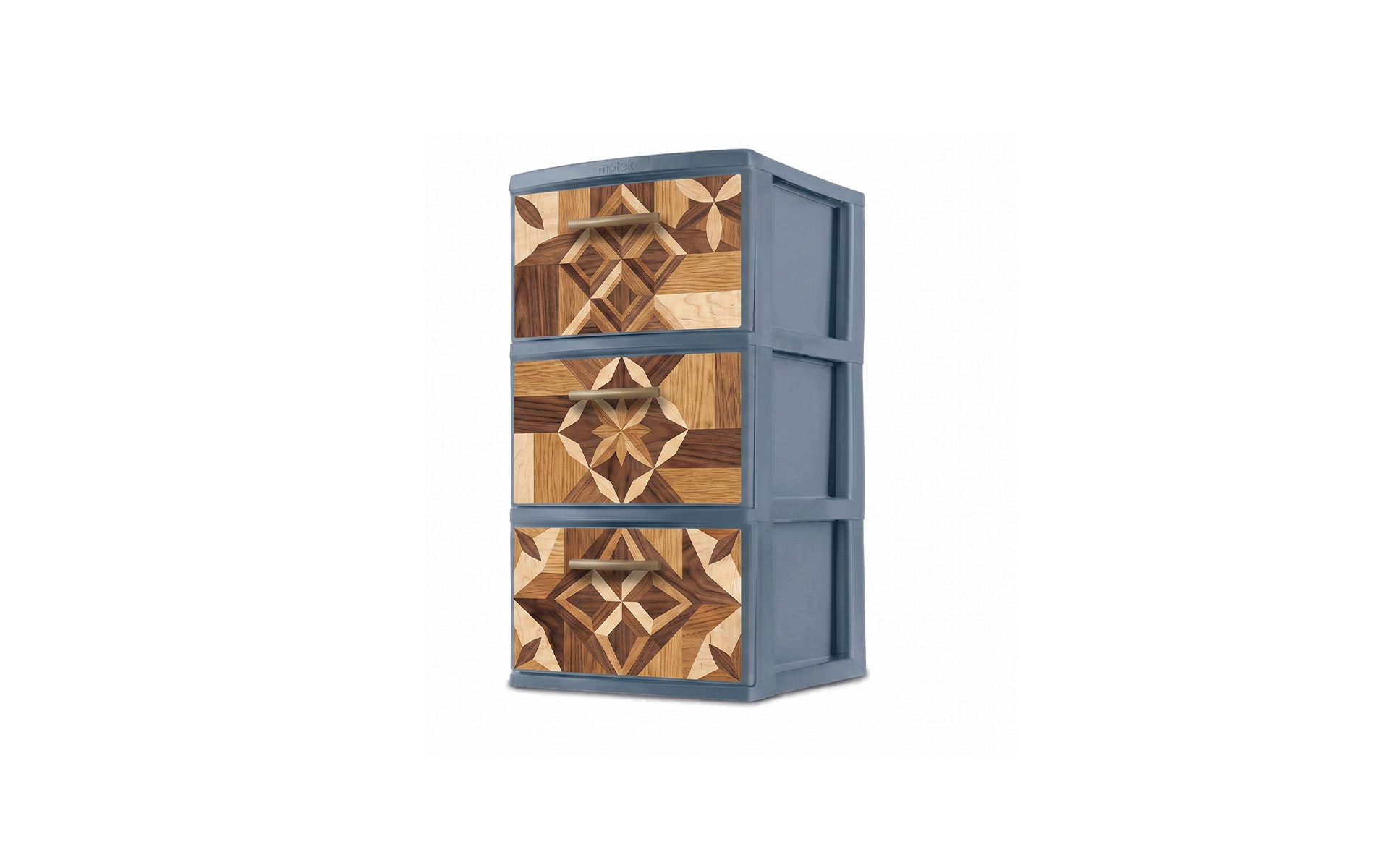
IML label inks are printed on the inside of the transparent film. The final color appearance is the ink seen through the film, over the plastic substrate's background color. If the substrate is dark (black, dark grey, dark brown, dark blue, etc.), light-colored and vivid inks will be "absorbed" by the dark background—the brightness and saturation of the colors will decrease significantly.
This is like painting watercolors on dark paper—no matter how vivid the paint, it looks dark.
The essence of a white base layer is to "lay a sheet of white paper" between the dark substrate and the color inks. White ink underlay ensures color fidelity on the substrate surface, allowing the color inks to express themselves without interference from the substrate color. White ink is used to improve adhesion and opacity—it "covers" the dark substrate, allowing the color inks to appear on a clean white base.
On dark drawer panels, a white base layer is not optional—it's mandatory.
2. White Base Coverage Range – How Much? Where?
White base coverage range is the most error-prone aspect of IML design on dark substrates. Too much coverage risks defects; too little coverage is insufficient.
2.1 Full Coverage vs. Partial Coverage
Full coverage: A full layer of white is laid down underneath the entire label printing area. Suitable for designs with large-area color patterns, vibrant brand colors, or patterns containing photographs, product images, or other elements requiring high color fidelity.
Partial coverage: White ink is applied only directly beneath the color patterns, while other areas (such as transparent or semi-transparent effect areas) remain without white. Suitable for designs where certain areas need to retain the substrate's texture, or where intentional blank spaces are part of the design.
Recommended strategy for dark drawer panels: If the drawer panel itself is dark and the label design contains large-area color patterns or a brand Logo requiring precise color reproduction, full coverage with local adjustments is recommended—full white coverage ensures a unified color benchmark across the entire design, while localized adjustment of white ink thickness controls coverage effects in different areas.
2.2 Which Areas Must Be Covered with White?
Areas that must be covered with white:
- Directly beneath all color patterns
- Brand Logo areas (especially Logos containing light or bright colors)
- Text areas (white or light-colored text)
- The starting end of gradient areas
Areas that can remain without white:
- Transparent decorative areas at the label edges
- "Transparent" areas intentionally designed to retain the substrate's texture
A critical reminder: The design file must establish an independent white ink layer and clearly indicate it. Do not attempt to "include white" as an afterthought in the color layer—IML production requires a clear white ink channel for precise execution.
3. Registration Accuracy – The "Alignment" Logic Between White Base and Color
White base is not simply "lay down white first, then print color on top"—in the IML process, the white ink layer and the color ink layer are completed through registration in the same printing workflow. The registration accuracy between the white base and the color directly determines whether pattern edges are crisp.
3.1 Consequences of Registration Deviation
If the white ink layer and the color ink layer are misaligned:
- White edges appear around patterns—a thin white line appears beside the color pattern, like a white outline
- Blurry text—the color ink at the text edges does not fully cover the white base, appearing "fuzzy"
- Color block shifting—the boundaries of large color blocks are blurred, and the overall pattern looks "muddy"
3.2 Industry Standards for Registration Accuracy
According to industry standard BB/T 0053-2023 "In-Mold Labels", there are clear technical requirements for IML label registration tolerances. The accuracy of robotic label placement into the mold is generally required to be within ±0.2mm.
In actual production, excellent IML suppliers can control registration accuracy within ±0.15mm—no color shift is visible to the naked eye, and the edges between the white base and color are clean and sharp.
3.3 How Design Can Support Registration Accuracy
Design recommendations:
- In the white ink layer, fill areas requiring white ink with K100 (pure black indicates "white ink required here")
- Reserve 0.1-0.2mm of overprint allowance between the color layer and the white ink layer to prevent white gaps caused by registration deviation
- Avoid designing extremely fine color lines (less than 0.15mm) at the edges of the white base—registration deviation will cause the lines to "break"
4. Design Taboos for Gradient Backgrounds
Gradient effects are common in IML labels, but when the substrate is dark, there are clear taboos in gradient design.
4.1 Taboo 1: Direct Gradient from Color to "Transparent"
Many designers are accustomed to creating a gradient from color to "transparent" at the edges of color patterns—allowing the pattern to fade out naturally. On a white substrate, this design works. But on a dark substrate, a color gradient to "transparent" results in: the color directly fading into the dark substrate color.
What should be a soft fade becomes an abrupt dark ending, and the entire gradient effect is ruined.
Solution: Use a white ink gradient in the gradient area—white ink from 100% to 0%, while the color ink remains constant throughout the gradient area. This way, the color fades to "white disappearing," not to "dark appearing."
4.2 Taboo 2: Light-to-Dark Gradients Without White Base Support
If the label design includes a gradient from light to dark, on a dark substrate, the color reproduction in the light areas depends entirely on the opacity of the white base. If the white base thickness or coverage is insufficient in the light areas, the light portions will directly "sink" into the dark substrate.
Solution: In the light gradient areas, ensure the white ink layer thickness meets requirements, and if necessary, increase the number of white ink layers (double white ink) in the light areas.
4.3 Taboo 3: Transparent Colors Overlaid on Dark Substrates
Certain special effects in IML labels (such as transparent colors, semi-transparent pearlescent effects) will completely disappear or change color on dark substrates. Transparent colors on a dark background appear completely different from how they appear on a white base.
Solution: All areas requiring color retention must have a white base underneath. Do not attempt to use transparent effects to "reveal" the dark substrate color—the result will not be what you expect.
5. Three Major Risks of Large-Area Thick White Base and How to Avoid Them
While a white base is necessary, large-area, high-thickness white ink layers themselves can create problems.
5.1 Risk 1: Bubbles
The thicker the white ink layer, the more solvent and additives volatilize under the high heat of injection molding. If the volatilized gases cannot be properly evacuated, bubbles will form between the label and the substrate.
Bubbles on dark substrates are more noticeable than on light substrates—bubbles on light-colored panels may be subtle under light, while bubbles on dark panels will "jump" out immediately.
Prevention solutions:
- Control the total thickness of the white ink layer to avoid excessive stacking
- Optimize the mold's venting system to ensure gases can be properly evacuated during injection
- Use layered printing when necessary—print a thin first layer of white ink and dry it, then print a second layer, rather than printing too thick in one pass
5.2 Risk 2: Wrinkles
An excessively thick white ink layer reduces the label film's flexibility. During injection molding, the film needs to deform slightly as the molten plastic flows. If the white ink layer is too hard and too thick, the film cannot deform properly, resulting in wrinkles.
Prevention solutions:
- Keep the white ink layer thickness as minimal as possible while meeting opacity requirements
- Choose label materials with shrinkage rates that match the substrate
- Optimize injection molding process parameters to reduce tensile stress on the label
5.3 Risk 3: White Edge Exposure
The edges of IML parts are exposed—the label and the panel fuse during injection molding, but a very fine line of substrate color will be visible at the label edge. Industry standards allow within 0.1mm of exposed edge.
On dark panels, if the white ink layer does not fully extend to the label edge, what is exposed is not the dark substrate but the white of the white ink layer—creating a conspicuous white edge against the dark panel, which is very jarring.
Prevention solutions:
- The white ink layer must extend to the bleed area—the white ink layer in the design file should fill the entire working area (including bleed)
- Apply an R0.1 radius at the label edge to use the curved surface to visually blur the exposed edge
- If any exposed edge is unacceptable, design a decorative line or color block around the edge to "conceal" it
6. FAQ
Yes. Dark substrates will "absorb" the brightness and saturation of color inks. A white base layer is a necessary design step to ensure color fidelity. On dark panels, a white base layer is not optional—it's mandatory.
If the label contains large-area color patterns or a brand Logo requiring precise color reproduction, full coverage is recommended—lay down a white ink layer across the entire printing area. If certain areas need to retain the substrate's texture or transparency effects, you can establish an independent white ink layer in the design file for partial coverage.
Yes. The white ink layer should fill the entire working area (including bleed). This prevents white gaps between the white base edge and the color pattern caused by die-cutting deviation.
When the white ink layer is too thick, solvents in the ink volatilize under injection molding heat. If the mold venting system is inadequate, trapped gases will form bubbles. Controlling white ink layer thickness and optimizing the mold venting system can prevent this issue.
Industry standards generally require robotic label placement accuracy within ±0.2mm. Excellent IML suppliers can control registration accuracy within ±0.15mm—no color shift is visible to the naked eye.
Avoid direct gradients from color to "transparent"—on dark substrates, this equals fading to dark. Instead, use a white ink gradient in the gradient area (white ink from 100% to 0%), allowing the color to fade out naturally on white support rather than directly "sinking" into the dark.
IML part edges allow within 0.1mm of exposed edge. On dark panels, the exposed white edge will be more noticeable. It is recommended to extend the white ink to the bleed area, or apply an R0.1 radius at the edge to visually blur the exposed edge effect.
Contact Us
Name*
Telephone*
Region*
Please fill in your request*


