
Reusable "Fashion Item" – How IML Makes Cold Drink Cups More Than Single‑Use?
Reusable "Fashion Items" – How IML Makes Cold Drink Cups More Than Single-Use?
More and more consumers are turning away from single-use cups and embracing reusable alternatives. From music festivals to daily coffee runs, the shift toward sustainability is reshaping how we drink on the go.
But reusability brings new challenges: how do you keep a cup looking fresh after hundreds of washes? How do you maintain brand visibility without compromising recyclability? And how can a simple cup become a tool for consumer engagement?
The answer lies in IML (In-Mold Labeling) – a technology that turns cold drink cups from disposable consumables into durable, stylish, and intelligent "fashion items" that consumers love to use again and again.
Table of Contents
- 1. Introduction: From "Use and Toss" to "Treasure"
- 2. What Is IML? – Embedding the Label into the Cup
- 3. What Makes IML Cold Drink Cups So Durable? – Four Core Properties
- 4. Beyond Durability – IML Turns Cold Drink Cups into Fashion Items
- 5. Eco-Friendly DNA – A Design for Recyclability
- 6. Real-World Cases: From Music Festivals to Your Table
- 7. FAQ: Common Questions About IML Cold Drink Cups
- 8. About the IML Industry and Leading Companies
1. Introduction: From "Use and Toss" to "Treasure"
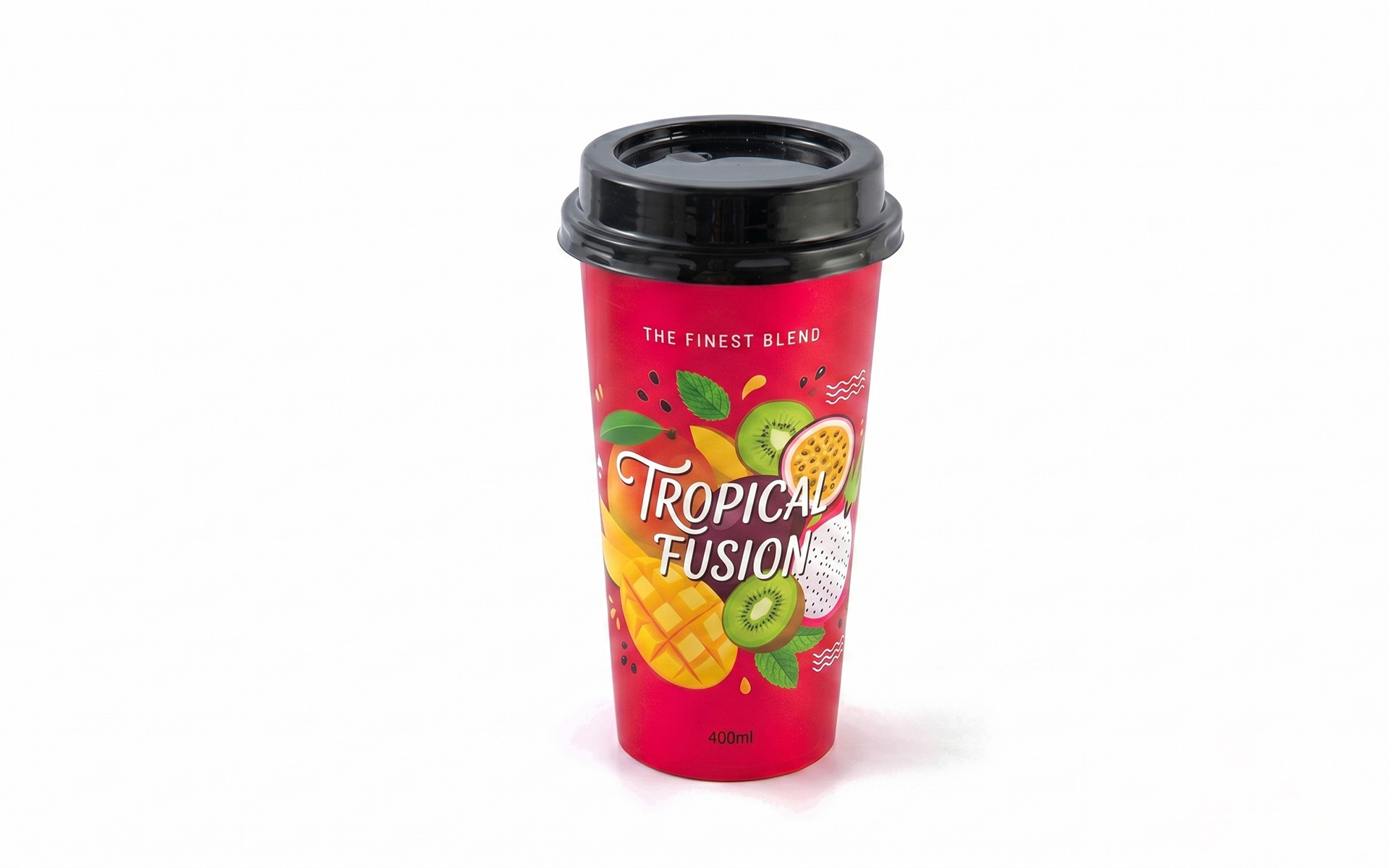
Walking down the street, buying an iced Americano or fruit tea, and tossing the cup into the trash after finishing – this is almost daily life for many. Globally, tens of billions of single-use cold drink cups are generated every year, with the vast majority ending up in landfills or the ocean.
But change is happening. More and more consumers are seeking reusable drink cups – from shared cups at music festivals to personal tumblers at coffee shops – a "plastic reduction revolution" is quietly underway. At the heart of this revolution, a technology called IML (In-Mold Labeling) is transforming cold drink cups from "disposable consumables" into reusable "fashion items."
2. What Is IML? – Embedding the Label into the Cup
To understand why IML cold drink cups are so durable, we first need to understand what IML actually stands for.
IML stands for In-Mold Labeling. Its core process is ingenious: a pre-printed label is placed into an injection mold, fixed by vacuum or electrostatic adsorption against the mold wall, and then molten plastic resin is injected. Under high temperature and high pressure, the label fuses with the plastic cup body in a single step.
To put it simply: traditional labeling is like applying a temporary tattoo to the cup – it will peel and wear over time. IML is like tattooing the design into the cup's skin – the label and cup are one, inseparable.
Because the label and container fuse during the molding process, IML cold drink cups do not suffer from label edge-lifting, peeling, or detachment. Even after repeated washing and long-term use, they maintain a fresh, new appearance.
3. What Makes IML Cold Drink Cups So Durable? – Four Core Properties
3.1 Water and Moisture Resistance
IML labels are made primarily from film and plastic materials, which are inherently water-resistant and moisture-proof. Traditional paper labels bubble, wrinkle, and peel when exposed to water, but IML labels are completely unaffected – even when the cup is filled with ice water, the label remains perfect.
3.2 Scratch and Abrasion Resistance
After the label is embedded into the container wall, it forms a unified, strong structure with the cup body. More importantly, IML labels can increase the side-wall crush strength of the container by about 20%. Not only is the design scratch-resistant, but the cup itself is also sturdier. For reusable applications, Laminated IML adds a protective film over the label, providing even greater abrasion and scratch resistance.
3.3 Color Fade Resistance
Ordinary prints fade after a few washes, but IML cold drink cups maintain vibrant colors even after repeated washings – a crucial feature for cups intended to be used hundreds of times. Reverse IML, which sandwiches the printing layer between the film and the container, further enhances fade resistance.
3.4 Edge-Lift Prevention
This is IML's most visible advantage: the label is fused with the cup body, edges are invisible, and it never lifts, peels, or curls. No more worries about a protruding label edge poking your lips while drinking.
4. Beyond Durability – IML Turns Cold Drink Cups into Fashion Items
If durability were all, IML would not be so remarkable. What truly sets IML cold drink cups apart is their ability to combine practicality with aesthetics.
4.1 Cold Foil: Metallic Look for High-Impact Visuals
Reusable IML cold drink cups can integrate cold foil elements, achieving striking metallic visual effects. In the 2025 IMDA (In-Mold Decorating Association) Awards, a reusable drinking cup with cold foil IML labels won an award. While cold foil printing on curved surfaces presents technical challenges, the result is spectacular when achieved.
4.2 Multiple Tactile Options
IML labels offer a variety of tactile and visual finishes:
- Soft Touch – fine, skin-like texture
- Frosted Look – understated elegance
- UltraGloss Look – dazzling, high-shine
4.3 Smart Interactivity: RFID Chips and QR Codes
IML cold drink cups can also embed RFID chips or QR codes, turning an ordinary cup into a smart terminal.
- RFID chips help restaurants and event organizers track reusable cups for precise inventory management, achieving accuracy rates of up to 99%. Checkpoint has deployed IML RFID tags for a global fast-food giant in over 1,200 restaurants in France, enabling intelligent management of reusable tableware.
- QR codes / Digimarc barcodes allow consumers to scan for brand interactions, product information, and data collection. This gives cold drink cups a completely new digital engagement value.
From a "drinking tool" to a "fashion item" to a "smart terminal," IML enables a single cold drink cup to carry far more value than one might imagine.
5. Eco-Friendly DNA – A Design for Recyclability
Durability is just the first step; recyclability is the ultimate environmental key of IML cold drink cups.
5.1 Single-Material Design
IML cold drink cups use the same material for both the cup body and the label (typically polypropylene, PP). This means that during recycling, there is no need to separate the label from the cup – they are already one.
5.2 Industry Recognition
- The Association of Plastic Recyclers (APR) in the US recognises IML as the "preferred" labeling method for PP and HDPE packaging when compatible polymer labels are used.
- The World Packaging Organisation, in its "Traffic Light Rating System", classifies IML as green, i.e., "best case".
- RecyClass recycling guidelines explicitly state that IML is fully compatible with coloured PP recycling.
5.3 From "Use Once" to "Use 200 Times"
Take the case of Happy Cup Company: their IML cold drink cups are reusable up to 200 times. One cup used 200 times means 200 single-use cups are avoided. And when it eventually reaches the end of its life, the entire cup can be 100% recycled, becoming raw material for new cups.
This is true circular economy.
6. Real-World Cases: From Music Festivals to Your Table
6.1 Happy Cup Company: Cup-Sharing in Russia
Happy Cup Company in Russia focuses on "cup-sharing" – cups used at concerts, sports events, and music festivals are returned to vendors for reuse rather than discarded. They chose MCC Global IML's Reverse IML labels. These labels are printed on the reverse side of a transparent film, are dishwasher-safe, and scratch-resistant – perfectly meeting the requirements for reusable cups. The cups can be used 200 times without fading or losing their design.
"Besides decorative value, it is a cost-effective product because production and decoration are done in one step," the company noted.
6.2 IMDA Award Winner: Cold Foil Reusable Cup
In the 2025 IMDA Awards, label printer iPB Printing submitted a reusable drinking cup that won an award. It integrated cold foil elements, achieving a high-impact metallic look, while a laminated coating enhanced scratch resistance and durability. It proved that IML cold drink cups can be both rugged and luxurious.
6.3 Fast-Food Giant RFID Implementation
Checkpoint deployed IML RFID injection-moulded tags for a global fast-food chain across more than 1,200 restaurants in France. All reusable tableware carried RFID tags for real-time tracking and inventory visibility, significantly reducing loss rates.
7. FAQ: Common Questions About IML Cold Drink Cups
Yes, absolutely. IML labels use food-grade materials and can directly contact food and beverages. The IML process does not use chemical adhesives, eliminating the risk of chemical migration associated with traditional labels.
Yes. IML cold drink cups are designed for repeated washing. Technologies like Laminated IML and Reverse IML, specifically engineered for reusable scenarios, can withstand the high-pressure water jets and detergents of commercial dishwashers. Some products can even tolerate pasteurisation and sterilisation temperatures.
Typically, up to 200 times or more. For example, Happy Cup's products are designed for 200 uses. Churchill Container's entries can even withstand hundreds of dishwasher cycles.
Yes, it is fully recyclable. The cup body and label are made of the same material (usually PP), so no separation is needed during recycling. The entire cup can be shredded, regranulated, and turned into feedstock for new cups.
The initial cost is slightly higher, but the total life-cycle cost is lower. While the mould and process investment are greater, production and decoration are done in one step, eliminating post-mould labelling. More importantly, one cup used 200 times has a per-use cost far below that of single-use cups.
Yes, they support a high degree of customisation. IML allows up to 8 colours and high-precision, high-resolution graphics. However, IML requires moulds, so it is better suited for medium to high volumes. Small-batch needs may be met by other decoration methods like digital printing.
Some are. Although this article focuses on cold drink cups, IML technology can also be used for hot cups. Laminated IML can withstand high temperatures. Always check the specific product's temperature rating.
8. About the IML Industry and Leading Companies
IML Industry Overview
IML technology originated in Europe and is widely adopted there; a significant proportion of food packaging in Europe uses IML. Today, IML has expanded worldwide, covering food, beverages, personal care, pharmaceuticals, and more.
The IMDA (In-Mold Decorating Association) is a key industry organisation that hosts the annual IMDA Awards, recognising innovations in in-mold labelling, decorating, and electronics. The association has also published white papers on IML recyclability, providing authoritative sustainability guidance.
Leading Companies in the Field
MCC Global IML (MCC Verstraete) – A global leader in IML labels with extensive experience in reusable cups. They supply Reverse IML labels for Happy Cup Company and have launched the NextCycle IML series of recyclable labels. They are also a member of the New Plastics Economy Initiative.
Checkpoint – A leader in IML RFID injection-moulded tags, providing intelligent management solutions for reusable tableware in the global fast-food industry.
Greiner Packaging – Winner of the 2024 IMDA Award for "Best Use of IML", well-known for sustainable IML packaging.
Berry Global – Offers reusable cold and hot drink cup ranges with IML decoration and RFID/QR integration.
iPB Printing – 2025 IMDA Award winner for their cold-foil IML reusable drinking cup.
Churchill Container – Specialises in reusable IML cups, made from 100% post-consumer recycled PP resin.
Contact Us
Name*
Telephone*
Region*
Please fill in your request*


