
Industrial Returnable Containers Essential Knowledge: IML In-Mold Labels Resist Acids, Alkalis, and Alcohol Disinfection – Ideal for High-Frequency Factory Cleaning
Industrial Returnable Containers Essential Knowledge: IML In-Mold Labels Resist Acids, Alkalis, and Alcohol Disinfection – Ideal for High-Frequency Factory Cleaning
In the daily operations of factories, warehouses, and logistics centers, returnable containers are subjected to high-frequency use and cleaning. The workshop environment is harsh—oil stains, dust, chemical cleaners, and disinfectant alcohol all take their toll. Ordinary externally applied labels, under these conditions, will start to curl, turn white, fade, and peel off after just a few uses—barcodes become unreadable, brand logos become blurry, and batch information cannot be traced.
IML (In-Mold Labeling) labels, however, are specifically designed for such demanding scenarios.
📖 Table of Contents
1. First Understand: Why Can IML Labels "Withstand" Chemical Corrosion?
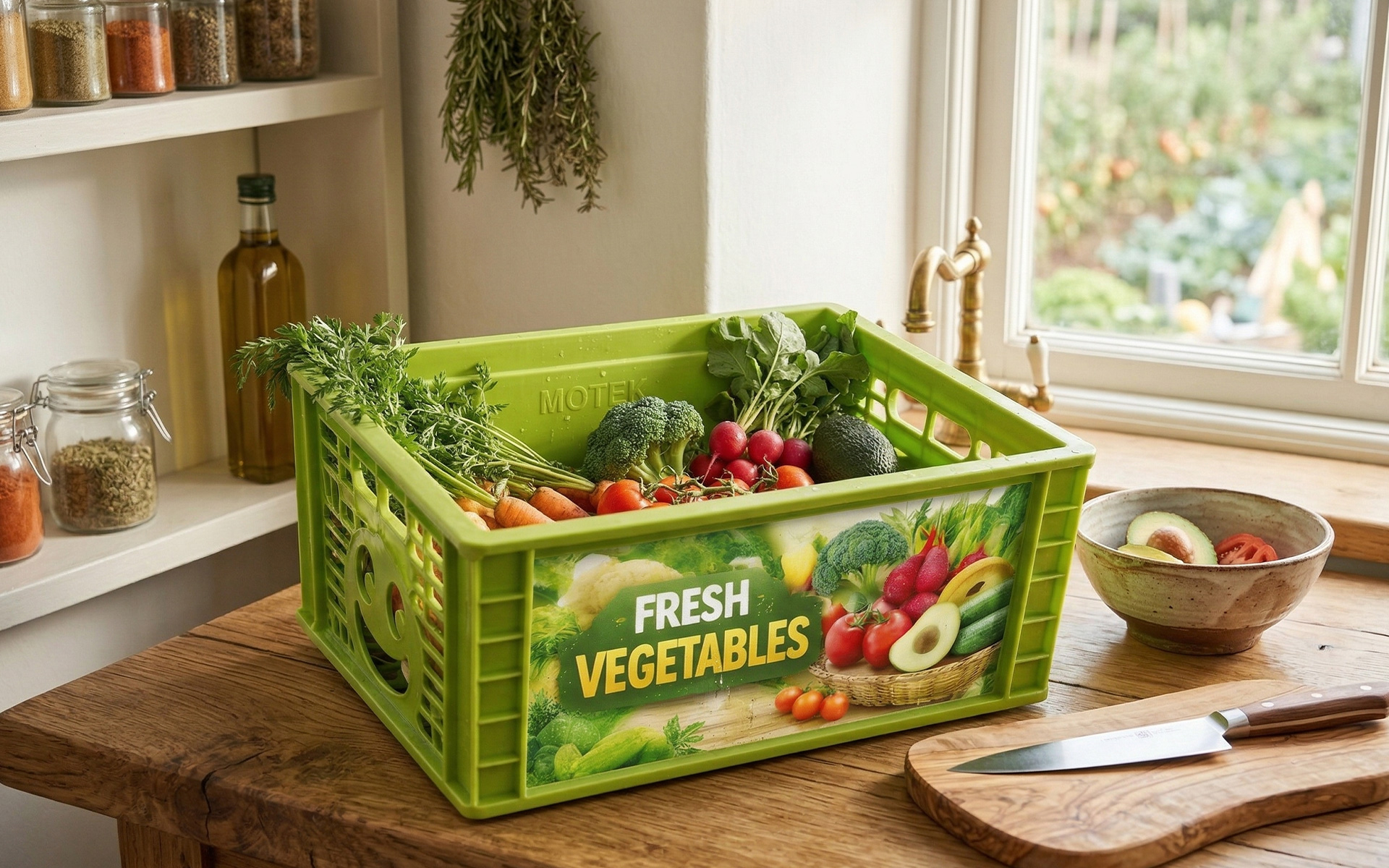
To understand why IML labels are not afraid of acids, alkalis, or alcohol, you first need to understand their structure.
Ordinary pressure-sensitive labels have ink exposed on the surface. Disinfectants, alcohol, and cleaning agents directly contact the ink layer—chemicals penetrate, causing the ink to fade, dissolve, and blur; the adhesive layer corrodes, causing the label to curl and peel.
IML labels are completely different. The ink is printed on the inside of the film and fuses with the plastic substrate during injection molding.
┌─────────────────────────────────────────────────────┐
│  Hardened transparent film (protective layer)        │  ← Directly contacts cleaners but will not corrode
├─────────────────────────────────────────────────────┤
│  Printed ink layer                                  │  ← Sandwiched in the middle; chemicals cannot reach it
├─────────────────────────────────────────────────────┤
│  Plastic substrate (fused with the container)        │  ← Never peels, never curls
└─────────────────────────────────────────────────────┘
The core logic of this structure is: chemicals must first penetrate the hardened transparent film before they can reach the ink. And the protective film of an IML label itself has excellent chemical resistance—it will not dissolve, corrode, or be penetrated.
After IML labels are bonded with the part during molding, there is no interface between the label and the plastic part—the label and the container are one piece, with no "edge gaps" for chemicals to seep into.
2. Which Specific Chemicals Can IML Labels Resist?
According to industry data and practical application results, IML labels can resist the following chemicals:
| Chemical Type | Resistance | Description |
|---|---|---|
| Acids | ⭐⭐⭐⭐⭐ | Acid and alkali resistant; not corroded |
| Alkalis | ⭐⭐⭐⭐⭐ | Acid and alkali resistant; not corroded |
| Alcohol / Isopropanol | ⭐⭐⭐⭐⭐ | Resists alcohol wiping; ink does not dissolve |
| Cleaners / Disinfectants | ⭐⭐⭐⭐⭐ | Can withstand repeated washing and wiping |
| Oils | ⭐⭐⭐⭐⭐ | Waterproof and oil-proof |
| Water / Moisture | ⭐⭐⭐⭐⭐ | Waterproof, mold-proof, moisture-proof |
IML labels themselves are waterproof, oil-proof, mold-proof, moisture-proof, abrasion-resistant, and acid/alkali-resistant. In applications such as chemical packaging containers, food containers, and appliance panels, where there is long-term exposure to water, oil, alcohol, or cleaning agents, externally applied labels tend to turn white and curl, while IML labels perform stably.
In actual testing, IML labels can withstand repeated exposure to industrial-grade high-pressure cleaning, chemicals, acids, and solvents without fading, corroding, or peeling.
3. Are There Standards for IML Label Chemical Resistance?
Yes. IML label chemical resistance is governed by clear industry standards.
BB/T 0053 "In-Mold Labels" is the core industry standard for IML labels. It specifies test methods for in-mold labels, including dimensional measurement, visual inspection, adhesion testing, temperature resistance testing, and chemical resistance testing. IML labels that pass this standard have reliable quality assurance for chemical corrosion resistance.
Additionally, IML labels can also be evaluated against international safety standards such as UL 969. In industrial environments, IML labels have also been proven suitable for glass-filled nylon and polycarbonate blends and other engineering plastics, expanding their application in durable goods and industrial settings.
In actual production, ink and coating performance must be tested both before and after molding, as the molding process itself may affect ink and coating performance.
4. IML Label Performance in High-Frequency Workshop Cleaning Scenarios
Workshop container cleaning typically includes the following steps:
- High-pressure water spray – removing surface dirt
- Alkaline cleaner soaking/wiping – removing oil and grease
- Acidic cleaner use – removing scale and rust
- Alcohol/disinfectant wiping – sterilization and disinfection
- High-temperature steam or hot water rinsing – deep cleaning
The "failure process" of ordinary externally applied labels:
External label → High-pressure water spray (edges curl) → Cleaner soaking (ink fades)
→ Alcohol wiping (ink dissolves) → High-temperature steam (adhesive fails) → Label peels off
The "survival process" of IML labels:
IML label → High-pressure water spray (surface unchanged) → Cleaner soaking (ink sealed, unaffected)
→ Alcohol wiping (pattern clear) → High-temperature steam (label and container integrated, immovable) → Still like new
IML labels form a permanent bond with the container, with a smooth, seamless surface. They can withstand stacking, transport, and repeated handling without damage. In high-sanitation environments such as the food and pharmaceutical industries, IML labels also perform exceptionally well.
Containers using IML labels, because the label and container are fused as one, are nearly impossible to peel, scratch, or damage.
5. FAQ
Yes, they really can. IML ink is sandwiched between the film and the plastic, not directly contacting organic solvents like alcohol. Alcohol wiping only contacts the surface hardened transparent film, never reaching the ink layer. In industrial environments, IML labels have been proven to resist repeated contact with alcohol, solvents, acids, and alkalis.
No. IML labels themselves are acid and alkali resistant. In applications such as chemical, food, and industrial settings where acidic and alkaline cleaners are frequently used, IML labels perform far better than ordinary labels.
Yes. IML labels are fused with the container as one piece, with no edge gaps for water pressure to "lift" the label. They can withstand high-pressure cleaning, repeated handling, and stacking without damage.
No. IML labels are fused with the plastic substrate during injection molding—they are not glued on. High-temperature steam does not damage the bonding strength of IML labels the way it damages adhesive layers. Labels can withstand the high-temperature, high-pressure injection molding process, and everyday steam cleaning is well within their tolerance range.
Check whether the supplier conducts chemical resistance testing in accordance with BB/T 0053 "In-Mold Labels" standard. Qualified IML label products will provide corresponding test reports.
Yes. Because the ink is sealed inside the film, the information on IML labels remains clearly readable throughout the entire life cycle of the product. This is crucial for industrial returnable containers that require traceability management.
Contact Us
Name*
Telephone*
Region*
Please fill in your request*


