
PET in IML: Clarity, Durability, and the Journey from Premium Niche to Mono‑Material Future
PET in IML: Clarity, Durability, and the Journey from Premium Niche to Mono‑Material Future
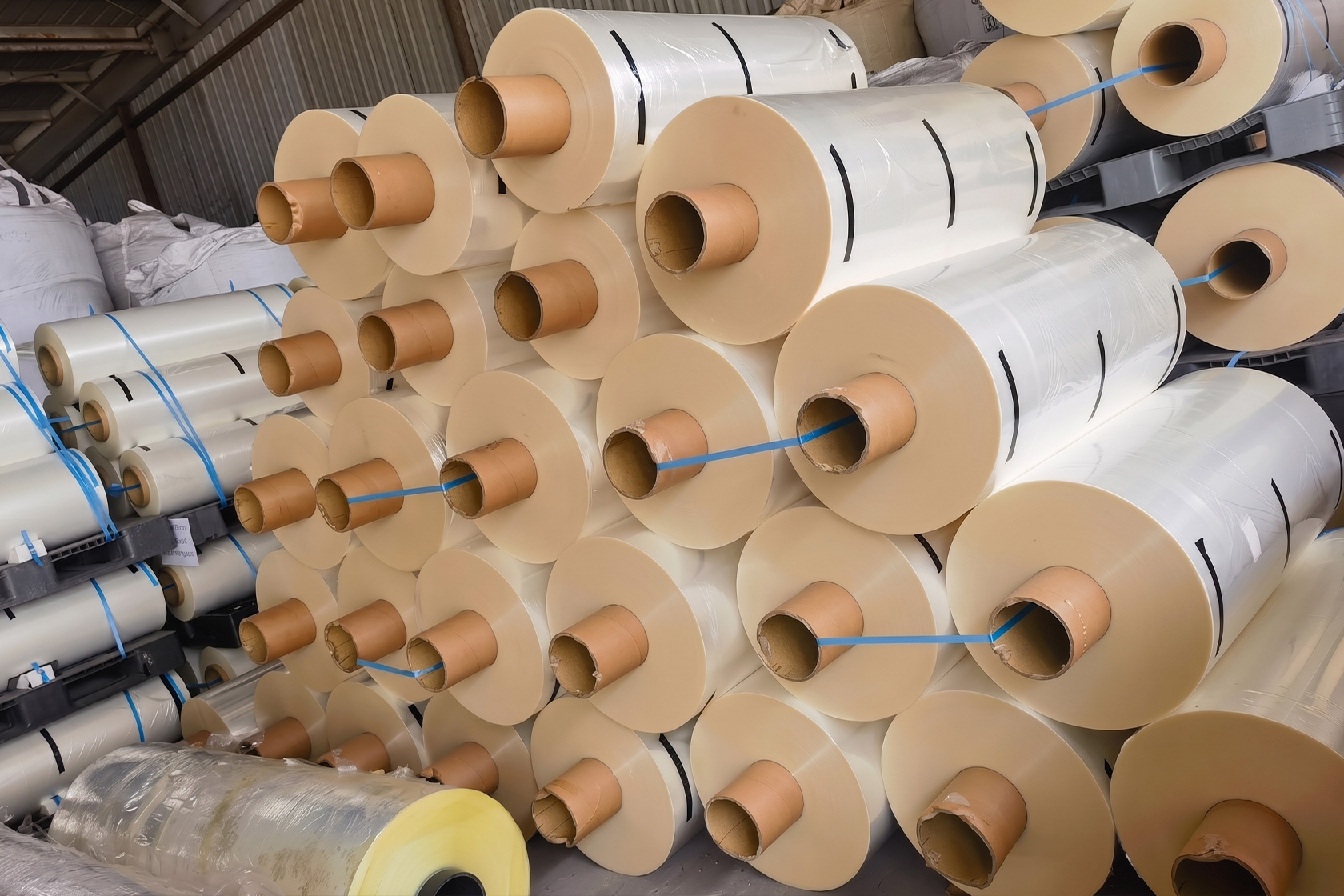
In the previous four articles, we introduced PE film, PP/BOPP film, PE+PP composite film, and specialty films (Primax, FasClear) in in‑mould labeling (IML), covering the mainstream material systems. However, when it comes to PET containers, the landscape shifts somewhat. PET containers—widely used for water bottles, edible oil bottles, cosmetic bottles, and pharmaceutical bottles—are highly transparent and glossy. Traditional polyolefin‑based IML labels (PP/PE) often face compatibility challenges with PET containers, and PET itself as a label substrate is gaining traction in specific IML applications, particularly injection‑moulded PET packaging [17†L4-L6].
1. Structure and Role of PET Film in IML
When used as an IML label substrate, PET film typically follows a three‑layer structure: a PET base layer (with a wear‑resistant protective coating on the surface), an ink layer, and an adhesive layer (a special hot‑melt adhesive) [15†L9-L11]. During injection moulding, the hot‑melt adhesive melts under high temperature, bonding the PET film permanently to the plastic container [10†L16-L18]. Notably, in IMD (In‑Mould Decoration) processes, PET is sometimes used as a carrier film where the film itself is stripped away after moulding – a “transfer” process distinctly different from IML, where the label remains fused with the container [15†L26-L28].
PET’s role in IML differs from that of polyolefin films:
PE/PP/PE+PP films target polyolefin containers (PE/PP) and pursue homogeneous recycling or performance balance;
PET film, by contrast, holds a clear advantage in injection‑moulded PET packaging (e.g., PET cups, food trays), enabling homogeneous bonding and fully recyclable all‑PET packaging;
For blow‑moulded PET bottles (e.g., water bottles), PET IML remains a premium niche market [12†L27-L31].
2. Key Advantages of PET Film in IML
2.1 High transparency and gloss – “no‑label look”
PET film offers extremely high transparency (light transmittance >90%) and gloss. When a PET label is fused to a PET container, the label edge is nearly invisible, creating excellent visual unity [16†L16-L19]. This “no‑label look” significantly elevates packaging grade, particularly for clear bottles in cosmetics and food applications.
2.2 High surface hardness – wear and scratch resistant
The surface of PET film is coated with a wear‑resistant protective layer, achieving a hardness of up to 3H, with a “the more you touch, the glossier it becomes” effect [9†L6-L7][15†L29-L30]. During shelf display, transportation, and daily use, the label resists scratching and remains pristine – significantly outperforming soft films such as PE.
2.3 Excellent mechanical properties and dimensional stability
PET film possesses the best toughness among all thermoplastic films, with tensile strength and impact resistance far exceeding those of conventional films [18†L12-L13]. During printing, die‑cutting, thermoforming, and injection moulding, PET film maintains stable dimensions, ensuring accurate registration.
2.4 Outstanding heat and chemical resistance
PET film operates over a wide temperature range (-40°C to +150°C, with short‑term resistance up to 150°C) and exhibits good resistance to acids, alkalis, oils, and solvents [18†L8-L10]. This makes PET IML labels particularly suitable for hot‑fill applications (e.g., hot‑fill beverages, sauces) or packaging that comes into contact with chemicals.
2.5 Homogeneous bonding with PET containers – enabling all‑PET recycling
PET labels and PET containers share the same material composition, providing good chemical similarity and strong bonding [16†L16-L19]. During recycling, PET labels can be crushed, washed, and pelletised together with the PET container – introducing no foreign materials and supporting mono‑material packaging design principles [19†L6-L8].
3. Technical Limitations and Challenges
3.1 Complex process for PET blow‑moulded IML – high equipment demands
PET containers are predominantly manufactured via Injection Stretch Blow Moulding (ISBM). To apply IML labels to blow‑moulded PET bottles, the label must be inserted into the mould simultaneously with the heated PET preform, requiring highly precise and stable robotic systems [12†L27-L31]. Due to process integration difficulties, PET blow‑moulded IML remains a “premium niche” market [8†L9-L12].
3.2 Shrinkage rate mismatch with PET blow‑moulding
PET undergoes biaxial orientation during blow moulding, and its shrinkage behaviour may differ from that of the IML film. If shrinkage rates are not properly matched, surface irregularities similar to the “orange peel effect” may occur. Material and process optimisation in this area is still ongoing.
3.3 Pre‑treatment required before printing
The surface energy of PET film is relatively low; corona treatment or an easy‑adhesion coating is often required before printing to ensure good ink adhesion [20†L22-L26]. This adds processing steps and costs.
3.4 Higher cost than conventional polyolefin labels
The raw material and processing costs of PET film are generally higher than those of PE and PP films. For large‑volume applications, the total cost of PET IML labels must be weighed against alternative labeling methods such as shrink sleeves or pressure‑sensitive labels. Currently, PET IML is positioned mainly in mid‑to‑high end packaging.
3.5 Lower toughness – potential brittleness
Compared to PE film, PET film offers higher stiffness but also exhibits some brittleness. Under significant bending or impact, PET labels may crack. Therefore, PET IML labels are better suited to regularly shaped containers with low mechanical stress.
4. Application Areas and Typical Scenarios
PET IML labels are primarily used for homogeneous bonding with PET containers, as well as for decorating injection‑moulded PET products. Typical applications include:
| Application Area | Typical Products | Rationale |
|---|---|---|
| Food packaging | Transparent PET cups, ice‑cream cups, PET food trays | High transparency blends with container; heat‑resistant for refrigeration and microwaving |
| Beverage packaging | Juice bottles, water bottles, carbonated drink bottles (ISBM‑IML) | Premium positioning, 360° decoration, homogeneous for recycling |
| Cosmetics / Personal care | Cream jars, serum bottles, cosmetic tubes | “No‑label look”, premium appearance; scratch‑resistant for long shelf life |
| Pharmaceuticals / Nutraceuticals | Pill bottles, supplement bottles, oral liquid bottles | Anti‑counterfeit; label‑container integration prevents tampering; chemical‑resistant |
| Premium spirits | Bottle labels for baijiu, vodka, etc. | Drives premiumisation; a key tool for “high‑end” PET packaging [8†L14-L17] |
| Industrial / Electronics | Battery casings, high‑temperature electronic part labels | Withstands -40 to +150°C; can survive oven curing and thermal ageing tests [18†L21-L23] |
5. Future Trends and Outlook
5.1 Continuous improvement of ISBM‑IML technology
With advances in robotic handling and mould design, the process integration challenges for PET blow‑moulded IML are gradually being overcome [8†L18-L24]. Equipment manufacturers are developing more precise and stable label insertion systems to improve productivity and yield.
5.2 Push for all‑PET mono‑material packaging
Under the plastics circular economy, all‑PET packaging (container + label + even closure) is becoming an important choice for premium brands [19†L12-L14]. PET IML labels, being homogeneous with the container, require no separation in the recycling stream, supporting high‑quality bottle‑to‑bottle recycling and meeting increasingly stringent eco‑design standards.
5.3 Development of wash‑off / removable PET label systems
To address label‑container separation challenges in PET bottle recycling, the industry is developing PET label systems with wash‑off coatings that can be removed in alkaline cleaning processes [19†L6-L8]. PET labels as a substrate, coated with specially formulated removable inks and functional coatings, can more efficiently shed label residues during recycling, improving rPET purity.
5.4 Multi‑functional surface finishes – high‑gloss / matte effects
Through surface coating optimisation, PET IML labels can achieve both localised high‑gloss and matte effects, offering greater creative freedom in packaging design [0†L23-L25]. Such multi‑layered visual effects are particularly popular in cosmetics and premium food packaging.
5.5 Expansion from premium niche to mid‑tier markets
As technology advances and costs decline, PET IML is gradually moving from premium niche applications into broader mid‑tier markets, particularly in the beverage and food packaging sectors.
Conclusion
PET film in in‑mould labeling represents a distinct technical pathway, positioned around homogeneous bonding with PET containers. Its high transparency delivers a “no‑label look”; 3H surface hardness ensures wear and scratch resistance; excellent mechanical and thermal properties satisfy demanding environmental conditions; and material homogeneity with PET containers supports fully recyclable all‑PET packaging.
However, challenges remain: the complexity of PET blow‑moulded IML, high equipment requirements, and precise shrinkage control still place it largely in the premium niche market. But with continuing advances in automation, moulding processes, and recyclability requirements, PET IML is poised to play an increasingly important role in beverage, food, cosmetics, and pharmaceutical packaging.
For brands seeking “transparency as design”, high durability, and environmental recyclability, PET IML represents a technology direction well worth watching – especially as all‑PET mono‑material packaging systems continue to mature.
Contact Us
Name*
Telephone*
Region*
Please fill in your request*


