
Flexographic Printing in In-Mold Labeling: Efficient, Eco-Friendly, Inline Integrated Mainstream Choice
Flexographic Printing in In-Mold Labeling: Efficient, Eco-Friendly, Inline Integrated Mainstream Choice
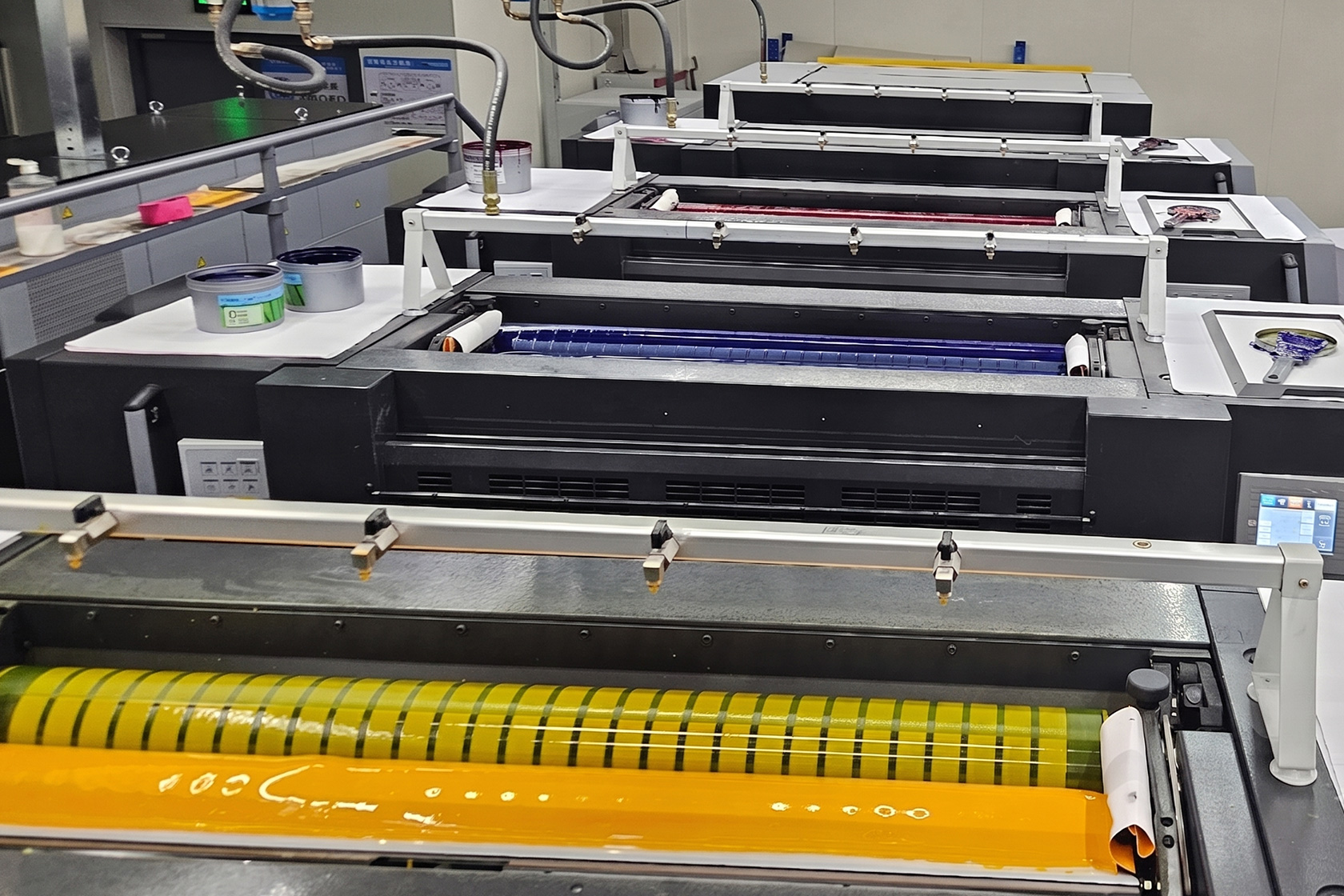
Among the printing methods for in-mold labeling (IML), flexographic printing (“flexo”) has become the mainstream process for industrial-scale IML production worldwide, thanks to its high efficiency, environmental friendliness, inline integration capability, and continuously improving print quality. For medium to large volumes, flexo achieves an optimal balance among cost, speed, and multi-function integration.
This article explains the technical principles of flexo printing and analyzes its process characteristics, core advantages, limitations, applications, and comparisons with other IML printing methods.
1. Technical Principle of Flexographic Printing
Flexographic printing is a direct relief printing method using flexible printing plates made of rubber or photosensitive resin. The image areas are raised, and the non-image areas are recessed. During printing, an anilox roller precisely transfers a metered amount of ink to the raised image areas of the plate, which then transfers the ink to the substrate (IML label film).
Printing process:
Ink is picked up from the ink pan by the anilox roller. A doctor blade removes excess ink from the anilox surface, leaving ink only in the tiny cells of the anilox roller.
The anilox roller contacts the flexible plate, transferring ink from its cells to the raised image areas.
The plate cylinder and impression cylinder work together to transfer the ink from the plate to the substrate surface.
The ink is dried (hot air, infrared, or UV curing), fixing it onto the film.
The key to flexo is the anilox roller – its cell volume (BCM – billion cubic microns per square inch) determines the ink transfer volume, affecting ink film thickness and color saturation. Modern flexo, combined with UV inks and high‑precision CDI (computer‑to‑plate) technology, achieves print quality approaching gravure.
2. Process Characteristics of Flexo for IML
2.1 Plate Making
Flexo plates are photosensitive resin plates or rubber plates, made using laser or UV exposure. Plate making costs are low, lead time short (1-3 days), and advanced technologies such as flat‑top dots and surface screening can be used to improve print quality. Plate life is moderate (several hundred thousand to one million impressions), suitable for medium to large runs.
2.2 Ink Systems
Two main ink types are used for IML flexo:
Water‑based flexo inks: Environmentally friendly, VOC‑free, suitable for food contact materials, but drying speed is slightly slower.
UV flexo inks: Instant curing, solvent‑free, bright colors, strong adhesion – becoming the mainstream choice for IML flexo.
Inks must have: heat resistance (no decomposition at 160-240°C), scratch resistance, good adhesion to PP/PE substrates, and flexibility (to withstand blow molding stretching).
2.3 Inline Integrated Production
One of the greatest advantages of flexo is the ability to achieve inline integrated production: a single flexo press can sequentially perform printing, varnishing (gloss/matte), cold foil stamping, adhesive coating, die‑cutting, waste removal, and rewinding or stacking into single labels. This “one pass, finished output” model significantly shortens production cycles, reduces labor costs, and minimizes work‑in‑process handling losses.
3. Core Advantages of Flexo for IML
3.1 High‑Efficiency Inline, Low Total Cost
Flexo presses typically run at 100-200 m/min. With inline finishing, from printed web to finished label can be completed on one machine. This eliminates separate offline processes required for gravure (such as separate coating and die‑cutting), significantly reducing labor and handling costs. For annual IML volumes of 500,000 to 5 million labels, flexo’s total unit cost is highly competitive.
3.2 Excellent Environmental Performance
Water‑based flexo inks contain almost no VOCs; UV flexo inks are 100% solids with no solvent emissions. The plate‑making process for flexo is also more environmentally friendly than gravure. Flexo meets increasingly stringent global packaging environmental regulations (e.g., EU PPWR, China GB standards).
3.3 Flexible Job Changeover, Suitable for Medium‑Volume Multi‑SKU
Flexo plate changeover is fast (typically 30-60 minutes) and plate costs are low, allowing more frequent job changes than gravure. For brand owners, this means the flexibility to handle multiple SKUs, seasonal promotions, and short‑run packaging needs.
3.4 Continuously Improving Print Quality
Modern flexo, combined with flat‑top dot technology and UV inks, can achieve screen rulings above 175 lpi, with greatly improved gradients and fine text reproduction. With register control systems, multi‑color registration accuracy can reach ±0.05 mm.
3.5 Suitable for a Wide Range of Substrates
Flexo is adaptable to many substrates – it can print on PE, BOPP, PET, paper, and other films without needing to re‑engrave cylinders for different materials as gravure would.
3.6 Integrable with Cold Foil Stamping
Flexo presses can easily be equipped with cold foil stamping units to create metallic effects on labels, enhancing product grade.
4. Limitations of Flexo for IML
4.1 Relatively Thin Ink Layer
Flexo’s ink layer thickness is typically 2-4 μm – only half to one‑third of gravure’s 5-15 μm. As a result, solid area saturation, opacity, and scratch resistance are slightly inferior to gravure. However, the gap is narrowing with high‑strength inks and anilox optimization.
4.2 Limits on Very Fine Dot Reproduction
Although greatly improved, flexo still lags slightly behind offset and gravure in reproducing very fine dots (below 1%) and extremely smooth gradients. For photographic‑grade images with the highest demands, careful evaluation is needed.
4.3 Limited Plate Life
Flexo plate life is typically 500,000 to 1 million impressions, whereas gravure cylinders can last several million impressions. For ultra‑long runs exceeding 10 million labels per year, flexo may require mid‑run plate changes, affecting production continuity.
4.4 Relatively High Initial Equipment Investment
High‑quality flexo presses (especially those with UV systems and inline finishing) require significant investment, though still lower than the cumulative plate‑making cost of gravure for long runs.
5. Typical Process Flow for Flexo‑Printed IML Labels
Design separation: Separate colors considering flexo characteristics; avoid overly small reverse‑type text and excessively fine lines.
Plate making: Produce flat‑top dot flexo plates using CDI laser technology.
Flexo printing: Print the label top layer on an inline flexo press (reverse printing possible).
Inline drying: Hot air or UV curing.
Inline coating / lamination: Apply protective varnish; then apply or laminate the heat‑seal adhesive layer (embossed or plain).
Inline die‑cutting and waste removal: Die‑cut the printed web into label shapes and remove waste.
Finished output: Rewind into rolls (for automatic IML robots) or stack as single sheets.
6. Suitable Applications for Flexo‑Printed IML Labels
| Application Category | Typical Products | Why Flexo |
|---|---|---|
| Personal care | Shampoo bottles, shower gel bottles, detergent jugs | Flexible changeover for medium volumes, environmentally compliant, efficient inline production |
| Food packaging | Ice cream tubs, yogurt cups, butter boxes | Meets food contact safety, low‑temperature resistant, controlled cost |
| Household cleaning | Cleaner bottles, disinfectant jugs | Chemical resistant, label‑container integrated, no peeling |
| Promotional / seasonal products | Limited edition holiday packaging | Fast changeover, suitable for short cycles and multiple designs |
| Medium‑volume cosmetics | Hand cream tubes, face cream jars (injection IML) | Print quality meets beauty requirements, economical for small to medium batches |
7. Flexo vs. Gravure vs. Offset for IML
| Aspect | Flexo | Gravure | Offset |
|---|---|---|---|
| Print quality | Good (UV flexo approaching gravure) | Excellent (thick ink, saturated) | Top‑notch detail and gradients |
| Ink layer thickness | 2-4 μm | 5-15 μm | 1-2 μm |
| Scratch resistance | Good | Excellent | Fair |
| High‑volume cost (>5M/year) | Medium | Lowest | High |
| Medium‑volume cost (0.5-5M/year) | Lowest | High (plate cost) | Medium |
| Low‑volume cost (<0.5M/year) | Medium | Very high | Lowest |
| Job changeover flexibility | Good | Poor | Excellent |
| Inline integration | Excellent (print+finishing one pass) | Usually offline | Usually offline |
| Environmental impact | Excellent (water/UV) | Solvent‑based has VOC; UV type OK | Dampening + inks, more complex |
| Recommended annual volume | 500k – 5M labels | ≥5M labels | ≤2M labels (flexible) |
| Typical speed | 100-200 m/min | 200-400 m/min | 50-100 m/min |
8. Motek’s Flexo IML Solutions
Motek provides comprehensive technical support for customers using flexo‑printed IML labels:
Material matching: Recommend PE/BOPP films suitable for flexo, with corona treatment to ensure surface energy ≥40 dynes/cm for good ink adhesion.
Custom adhesive layer: Design embossed or plain heat‑seal adhesive patterns based on label size and molding process to ensure strong fusion and proper venting.
Antistatic and slip properties: Flexo films tend to generate static during high‑speed web travel. Motek provides specialty antistatic coatings to control surface resistance between 10⁹ and 10¹¹ Ω, ensuring reliable robot pick‑and‑place.
Process parameter optimization: For injection or blow molding, provide label shrinkage compensation and heat resistance testing to reduce mold trial costs.
Quality inspection: Integrate inline inspection systems to monitor print defects, color deviation, and registration accuracy in real time.
9. Future Trends: Flexo Technology Continues to Upgrade
Flat‑top dot technology: Eliminates the “shoulder” of traditional flexo dots, achieving smoother gradients and wider color gamut.
Fully automatic register systems: AI‑assisted registration dramatically reduces startup waste.
Hybrid printing (flexo + digital): Flexo for base colors and large solid areas, with digital inkjet for variable data (QR codes, serial numbers), enabling customized batch production.
Water‑based UV hybrid inks: Combining environmental friendliness with high performance, gradually being applied to food‑contact IML.
10. Conclusion
Flexographic printing, with its high‑efficiency inline capability, environmental friendliness, flexible job changeover, and continuously improving print quality, has become the most widely used process in IML production. For medium to large volumes (500,000 to 5 million labels per year), flexo offers significant advantages in total cost, production efficiency, and multi‑function integration. Although ink layer thickness and ultra‑high precision still lag behind gravure, for the vast majority of personal care, food, and household cleaning products, flexo fully meets requirements.
Motek has extensive experience in flexo IML material matching and process optimization, offering one‑stop services from film selection, ink compatibility, adhesive design, to production support. Please contact the Motek technical team for a flexo IML solution assessment for your product.
Contact Us
Name*
Telephone*
Region*
Please fill in your request*


