
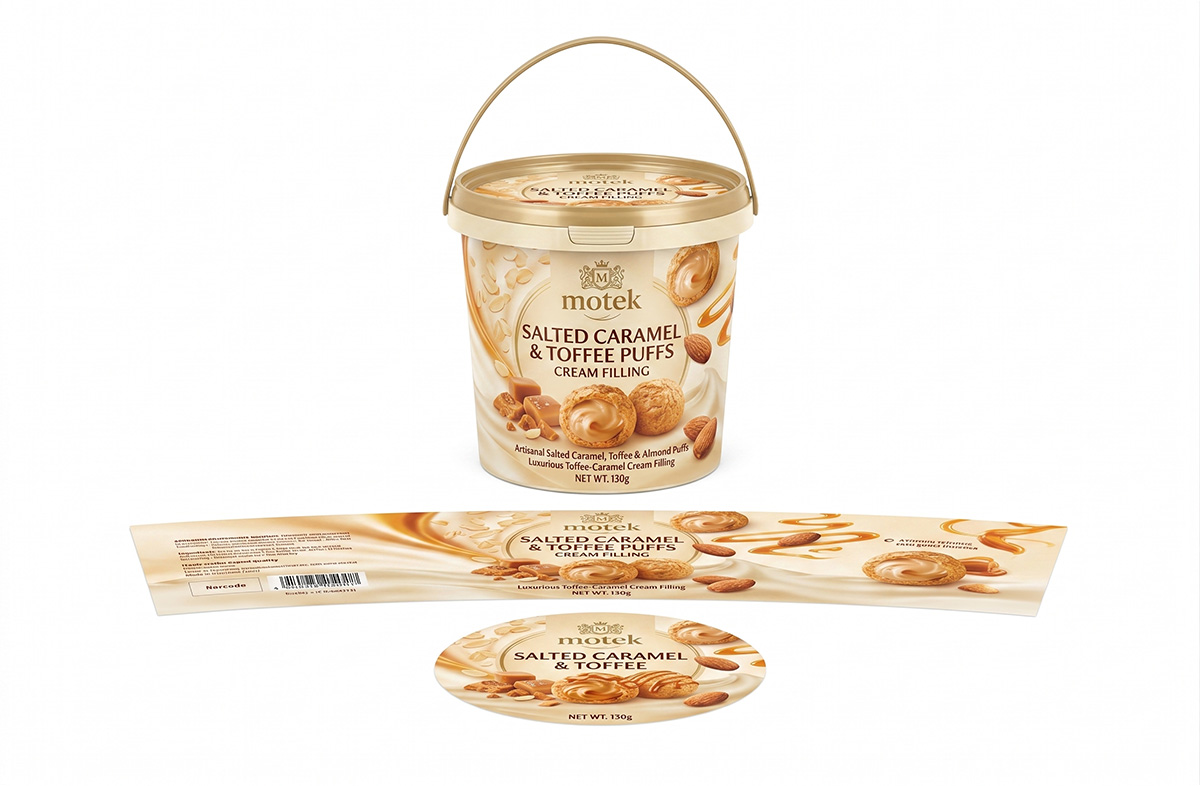
Waterproof, Oil-Proof, Freezer-Resistant – Motek IML Keeps Bucket Information Like New in Cold Chain Environments
When ice cream is taken out of the freezer, beads of condensation form on the bucket. When sauce buckets sit on the shelf, oil seeps from the edges. When frozen foods go through repeated freeze-thaw cycles during transport, the temperature shocks are severe. In these harsh cold chain environments, traditional labels often suffer from curling, fading, blurring, and peeling.
For food packaging buckets, the cold chain is not a special case but daily reality. Consumers want to see clear production dates, complete ingredient lists, and appetizing product images. But when labels are soaked by condensation, penetrated by oil, or embrittled by low temperatures, this information disappears. Brand image is damaged, compliance risk increases, and consumer trust is lost.
Motek in-mold labeling technology is specifically designed for cold chain environments. The label is molded as one with the bucket – no adhesive, no gaps, no peelable interface. Waterproof, oil-proof, and freezer-resistant. From minus 20 degrees Celsius freezers to 80 degree Celsius hot-fill lines, bucket information remains clear like new.
Three Major Cold Chain Challenges and Motek IML Solutions
| Environmental Challenge | Impact on Traditional Labels | Motek IML Solution |
|---|---|---|
| Condensation (waterproof) | Adhesive labels curl from moisture; paper labels soak through and tear | Adhesive-free structure – moisture cannot penetrate; hydrophobic surface coating – water beads up and rolls off |
| Oil and grease (oil-proof) | Oil penetrates labels, causing文字 blurring and discoloration | Oil-proof protective layer – oil cannot penetrate; wipe clean with a damp cloth |
| Low temperature freezing (freezer-resistant) | Adhesive becomes brittle and loses tack; label material cracks | Minus 20 to minus 30 degree Celsius formulation – no embrittlement, no cracking, no peeling |
How Motek IML Achieves Waterproof, Oil-Proof, and Freezer-Resistant Performance
1. Waterproof: Adhesive-Free Structure Plus Hydrophobic Surface
Traditional labels rely on adhesives. Adhesive failure when wet is the root cause of curling. Motek IML labels are physically fused with the bucket during injection molding – no adhesive layer. Additionally, the surface is treated with a hydrophobic coating:
Condensation forms beads that roll off, never pooling at label edges
Even when the bucket is fully submerged in water, the label remains unchanged
Passes 72-hour water immersion test with no change
2. Oil-Proof: Dense Protective Layer – Oil Cannot Enter
Sauce buckets, fried food buckets, and high-oil cookie buckets all face oil as the number one enemy of labels. Motek IML labels have a dense protective layer on the surface:
Oil cannot penetrate to the printing layer
Surface is easy to clean – a damp cloth restores clarity
Passes 24-hour cooking oil immersion test with no penetration and no discoloration
3. Freezer-Resistant: Stable at Minus 20 Degrees Celsius, Minus 30 Optional
Cold chain environments range from refrigeration at 0 to 4 degrees Celsius to freezing at minus 18 degrees Celsius or lower. Motek IML labels offer:
Standard formulation: minus 20 to 80 degrees Celsius – suitable for most frozen foods such as ice cream, frozen seafood, and frozen dumplings
Low-temperature formulation: minus 30 to 80 degrees Celsius – suitable for deep freezing such as minus 25 degree Celsius冷链运输
Passes 500 cycles from minus 20 degrees Celsius to room temperature with no cracking and no peeling
Dedicated Cold Chain Solutions for Three Food Bucket Categories
| Category | Cold Chain Environment | Core Challenge | Motek IML Solution |
|---|---|---|---|
| Ice cream buckets | Minus 18 degrees Celsius freezing, repeated in-and-out of freezer | Condensation curling, low-temperature embrittlement | Minus 20 degree Celsius formulation plus hydrophobic surface plus seamless structure |
| Frozen seafood buckets | Minus 25 degrees Celsius deep freezing, high humidity | Label adhesion under frost, information legibility | Minus 30 degree Celsius formulation plus high-contrast printing |
| Refrigerated sauce buckets | 0 to 4 degrees Celsius refrigeration, oil seepage | Oil stain coverage, label peeling | Oil-proof protective layer plus easy-clean surface |
Core Value in Cold Chain Environments
Value 1: Eliminate Returns and Complaints Caused by Label Peeling
In cold chain transport, a peeled label means the product has lost its identity. Retail terminals may refuse to accept or remove the product from shelves. Motek IML labels never peel, eliminating this risk at the source.
Value 2: Ensure Consumer Information Legibility – Compliance Without Worry
Food regulations require product information to be legible before sale. Traditional labels often become blurry in the cold chain. IML labels ensure information remains legible at all times, avoiding penalties due to label issues.
Value 3: Extend Brand Exposure – Secondary Use Value
Many food buckets are kept by consumers for storage after the contents are used. IML labels remain clear during this secondary use, providing continued brand exposure.
Value 4: Reduce Packaging Waste – Lower Costs
Traditional labels in cold chains have a damage rate of 5% to 10% due to curling, peeling, and blurring that require relabeling. IML labels have zero waste, resulting in lower long-term costs.
Customization Process (Cold Chain Focus)
| Step | Action | Lead Time |
|---|---|---|
| One | Confirm cold chain requirements: tell us the minimum storage temperature (e.g., minus 18 degrees Celsius), whether oil contact is involved, and whether condensation is present | 0.5 day |
| Two | Material selection: Motek selects standard or low-temperature formulation based on temperature requirements and recommends surface treatment (hydrophobic or oil-proof) | 1 day |
| Three | Sampling and testing: produce sample labels and conduct simulated cold chain testing (or ship samples for you to test) | 5-7 days |
| Four | Mass production: produce per order quantity; each batch includes a cold chain durability test report | 7-15 days |
Note: Motek can provide third-party cold chain durability test reports from SGS, TUV, etc., to meet export and major client factory audit requirements.
Customer Case: A Frozen Seafood Exporter's Zero Peeling Transformation
Background: A frozen seafood exporter shipping products to Europe and the United States faced大量 label peeling during minus 25 degree Celsius cold chain transport. Foreign clients complained repeatedly and demanded corrective action.
Motek solution:
Used minus 30 degree Celsius IML formulation
Front of bucket printed with product photography and brand logo
Back of bucket printed with multi-language ingredient lists and allergen warnings
Surface treated with hydrophobic coating to handle condensation during thawing
Results:
Across three consecutive batches of international transport, the label peeling rate was zero percent
The client passed European retailer factory audits, with IML packaging listed as a positive differentiator
Annual usage grew from 500,000 to 2,000,000 units
Frequently Asked Questions
Question: Ice cream buckets are taken out of the freezer and put back repeatedly. Will this affect the label?
Answer: No. Motek IML labels have passed 500 cycles from minus 20 degrees Celsius to room temperature with no change.
Question: If frost forms on the bucket surface, can the label still be read clearly?
Answer: Yes. The hydrophobic surface makes it difficult for frost to adhere. A gentle wipe restores clarity. If frost is heavy, the label remains完好 after the frost melts.
Question: Can oil from sauce buckets penetrate the label edges?
Answer: No. IML labels are seamlessly fused with the bucket. Oil cannot penetrate from the edges. The oil-proof surface layer also prevents oil from adhering.
Question: Does the freezer-resistant formulation add cost?
Answer: The standard minus 20 degree Celsius formulation adds no cost. The minus 30 degree Celsius formulation adds approximately 5% to 10% in label cost, but this is far lower than the waste cost of traditional labels.
Make the Cold Chain No Longer a Graveyard for Labels
The cold chain protects food quality, but it should not be the end of packaging information. Motek in-mold labels, with their outstanding waterproof, oil-proof, and freezer-resistant performance, keep bucket information like new in cold chain environments.
From the freezer warehouse to the consumer's refrigerator, your brand information remains clearly visible.
Waterproof, Oil-Proof, Freezer-Resistant – Motek IML Keeps Bucket Information Like New in Cold Chain Environments


