
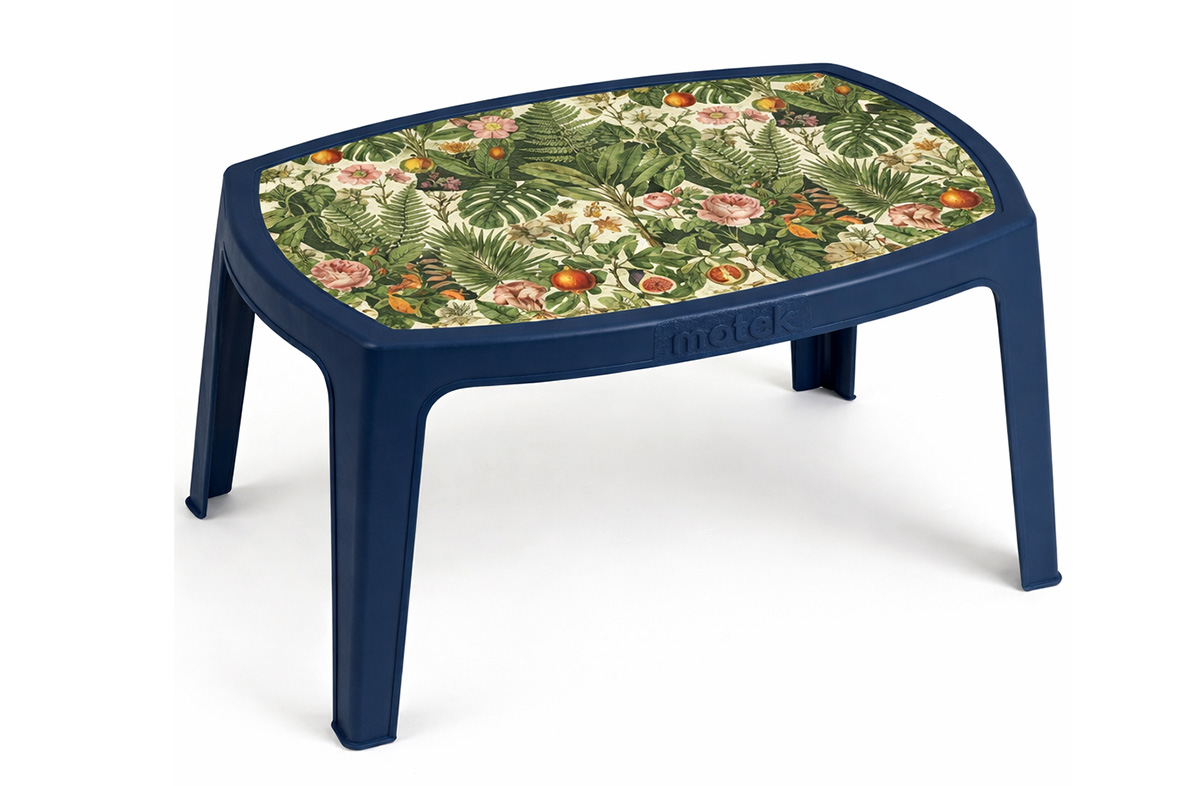
One Mold, a Thousand Faces – Motek IML Helps You Build a Versatile Series of Dining Tables
Consumers no longer settle for “one table for ten years.” They want tabletops that adapt to subtle changes in home décor, seasonal moods, or even their daily feelings. But in traditional mold‑based production, adding a new tabletop style means tens of thousands of dollars for a new mold and weeks of waiting.
Motek in‑mold labeling (IML) technology makes “one mold, a thousand faces” a reality. With just one mold, you can produce dozens of different tabletop styles – from Nordic minimalism to French country, from industrial concrete to neo‑Chinese ink wash. One mold, one product line, infinite possibilities. Your table collection can evolve like a fashion line – fast, flexible, and responsive to trends.
What Is a “Series Table Collection”?
A series table collection means using the same mold (same dimensions, structure, function) to create a family of products with consistent style but visually diverse tops. For example:
| Series Theme | Style Direction | Pattern Examples |
|---|---|---|
| Nordic Forest | Natural, fresh | Light wood grain, pine green, moss grey |
| Italian Luxury Stone | Elegant, glamorous | Black & Gold, Carrara White, Blue Emerald |
| Industrial Minimalist | Tough, cool | Cement grey, brushed metal, carbon black |
| French Country | Romantic, soft | Off‑white linen, lavender purple, distressed wood |
| Eastern Aesthetics | Zen, refined | Ink wash mountains, bamboo grain, cinnabar red |
| Kids’ Playland | Lively, colorful | Animal illustrations, rainbow stripes, color blocks |
Each series contains 3–8 different patterns, all sharing the same mold. The only added cost is the IML labels.
How Motek IML Achieves “One Mold, a Thousand Faces”
1. Pattern and mold are physically separated
Traditional injection‑molded tables either engrave the pattern into the mold (fixed forever) or use heat transfer (inefficient, low durability). Motek IML prints the pattern onto a label that fuses with the tabletop during molding. The mold only defines the shape – not the decoration. Changing patterns only requires changing the label roll; the mold stays untouched.
2. Quick changeover – production without stopping
IML labels are supplied in rolls, compatible with robotic pick‑and‑place systems. To change a pattern, simply replace the label roll at the feeder – no need to stop the machine or adjust the mold. The same injection machine can produce “Oak Wood” series in the morning and “Marble” series in the afternoon.
3. Mixed batches – flexible combinations
One order can include multiple patterns, with a minimum of 500 labels per pattern. You can restock flexibly based on sales data – reorder bestsellers, discontinue slow movers – with very low inventory risk.
4. Consistent style, unchanged mold
Even with thousands of different patterns, the table’s dimensions, structure, and assembly remain identical. This means packaging, manuals, and accessories are all universal – greatly simplifying your supply chain.
Core Value of a Series Table Collection
Value 1: Enrich your product line – reach more customer segments
One mold can cover modern, vintage, minimalist, and luxury aesthetics – all in one product family. Satisfy diverse preferences and increase market share.
Value 2: Respond to trends fast – seize the market
Home trends change quickly – last year terrazzo, this year micro‑cement. Motek IML lets you launch new styles within 1–2 weeks of a trend emerging, while competitors may take 1–2 months to make new molds.
Value 3: Reduce inventory risk – flexible stocking
Traditional models require you to stock finished tabletops for each design – slow movers become dead stock. With IML, you only stock plain tabletops and label rolls. Label rolls take up very little space. You can produce on demand – truly “make to order.”
Value 4: Enhance brand professionalism
A brand with a rich, well‑designed series collection appears more professional, design‑forward, and trustworthy. Series collections build brand recognition and loyalty.
Value 5: Enable channel differentiation
You can create exclusive patterns for different sales channels: e‑commerce exclusives, in‑store limited editions, bulk project designs, gift sets – all from the same mold, avoiding channel price conflicts.
Implementation Process for a Series Table Collection
| Step | Action | Lead Time |
|---|---|---|
| 1. Series planning | Define series theme (e.g., “Nordic Forest”), select 3–8 pattern directions | 1–2 days |
| 2. Pattern design | Motek designers create renderings for each pattern, ensuring a consistent color palette and style language | 3–5 days |
| 3. Plate making | Make separate printing plates for each pattern (can be done in phases – start with 2–3 test patterns) | 3–5 days per pattern |
| 4. Sampling | Produce 50–100 sample labels per pattern; run trial molding | 5–7 days |
| 5. Mass production | Produce labels per pattern based on orders; deliver together | 7–15 days |
| 6. Continuous refresh | Add new patterns quarterly or semi‑annually; retire old ones as needed | 7–10 days for new pattern |
Recommendation for starting a series: Begin with 3 core patterns to test the market, then expand to 8–10 patterns.
Customer Case: An E‑commerce Brand’s “Bestseller Series Matrix”
Background: A cross‑border e‑commerce seller of dining tables had 5 molds for 5 tabletop styles. Each style sold a few hundred units per month, but mold investment was high and changeover cycles were long.
Motek solution:
Consolidated 5 molds into 1 universal mold (size 120cm×70cm)
Developed 3 series with 12 patterns total: Modern Luxury (4 marble patterns), Nordic Wood (4 wood grains), Industrial Retro (4 cement + metal patterns)
First order: 1,000 labels per pattern – total 12,000 labels
Results:
Mold cost reduced from 5 molds to 1 – 80% savings
12 independent listings – organic traffic increased 4x
Bestsellers (Black & Gold marble, Light Oak) now sell 3,000+ units/month; 2 slow movers discontinued – zero dead stock
Client feedback: “We can now launch new styles every month. Competitors simply can’t keep up.”
Design Tips for Series Collections
1. Unify visual elements
Within a series, maintain consistency in color saturation, line weight, or background texture – so customers recognize they belong to the same family.
2. Create a “flagship” pattern
Design 1–2 of the most striking, complex patterns in each series to act as hero products – use them for main images and traffic generation.
3. Leave room for iteration
When designing the mold, leave some margin around the label area – this allows for larger or irregular patterns in future updates.
4. Name your patterns
Give each pattern a distinctive name (e.g., “Aurora White,” “Lava Grey”) to enhance storytelling and make them memorable for customers.
Who Should Develop Series Collections?
Furniture brands – maximize product variety with limited mold investment
Cross‑border e‑commerce sellers – need many SKUs for traffic while controlling costs
Chain restaurants / hotel procurement – need consistent but slightly varied tabletops within the same space
Injection molders (OEM) – offer series options to clients and win more orders
FAQ
Q: Do different patterns in a series cost the same per label?
A: Not necessarily. Cost depends on pattern complexity (number of colors, detail density). A complex marble pattern may cost slightly more than a solid color + logo. Motek quotes each pattern separately.
Q: Can I start with 2 patterns to test the market, then add more later?
A: Absolutely. Adding new patterns later only requires the new pattern’s plate‑making and label costs – the mold and existing plates are reusable.
Q: How do I avoid mixing up different pattern labels?
A: Motek clearly marks each label roll with the pattern name and code, and provides a QR code tracking system. We can also print identification codes on the back of the labels if needed.
Q: Do series tabletops need different packaging?
A: No. Because the tabletops are identical in size and structure, packaging is universal. You only need to apply a different pattern sticker on the outer box for identification.
Make Your Table Product Line “Alive”
In the past, one mold could only produce one tabletop – product lines were rigid and costly. Now, Motek IML turns a single mold into the mother of an entire series. You can adjust, expand, and optimize your product mix based on market feedback – anytime.
One mold, a thousand faces. Start building your series table collection today.
One Mold, a Thousand Faces – Motek IML Helps You Build a Versatile Series of Dining Tables


