
How to Use IML In-Mold Labels for Brand Anti-Counterfeiting on Storage Containers? A Guide to Common Anti-Counterfeiting Printing Techniques
How to Use IML In-Mold Labels for Brand Anti-Counterfeiting on Storage Containers? A Guide to Common Anti-Counterfeiting Printing Techniques
Storage containers may seem like an unremarkable product category, but they are actually a major target for brand counterfeiting. A well-designed storage container with a good reputation can be copied and sold across platforms like Pinduoduo and Xianyu within a month of its launch – the counterfeits "look similar," but use inferior materials, have blurry printing, and crack after a few months. Consumers cannot tell the difference between genuine and fake products, and the brand's reputation and pricing system suffer direct damage.
For branded storage containers, anti-counterfeiting is not "icing on the cake" – it is a "survival project."
IML (In-Mold Labeling) technology provides storage containers with a natural anti-counterfeiting foundation – the label and the container body fuse together during the injection molding process, making it impossible to peel off, replace, or copy. Building specialized anti-counterfeiting printing techniques on top of this foundation creates a defense line that counterfeiters find difficult to breach.
📖 Table of Contents
1. Why Is IML Itself an Anti-Counterfeiting Barrier?
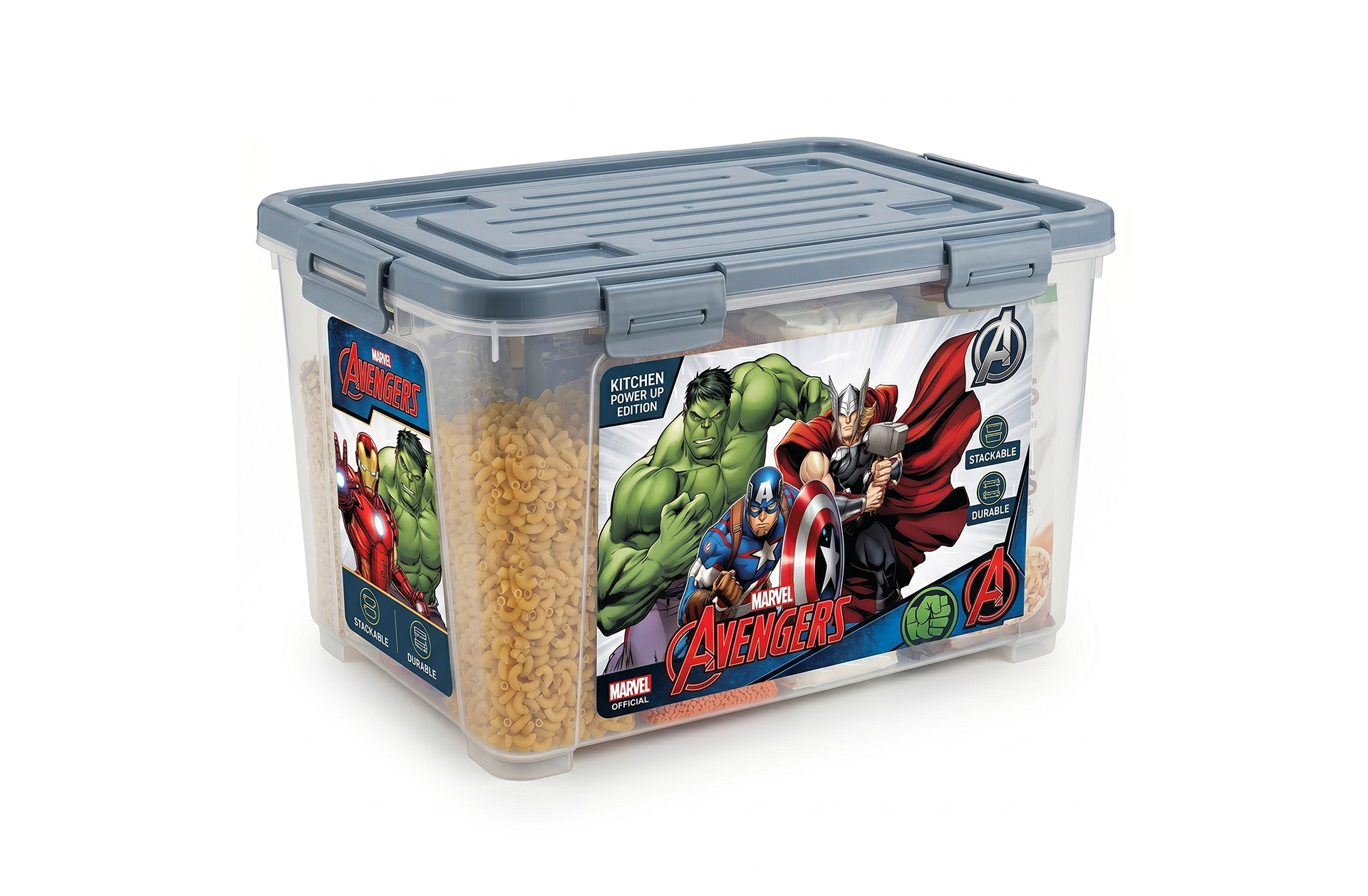
Before discussing specific anti-counterfeiting printing techniques, let's first clarify a fundamental question: Why does an IML label itself have anti-counterfeiting properties?
For ordinary pressure-sensitive labels, counterfeiters can buy a similar printing press and similar materials, print the labels, and stick them onto counterfeit container bodies – low cost, fast, and with low barriers to entry.
But IML is different.
First barrier: Mold cost anti-counterfeiting. IML labels require special molds, which are expensive to manufacture. This itself serves as a "cost-based anti-counterfeiting" measure. A precision IML injection mold plus an in-mold labeling system represents an investment of several hundred thousand yuan – would a counterfeiter be willing to invest that much just to copy a storage container? Most would not.
Second barrier: Process anti-counterfeiting. The IML label printing process is more difficult than traditional labeling. In-mold labeling involves an interconnected production process – material selection, label production, mold structure design, production equipment, and process parameters – all of which must work in close coordination. The high technical requirements alone increase the difficulty of counterfeiting. Ordinary counterfeit workshops simply do not have the capability to replicate this complete process chain.
Third barrier: Integrated molding anti-counterfeiting. IML labels fuse with the storage container body during injection molding, becoming one seamless unit. The label and the container are on the same surface; you cannot feel the presence of the label, and the colored graphics appear as if printed directly onto the container surface. The label cannot be peeled off, replaced, or covered. Even if counterfeiters replicate the appearance, they cannot replicate the "label-and-container-as-one" quality.
But the anti-counterfeiting barriers provided by IML alone are not enough – these three barriers protect against "ordinary counterfeiters." For more sophisticated counterfeiters, additional advanced anti-counterfeiting measures need to be added at the printing level.
2. Common IML Anti-Counterfeiting Printing Techniques
2.1 Micro-Text – The "Password" Hidden in Plain Sight
What is micro-text?
Micro-text involves printing extremely small text or patterns in specific positions on the label – so small that they are almost invisible to the naked eye and can only be read with a magnifying glass or microscope. These texts are typically only 0.2-0.5mm high, a precision that ordinary printing equipment simply cannot achieve.
On storage containers, micro-text can be hidden in a stroke of the brand logo, a line in the pattern, or a decorative band along the label edge. Consumers can verify with a smartphone macro lens or magnifying glass, but counterfeiters find it extremely difficult to replicate – because their printing equipment cannot achieve this level of precision.
Anti-counterfeiting logic: Micro-text printing requires high-precision plate-making and printing equipment. The printing presses used by ordinary counterfeit workshops do not have sufficient resolution – the micro-text they print appears as a blurry ink blob rather than clearly legible text.
Application suggestion for storage containers: Embed micro-text within a letter or graphic element of the brand logo – for example, print "Brand Name + Year" in micro-text inside the first letter of the brand name. Consumers can verify instantly with a magnifying glass.
2.2 Invisible Ink – The "Cipher" You Cannot See
What is invisible ink?
Invisible ink is a type of ink that is completely invisible under natural light but becomes visible under specific light sources (such as UV light). It can be printed anywhere on the label – covering the entire pattern, hidden in a color block, or existing as an independent concealed element.
Anti-counterfeiting logic: The formulation of invisible ink is highly confidential. Counterfeiters do not know which ink is used, where it is printed, or what light source to use to reveal it. Even if they know the technology exists, they cannot replicate it.
The application on storage containers is highly flexible:
- Print an invisible ink brand pattern on the label surface that only appears under UV light
- Combine invisible ink with micro-text – the micro-text is printed in invisible ink, requiring both a magnifying glass and a UV light for verification
- Use multiple types of invisible ink in different areas of the label, displaying different content under different wavelengths
Application suggestion for storage containers: Apply a layer of invisible ink over the brand logo area on the storage container label, revealing text such as "GENUINE" or a brand-specific pattern under UV light. Distribute UV verification pens to dealers for channel verification.
2.3 Texture Positioning Printing – Every Label Is "Unique"
What is texture positioning printing?
Texture positioning printing involves controlling the random distribution of ink or adding random fibers during the label printing process, so that each label forms a unique texture pattern. These textures are like fingerprints – every one is different.
Anti-counterfeiting logic: The randomness of the texture makes it impossible to replicate. Counterfeiters can copy the pattern, but they cannot replicate the random distribution of textures. Brands can establish texture databases, allowing consumers to upload photos for verification.
Technical implementation methods:
- Fiber texture: Embed randomly distributed colored fibers into the label material; the fiber distribution on each label is different
- Ink texture: Control the random diffusion of ink through special printing techniques to form unrepeatable texture patterns
- Positioned relief: Create micro-relief textures in specific positions on the label, precisely aligned with the printed pattern
Application suggestion for storage containers: Add random fiber textures in designated areas of the storage container label (such as corners or the back), and establish a corresponding texture database. Consumers can scan a QR code and upload a texture photo for verification.
2.4 Optically Variable Ink and Holographic Effects – The "ID Card" That Changes with Angle
What is optically variable ink?
Optically variable ink is a specialty ink that changes color as the viewing angle changes. From the front, it appears one color; from the side, it appears another color.
What are holographic effects?
Holographic effects are formed by micro-nano structures on the label surface, creating rainbow-colored diffraction patterns. These effects cannot be replicated through ordinary printing and must be produced using specialized embossing processes.
The smooth surface of IML film is highly suitable for carrying holographic and optically variable effects. These effects can be integrated into specific areas of the label or cover the entire label surface.
Anti-counterfeiting logic: Both optically variable ink and holographic effects require specialized equipment and materials – ordinary printing houses simply do not have this capability. Consumers can quickly verify authenticity simply by rotating the storage container and observing whether the label color changes.
Application suggestion for storage containers: Use optically variable ink on the brand logo or key pattern areas, allowing consumers to verify through a simple "flip and observe" test – genuine products change color; counterfeits do not.
3. Practical Application of Anti-Counterfeiting Techniques on Storage Containers
The above anti-counterfeiting techniques can be combined based on the storage container brand's positioning and cost budget:
| Anti-Counterfeiting Level | Recommended Technique | Applicable Scenarios | Cost |
|---|---|---|---|
| Basic Anti-Counterfeiting | IML Integrated Molding (built-in) | All storage containers | Already included in IML process |
| Level 1 (Public) | Optically Variable Ink / Holographic Effects | Mid-to-high-end brands | Medium |
| Level 2 (Professional) | Micro-Text | Full product range | Low-Medium |
| Level 3 (Expert) | Invisible Ink | Premium series, limited editions | Medium |
| Level 4 (Top-Tier) | Texture Positioning Printing | Luxury, collectible grades | High |
Combination recommendations:
- Mass-market storage containers: IML integrated molding + micro-text (low cost, sufficiently deterrent)
- Mid-to-high-end storage containers: IML + micro-text + optically variable ink (publicly verifiable, professionally difficult to copy)
- Premium/limited editions: IML + invisible ink + texture positioning + holographic effects (multi-layer protection, nearly impossible to copy)
Additional value for channel management: Invisible ink and texture positioning are not only for consumer-facing anti-counterfeiting but can also be used for channel diversion control. Brands can embed different invisible codes or texture features into different batches of labels. Once diversion is detected, the specific batch and channel can be traced through inspection.
4. Recommendations for Building a Brand Anti-Counterfeiting System
Anti-counterfeiting is not a case of "print it and forget it" – it is a systematic project. For storage container brands, building an anti-counterfeiting system requires consideration from the following dimensions:
Step 1: Choose the right process foundation. If you are not already using IML, start with "IML integrated molding" – this itself is the strongest physical anti-counterfeiting. If you are already using IML, you can layer anti-counterfeiting printing techniques on top.
Step 2: Design a tiered anti-counterfeiting solution. Different product lines at different price points use different anti-counterfeiting levels. Premium lines use multi-layer anti-counterfeiting; mass-market lines use basic anti-counterfeiting – controlling costs while leaving counterfeiters with no gaps.
Step 3: Establish a consumer verification channel. No matter how good the anti-counterfeiting is, it is useless if consumers do not know how to verify it. It is recommended to print a QR code + verification instructions on the storage container label. Scanning the code leads to the brand's verification page with图文 or video tutorials – how to use a UV light, how to observe micro-text with a magnifying glass, how to upload texture photos for verification.
Step 4: Partner with a professional IML supplier. Anti-counterfeiting printing involves multiple specialty inks and processes – not just any printing house can do it. Choose a supplier with IML anti-counterfeiting experience to ensure full control from label material selection, printing processes, to injection molding.
Step 5: Update the anti-counterfeiting solution dynamically. Anti-counterfeiting is a "cat-and-mouse game." It is recommended to regularly update anti-counterfeiting elements – for example, change the invisible ink formulation annually and update micro-text content quarterly – keeping counterfeiters perpetually one step behind.
5. FAQ
Yes. IML requires special molds (high cost) and complex printing processes (high difficulty), and the label fuses with the container body during injection molding – it cannot be peeled off or replaced. These three barriers together constitute an effective anti-counterfeiting defense line.
Typically 0.2-0.5mm high. At this size, the text is almost invisible to the naked eye and requires a magnifying glass (5-10x) to read. Ordinary printing equipment cannot achieve this precision, thus serving the anti-counterfeiting purpose.
Yes. High-quality invisible ink is completely transparent or blends with the background color under natural light, only appearing under specific light sources such as UV light (365nm wavelength).
Relatively expensive. Because each label's texture is randomly generated, it requires establishing a corresponding database and verification system. It is suitable for high-end product lines or limited editions.
Yes. Techniques such as micro-text, invisible ink, optically variable ink, and texture positioning can all be layered on the same label without interfering with each other. Multi-layer anti-counterfeiting increases the difficulty of counterfeiting exponentially.
High-quality anti-counterfeiting inks and processes do not affect normal IML injection molding. However, it is important to confirm compatibility with the IML supplier during the design phase to ensure the anti-counterfeiting process is compatible with the injection molding process.
It is recommended to print a QR code + concise verification instructions on the label. Scanning the code leads to the brand's verification page with picture or video tutorials – how to use a UV light, how to observe micro-text with a magnifying glass, and how to upload texture photos for verification.
Contact Us
Name*
Telephone*
Region*
Please fill in your request*


