
Why Do Yogurt Cups Prefer In-Mold Labeling? – Five Core Advantages
Why Do Yogurt Cups Prefer In-Mold Labeling? – Five Core Advantages
If you frequently visit the refrigerated section of supermarkets, you may have noticed an interesting trend: more and more premium yogurt cups have labels that are no longer "stuck on" but appear to "grow" directly from the cup body itself – no edges to feel, no way to peel off, no bubbling even when soaked in water.
Behind this is a technology that is reshaping the dairy packaging industry: In-Mold Labeling (IML).
In simple terms, IML involves placing a pre-printed label into the mold before the injection molding process begins. When molten plastic is injected, it fuses with the label under high temperature and pressure. The label is not "stuck on" – it is "born together" with the cup.
It is this fundamental difference of "integral molding" that gives IML yogurt cups a comprehensive advantage over traditional pressure-sensitive labeling and screen printing in the following five dimensions.
📖 Table of Contents
- 1. Advantage 1: Superior Appearance – Label and Cup Body as One
- 2. Advantage 2: Never Peels Off – No Bubbling, No Curling, No Label Loss
- 3. Advantage 3: Waterproof, Oil-Proof, and Mold-Proof – Withstands Harsh Environments
- 4. Advantage 4: 100% Recyclable – Eco-Friendly and Pollution-Free
- 5. Advantage 5: Lower Overall Cost – Saving Processes, Materials, and Labor
- 6. FAQ
1. Advantage 1: Superior Appearance – Label and Cup Body as One
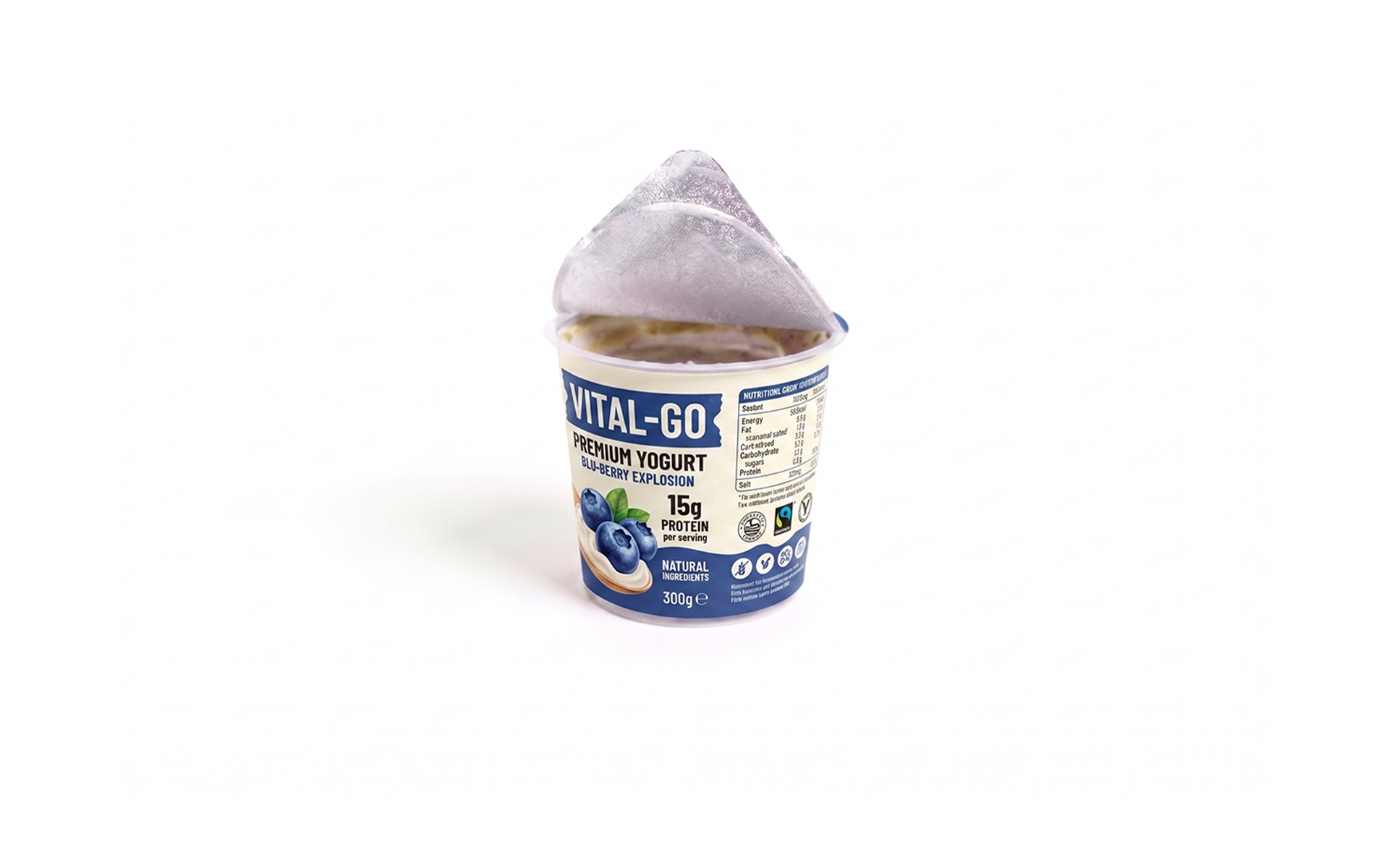
On the yogurt shelf, the first battle is won by "visual appeal." IML has a natural advantage here.
IML labels fuse seamlessly with the cup body during injection molding. The label and the cup are on the same plane – you cannot feel the presence of the label, and the colorful graphics appear as if printed directly on the cup surface. It feels smooth and integrated to the touch, with no raised edges or the "step" feeling of stickers.
Effect on the shelf: Traditional pressure-sensitive labels always have edges and visible thickness, while IML labels look like a pattern that the cup body "naturally possesses." 360° high-resolution printing achieves photo-quality graphics, with more brilliant colors, richer layers, and more refined details. With a wide variety of yogurt options and intense shelf competition, high image quality and 360° visibility help with differentiation and premium display.
A packaging director at Bright Dairy once commented: "In-mold labeling technology effectively solves the problems of labels easily falling off and curling at the edges. The packaging is more attractive and can greatly enhance the product's market competitiveness."
2. Advantage 2: Never Peels Off – No Bubbling, No Curling, No Label Loss
The biggest pain point of traditional pressure-sensitive labels is: they curl up over time.
Condensation in refrigerated environments, friction and impact during transportation, and moisture from consumers' hands – all these cause the edges of pressure-sensitive labels to gradually curl, bubble, or even peel off entirely. IML fundamentally eliminates this problem.
The reason: there is no adhesive layer between the IML label and the cup body. Traditional pressure-sensitive labels rely on adhesive bonding – adhesives age, become damp, and lose effectiveness. IML relies on molecular-level fusion – the label and the cup body fuse together during injection molding, with no "interface" that can be compromised.
Actual performance: IML labels do not deform, curl, or fall off. They resist collision, scratching, and contamination during production and transport. Even in very harsh environments, they remain intact. No matter how the cup deforms, the label follows – because it is part of the cup itself.
For yogurt products that require refrigeration, transportation, and stacking, "no label loss" means fewer after-sales complaints, better unboxing experiences, and longer shelf life cycles.
3. Advantage 3: Waterproof, Oil-Proof, and Mold-Proof – Withstands Harsh Environments
A yogurt cup's life involves condensation in refrigerators, milk fat during filling, and sweat from consumers' hands. Ordinary labels are prone to moisture damage, mold growth, and ink bleeding under such conditions.
IML labels far outperform traditional processes in waterproof, oil-proof, and mold-proof performance.
Waterproof: IML labels have excellent water and moisture resistance. They do not curl or fall off due to condensation in refrigerated environments.
Oil-proof: Milk fat in yogurt does not penetrate the label, preventing discoloration or peeling caused by oil infiltration.
Mold-proof: IML labels do not develop mold in humid environments. Yogurt containers often have condensation on the surface under refrigerated conditions. Pressure-sensitive labels are prone to bubbling and mold growth when damp, but IML completely avoids this issue.
Temperature resistance: IML yogurt cups can withstand temperatures ranging from -20°C to 120°C, making them suitable for both cold filling and hot filling up to 85°C.
4. Advantage 4: 100% Recyclable – Eco-Friendly and Pollution-Free
Under the wave of environmental sustainability, packaging recyclability is becoming increasingly important. IML has an advantage in this area that other labeling processes cannot match: no label removal is required.
Yogurt cups are typically made of PP (polypropylene). IML labels use the same PP material. During recycling, the entire cup can be directly shredded and repelletized – no need to peel off the label first.
In contrast, pressure-sensitive labels require peeling off the label and removing residual adhesive before recycling – a process that is inefficient, costly, and leaves residual adhesive that contaminates recycled materials.
Industry recognition: NextCycle IML™ labels enable 100% recyclability of PP yogurt cups with IML labels, with no impact on the recycled PP material. In-mold labels use the same material as the container and can be directly melted and recycled for reuse, simplifying the recycling process and being more environmentally friendly. IML also eliminates the environmental pollution and food safety risks associated with secondary printing and labeling.
5. Advantage 5: Lower Overall Cost – Saving Processes, Materials, and Labor
Many assume that because IML is a more sophisticated process, it must be more expensive. But when calculating total cost, IML may actually be more economical.
Process savings: The container and labeling are completed in one step, requiring no post-processing, improving production efficiency. Traditional processes require making the cup first and then labeling it – each additional step adds cost and quality risk.
Material savings: IML labels do not require backing paper. The release liner of pressure-sensitive labels is a pure consumable. IML eliminates this layer, creating inherent material cost savings.
Labor savings: IML production is fully automated – robotic arms pick labels from the magazine, place them into the mold, and after injection molding, eject the finished product for quality control. No manual labeling is required, saving labor costs.
Comprehensive benefits: IML suppliers offer integrated system solutions from yogurt cup IML labeling to lid and spoon assembly and automated back-end packaging, meeting high-efficiency production requirements while significantly improving productivity and reducing costs.
6. FAQ
IML labels fuse with the cup body during injection molding – they are not "stuck on." Pressure-sensitive labels rely on adhesive on the surface, with risks of falling off, curling, and bubbling. IML structurally eliminates these issues entirely.
IML yogurt cups are typically made from food-grade PP material, with a temperature tolerance range of -20°C to 120°C. However, whether they can be microwaved depends on the cup design and the label material's temperature specifications. Always check the usage instructions on the product packaging.
No. IML ink is sandwiched between the film and plastic, not directly exposed to air, UV radiation, or friction. Compared to traditional printed labels, IML labels offer superior durability and visual appeal.
Yes. IML yogurt cups are suitable for both cold filling and hot filling up to 85°C. Some high-quality products can withstand even higher temperatures.
No. IML labels have fused with the cup body. Forcibly tearing them would damage the cup itself. This is also why IML offers some anti-counterfeiting benefits.
IML is better suited for medium-to-large batch production due to higher upfront mold and equipment investment. However, for multi-flavor series, all flavors can share the same mold and label plates, making the per-unit cost advantage clear when spread across sufficient volume.
Contact Us
Name*
Telephone*
Region*
Please fill in your request*


