
The "Green Passport" of Ice Cream Containers – How Does Single-Material IML Support the Circular Economy?
The "Green Passport" of Ice Cream Containers – How Does Single-Material IML Support the Circular Economy?
The global plastic pollution problem is becoming increasingly severe. The proliferation of single-use plastic containers, concerns over climate change, and the rise of the circular economy concept are driving consumers and regulators to actively seek ways to reduce the environmental impact of plastic packaging.
The EU's Packaging and Packaging Waste Regulation (PPWR), China's "dual carbon" goals, and various "plastic bans" around the world – a series of environmental regulations are turning packaging recyclability from a "nice-to-have" into a "must-have."
For ice cream brands, the challenge is particularly specific: how to ensure packaging protection in deep-freeze environments at -20°C while meeting increasingly stringent environmental requirements? How to maintain high-quality printing while allowing the packaging to flow smoothly into recycling systems?
IML (In-Mold Labeling) technology provides the answer.
Table of Contents
- 1. The New Packaging Challenge Under the Environmental Storm
- 2. IML's "Green Gene" – Single-Material Design
- 3. Industry Authority Certifications – IML's "Green Passport"
- 4. Classic Case Study: Magnum's "Completely Recyclable" Commitment
- 5. Beyond Recycling – IML's Full Sustainability Chain
- 6. FAQ: Common Questions About IML Sustainability
1. The New Packaging Challenge Under the Environmental Storm
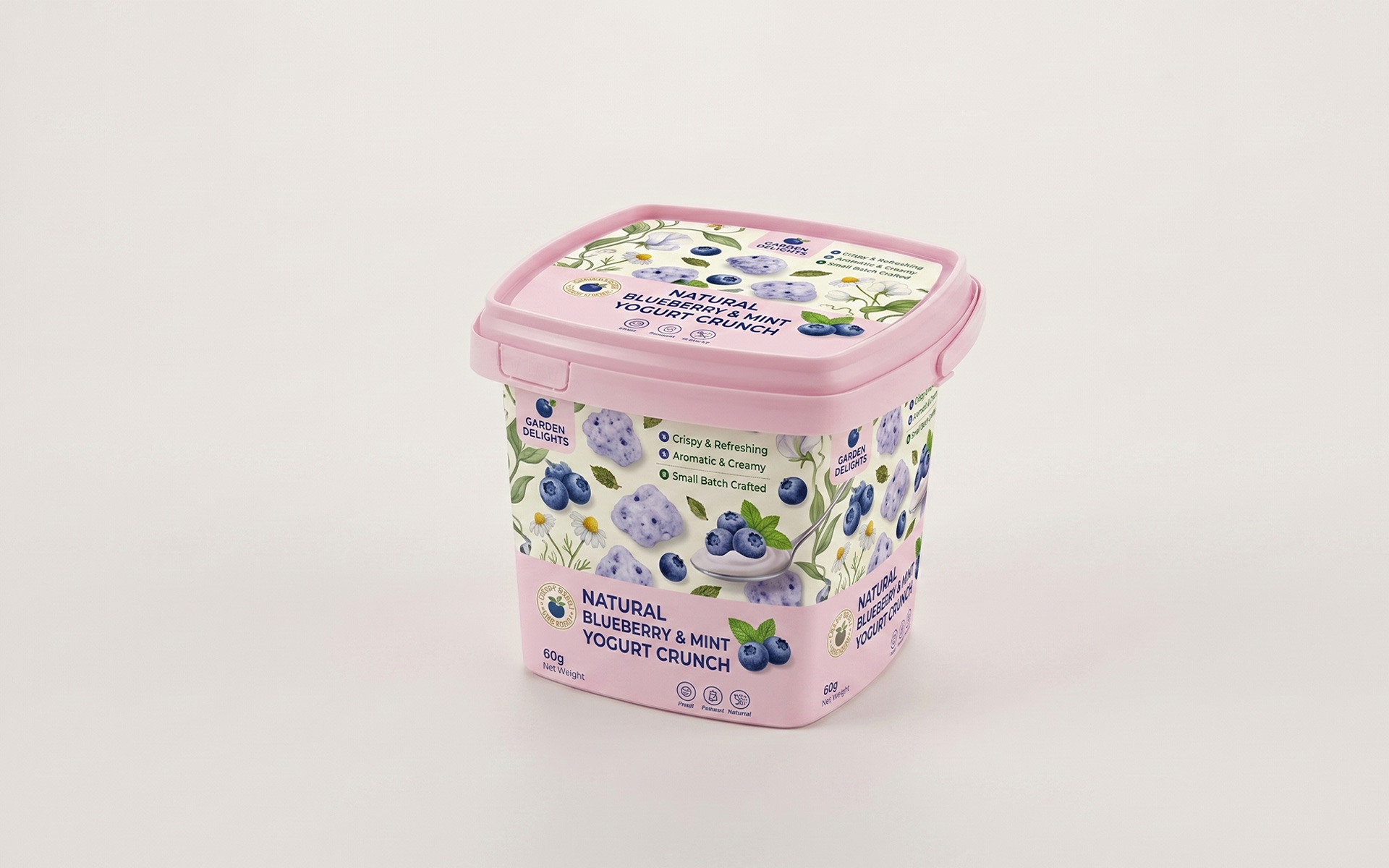
The global plastic pollution problem is becoming increasingly severe. The proliferation of single-use plastic containers, concerns over climate change, and the rise of the circular economy concept are driving consumers and regulators to actively seek ways to reduce the environmental impact of plastic packaging.
The EU's Packaging and Packaging Waste Regulation (PPWR), China's "dual carbon" goals, and various "plastic bans" around the world – a series of environmental regulations are turning packaging recyclability from a "nice-to-have" into a "must-have."
For ice cream brands, the challenge is particularly specific: how to ensure packaging protection in deep-freeze environments at -20°C while meeting increasingly stringent environmental requirements? How to maintain high-quality printing while allowing the packaging to flow smoothly into recycling systems?
IML (In-Mold Labeling) technology provides the answer.
2. IML's "Green Gene" – Single-Material Design
2.1 What Is "Single-Material"?
Traditional ice cream packaging often consists of multiple materials: the container may be PP (polypropylene), the label may be PET or paper, plus adhesive glue. This "mixed-material" structure creates huge recycling challenges – different materials need to be separated, and the separation process is costly and inefficient, resulting in a large amount of packaging never entering the recycling stream.
IML's solution is simple and clever: the container and label use the same material – polypropylene (PP). IML labels use PP film (typically 50–60 microns thick) and fuse with the PP container during injection molding. This "single-material" design gives IML packaging its "green gene" for recyclability from the very start.
2.2 No Label Removal, Direct Recycling
With traditional label packaging, consumers or recycling facilities need to peel off the label before the container can be recycled. With IML, the label is fused with the container during molding, so the entire container can be put into the recycling system without removing the label.
This advantage is significant in real-world recycling. IML packaging can go directly into automated sorting and washing, without the need for an additional label-removal step. The label is not "removed" – it is incorporated with the recyclable polymer, simplifying the entire recycling process.
2.3 No Adhesive, No Contamination
Traditional pressure-sensitive labels rely on chemical adhesives, which can affect the color and mechanical properties of the recycled material. IML technology uses no adhesive at all – the label is fused directly with the plastic container through high temperature and high pressure during injection molding.
No adhesive means no chemical residues, no extra separation steps, and no negative impact on recycled material quality. This is a key reason why IML is recognised by industry authorities as a "preferred" labeling method.
3. Industry Authority Certifications – IML's "Green Passport"
IML's sustainability advantages are not just claims – they have been certified and recommended by multiple global authoritative industry bodies.
3.1 APR "Preferred" Labeling Method
The Association of Plastic Recyclers (APR) in the US is one of the most influential industry organisations in the field of plastic recycling. After rigorous evaluation, APR officially recognises IML as the "Preferred" labeling method for PP and HDPE packaging.
APR's rationale is that IML labels are integrated with the packaging/component wall, and when compatible polymer labels are used, they do not negatively affect the recycling process.
3.2 RecyClass Full Compatibility Certification
RecyClass is Europe's leading platform for assessing and certifying the recyclability of plastic packaging. RecyClass conducted comprehensive laboratory testing on IML technology.
The test results show that PP-based IML technology is fully compatible with coloured PP recycling streams, provided that the total ink content does not exceed 1% of the packaging's total weight. This certification provides solid technical backing for the recyclability claims of IML packaging in the European market.
3.3 World Packaging Organisation "Best Case" Rating
The World Packaging Organisation, in its design guidelines, explicitly recommends the use of single materials in packaging applications. In its "Traffic Light Rating System," it classifies IML and similar labeling processes as green "Best Case".
This means that from the perspective of the world's most authoritative packaging body, IML achieves the highest possible rating in terms of sustainability.
4. Classic Case Study: Magnum's "Completely Recyclable" Commitment
In our previous article, we discussed how Magnum Pints used IML technology to create a unique "crack experience." In this packaging revolution, sustainability was equally a core consideration for Magnum.
Rahul Rajpal, Magnum's European Brand Development Lead, explicitly stated: "IML packaging is completely recyclable."
He further elaborated on the three reasons Magnum chose IML:
"First, we chose IML for its appearance – it exudes a premium feel that perfectly matches Magnum's high-end brand image. Second, the quality of IML packaging is first class, which is really important for deep-frozen products. Last but not least, IML packaging is fully recyclable."
Magnum Pints' packaging is made entirely of PP material – from container to label – requiring no separation for recycling. This case proves that premium packaging and environmental sustainability are not contradictory – IML allows ice cream containers to maintain their visual appeal while also reducing the burden on the planet.
5. Beyond Recycling – IML's Full Sustainability Chain
IML's contribution to the circular economy goes beyond just "recyclability." From production to use to recycling, IML demonstrates sustainability throughout the entire packaging lifecycle.
5.1 Material Reduction in Production
IML combines labeling and container molding into one step – decoration and production are completed simultaneously during injection molding. This means:
- Elimination of post-mold labeling processes: Reduced equipment, energy, and labour costs.
- Reduced material usage: IML labels can increase the sidewall strength of the container, allowing for thinner walls and less plastic resin.
- Elimination of adhesives and auxiliary materials: No additional label substrate or adhesive consumption.
5.2 Application of PCR Materials
IML packaging is not only "recyclable" – it can also be "made from recycled materials." Leading packaging companies such as Greiner Packaging have launched IML containers manufactured using post-consumer recycled (PCR) PP resin.
This means IML packaging can achieve a closed-loop cycle: discarded PP packaging is collected, regranulated, and reformed into new IML containers and labels – a complete material circularity.
5.3 NextCycle IML – Next-Generation Detachable Labels
The industry is also continuing to innovate. NextCycle IML™, developed by MCC Global IML, is a breakthrough in next-generation IML label technology.
Unlike conventional IML labels which melt together with the container during recycling, NextCycle IML labels are designed to separate from the container flakes during the grinding and air-sieving stages of recycling – with over 98% of NextCycle IML labels being effectively removed in this process.
This brings significant benefits:
- The recovered PP material is free from ink contamination, resulting in higher quality.
- The separated PP can be reapplied in closed-loop applications such as PP injection molding, with a reuse ratio up to 50%.
- The separation of natural PP containers from printed labels is effectively resolved.
NextCycle IML has received formal certification from RecyClass as fully compatible with European PP container recycling streams. This technology is another important milestone in IML's drive toward a circular economy.
6. FAQ: Common Questions About IML Sustainability
Yes. IML labels are fused with the container during injection molding, and because they use the same PP material, the entire container can be placed into the recycling system without label separation. This is technically known as "single-material" packaging, which is one of the most highly regarded sustainable design directions in the packaging industry today.
No. Since the label and container are the same PP material, the label melts together with the container during recycling, becoming part of the recycled PP pellets. IML uses no adhesives, so there is no additional chemical contamination like that from traditional labels. Regarding ink, RecyClass tests have shown that as long as the total ink content is within 1% of the packaging's total weight, IML is fully compatible with coloured PP recycling streams.
IML has received multiple global certifications: the Association of Plastic Recyclers (APR) recognises it as a "Preferred" labeling method for PP and HDPE packaging; RecyClass certifies it as fully compatible with coloured PP recycling; and the World Packaging Organisation gives IML a green "Best Case" rating in its "Traffic Light Rating System."
Yes. Magnum's European Brand Lead, Rahul Rajpal, explicitly stated: "IML packaging is completely recyclable." The containers, lids, and IML labels of Magnum Pints are all manufactured from 100% recyclable polypropylene (PP).
Yes. Many leading packaging companies already offer IML containers made from post-consumer recycled (PCR) PP resin. IML enables a closed-loop cycle of "collection – regranulation – re‑manufacturing into new packaging."
NextCycle IML is a next-generation label technology developed by MCC Global IML. Unlike conventional IML, which melts together with the container during recycling, NextCycle IML labels can be separated from container flakes during the grinding and air-sieving stages (removal rate over 98%), thus avoiding ink contamination of the recycled PP material. The technology has received RecyClass certification.
The initial mold investment for IML is higher, but it eliminates post-mold labeling steps and auxiliary materials like adhesives. More importantly, as global environmental regulations tighten, non‑recyclable packaging will face increasing "eco‑tax" costs and market rejection. The total lifecycle cost of IML packaging – including recycling value and regulatory compliance – is often more competitive.
Contact Us
Name*
Telephone*
Region*
Please fill in your request*


