
The "-20°C Survival Test" – Why Do IML Labels Stay Firmly "Grown" on Ice Cream Containers?
The "-20°C Survival Test" – Why Do IML Labels Stay Firmly "Grown" on Ice Cream Containers?
Ice cream needs to be stored in circulating cold air at temperatures below -20°C. In freezer cabinets, heavy humidity and frost are unavoidable. Under such extreme conditions, ordinary self-adhesive labels are prone to edge-lifting, blistering, and even peeling off entirely.
But IML (In-Mold Labeling) labels tell a completely different story. They don't just "stick" to the container – they "grow" into it, becoming one with the plastic itself. This article explores how IML technology helps ice cream containers survive the deep-freeze environment while staying visually flawless.
Table of Contents
- 1. The Deep-Freeze Challenge: Why Ice Cream Packaging Is Different
- 2. What Is IML? – The Label That "Grows" into the Container
- 3. Why Do IML Labels Excel in -20°C Environments? – Four Core Advantages
- 4. Real-World Success: From Nestlé to Magnum
- 5. Beyond the Freezer: The Broader Value of IML
- 6. FAQ: Common Questions About IML in Ice Cream Packaging
1. The Deep-Freeze Challenge: Why Ice Cream Packaging Is Different
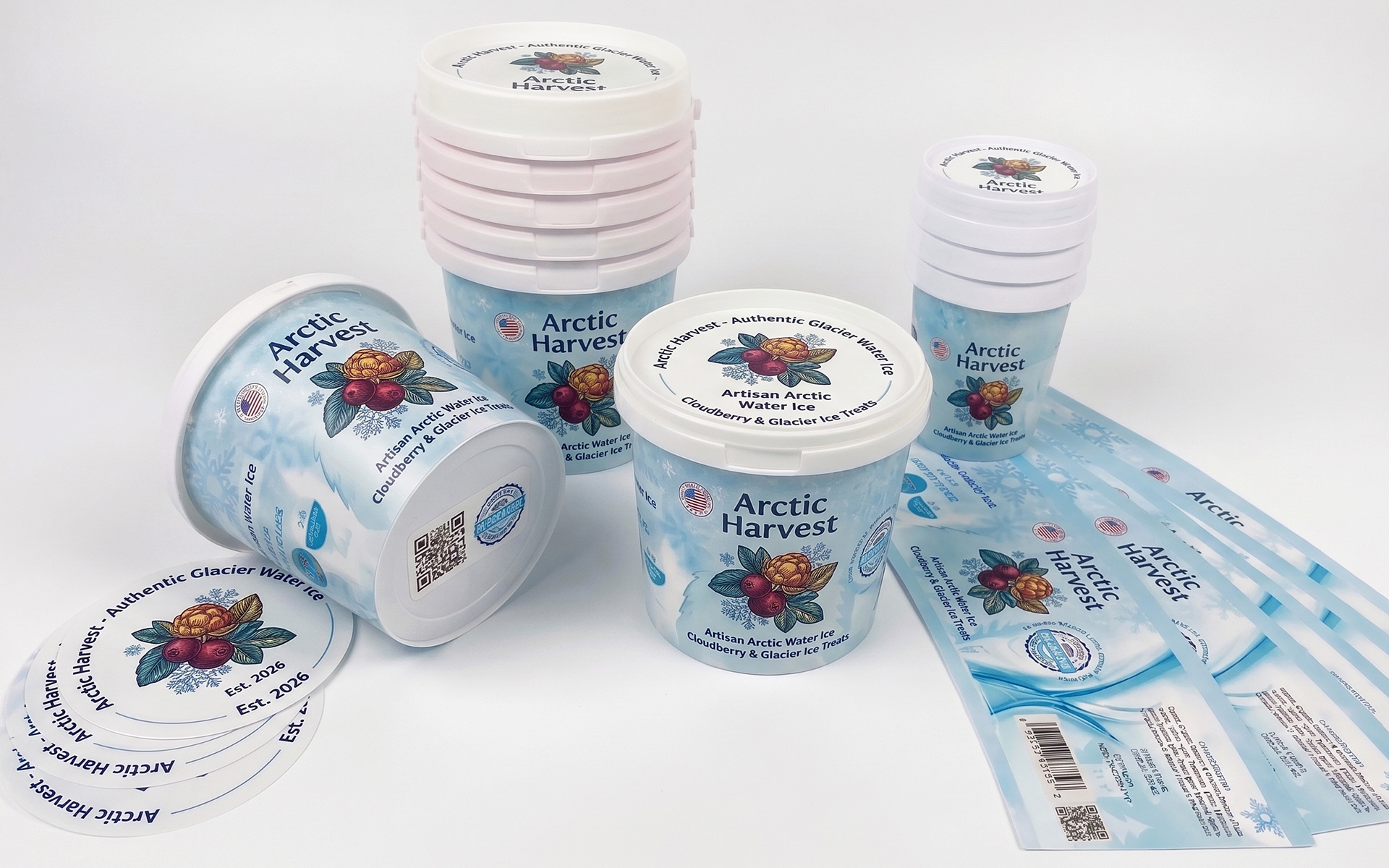
Ice cream is not like ordinary refrigerated products. It demands storage in circulating cold air at temperatures consistently below -20°C[reference:0][reference:1]. In supermarket freezer cabinets, containers are constantly exposed to:
- Extreme cold: Prolonged exposure to sub-zero temperatures.
- Heavy humidity and frost: Condensation forms every time the freezer door opens[reference:2].
- Repeated handling: Staff and shoppers pick up and put back containers countless times.
For ordinary self-adhesive labels, this environment is a nightmare. The adhesive weakens in the cold, moisture seeps in from the edges, and the label starts to bubble, curl, or peel off entirely[reference:3]. A consumer reaching for an ice cream tub may put it back if the label looks damaged – and that lost sale is just the beginning of the brand's problem.
This is precisely the problem that IML technology was designed to solve.
2. What Is IML? – The Label That "Grows" into the Container
To understand why IML labels survive where ordinary labels fail, we need to understand how they are made.
IML (In-Mold Labeling) is a process where a pre-printed label is placed into an injection mold before the plastic is injected[reference:4]. Under high temperature and high pressure, the molten plastic fuses with the label – they become a single, inseparable piece[reference:5].
The key difference is this: ordinary labels are "stuck on" – IML labels are "grown in." A self-adhesive label sits on the surface of the container, with a clear boundary between label and plastic. An IML label has no boundary – it is part of the container itself[reference:6].
This fundamental difference is what makes IML the ideal solution for ice cream packaging[reference:7][reference:8].
3. Why Do IML Labels Excel in -20°C Environments? – Four Core Advantages
3.1 Integrated Structure – No Edge to Lift, No Interface to Separate
This is IML's most fundamental advantage. Because the label and container are fused during the molding process, there is no physical "edge" where moisture can seep in[reference:9]. The label doesn't sit on top of the plastic – it is the plastic.
Counterfeiters and competitors cannot peel off an IML label without destroying the container itself[reference:10]. More importantly for ice cream, frost and condensation cannot get underneath the label because there is no "underneath" to speak of. The label simply cannot lift, curl, or peel off[reference:11][reference:12].
3.2 Unaffected by Humidity – Frost and Condensation Are No Match
IML labels are made from film and plastic materials that are inherently moisture-resistant[reference:13]. Traditional paper labels absorb moisture, swell, and warp – but IML labels have no paper component to absorb water.
Even when an ice cream container is covered in frost or dripping with condensation as it leaves the freezer, the IML label remains perfectly intact[reference:14][reference:15]. The printing is protected by the plastic layer, so it won't run, blur, or wash away[reference:16]. This moisture immunity is critical for products that spend their entire lifecycle in冷链 environments[reference:17].
3.3 Color Stability – High Contrast Even in Deep Freeze
Ordinary labels can fade or become discolored due to extreme temperature fluctuations. IML labels, however, maintain their high contrast and crisp readability even after prolonged exposure to -20°C conditions[reference:18][reference:19].
The printing is sandwiched between layers of plastic, protecting it from the elements[reference:20]. Whether it's a vibrant fruit image or fine-print nutritional information, the graphics remain sharp and eye-catching – exactly what a brand needs to stand out in a crowded freezer aisle[reference:21].
3.4 Temperature Resilience – From -20°C Freezer to Microwave
IML containers are typically made from food-grade polypropylene (PP), which offers an impressive operating temperature range of -20°C to 120°C[reference:22][reference:23]. This means the same container that survives the deep freeze can also go into the microwave for defrosting or reheating – without the label cracking, peeling, or releasing harmful substances[reference:24].
This thermal versatility adds real convenience for consumers and reduces the need for separate packaging for different temperature stages.
4. Real-World Success: From Nestlé to Magnum
4.1 Nestlé: The Pioneer of IML in Ice Cream Packaging
In China, the adoption of IML for ice cream packaging began around 2003, when Nestlé (China) launched its 1.5L family-size ice cream tubs with IML labels[reference:25]. The results were immediate and impressive:
- No more edge-lifting or blistering from freezer humidity[reference:26].
- Labels remained flat and clean, never stained by异物[reference:27].
- Production costs were reduced because labeling happened during molding, eliminating separate labeling steps[reference:28].
A Nestlé procurement representative confirmed that after nearly a year of market sales and storage testing, IML proved to be the ideal solution for ice cream products[reference:29]. The company's annual IML usage reached 50,000 units at that time[reference:30].
4.2 Magnum: IML for Deep-Freeze Excellence
More recently, Magnum – the premium ice cream brand – has embraced IML packaging for its pint-sized products[reference:31]. According to industry reports, the quality of IML packaging is "first class," which is "really important for deep freeze products"[reference:32].
The IML technology ensures that Magnum Pints "remain free of cracks and are perfectly protected against moisture and large fluctuations in temperature"[reference:33]. This level of protection is essential for maintaining both product quality and brand perception in the premium segment.
4.3 Major Chinese Brands Joining the Trend
Today, IML has become the go-to labeling solution for leading ice cream brands across China. Nestlé, Wall's (和路雪), BaXi (八喜), Mengniu (蒙牛), and Yili (伊利) have all transitioned their plastic ice cream cups to IML labels[reference:34][reference:35].
The technology has proven so successful in ice cream that it has since expanded to other food categories including milk, yogurt, coffee, milk tea, herbal jelly, biscuits, and candy[reference:36]. What started as a solution for the -20°C freezer has become a standard across the food packaging industry.
5. Beyond the Freezer: The Broader Value of IML
5.1 Enhanced Brand Image and Shelf Appeal
IML supports high-definition printing with up to 11 colors, as well as special effects like metallic finishes, holographic patterns, and 360-degree panoramic graphics[reference:37][reference:38]. The result is a container that looks premium, feels smooth to the touch, and commands attention on the freezer shelf[reference:39].
Unlike silk-screening or glued labels, IML colors are more vibrant and three-dimensional[reference:40]. This visual superiority directly translates into higher consumer appeal and stronger brand recognition.
5.2 Cost Efficiency and Production Speed
While the initial investment in IML molds and equipment can be significant[reference:41], the per-unit cost becomes highly competitive at scale. For example, a 150g PP cup produced in a four-cavity mold with a 6-second cycle time can achieve an IML label cost of approximately 0.12 RMB per unit[reference:42].
Additional cost savings come from:
- Eliminating separate labeling steps and labor[reference:43].
- Reducing material usage – labels applied inside the lid can reduce the amount of plastic resin needed[reference:44][reference:45].
- IML can also increase container side-wall strength, allowing for thinner walls and less resin usage[reference:46].
5.3 Full Recyclability – A Sustainable Choice
Because IML labels and containers use the same material (typically PP), there is no need to separate the label during recycling[reference:47]. The entire container can be shredded and recycled together[reference:48]. This single-material design makes IML packaging fully recyclable[reference:49] – a growing requirement for brands committed to sustainability.
Some manufacturers are now offering IML containers made from 100% post-consumer recycled (PCR) PP, further reducing the environmental footprint[reference:50].
6. FAQ: Common Questions About IML in Ice Cream Packaging
Yes. IML containers are typically made from food-grade PP with an operating range of -20°C to 120°C[reference:51][reference:52]. The integrated structure means the label expands and contracts with the container, preventing cracks or detachment[reference:53].
Nothing. IML labels are completely waterproof and unaffected by humidity[reference:54][reference:55]. The label is fused into the plastic, so moisture cannot get underneath it. The printing remains crisp and clear even when covered in frost[reference:56].
Yes. The PP material used for IML containers is microwave-safe up to 120°C[reference:57][reference:58]. The label is fully integrated and will not peel, crack, or release harmful substances during heating.
The upfront investment in molds and equipment is higher[reference:59]. However, at scale, the per-unit cost is highly competitive – as low as 0.12 RMB per label for high-volume production[reference:60]. When you factor in the elimination of separate labeling steps and reduced material usage, IML often offers lower total cost[reference:61].
Yes. IML labels and containers use the same PP material, so no label separation is needed during recycling[reference:62]. The entire container can be shredded and recycled together, making IML a fully recyclable packaging solution[reference:63][reference:64].
Major brands including Nestlé, Wall's, BaXi, Mengniu, Yili, and Magnum have all adopted IML for their ice cream packaging[reference:65][reference:66][reference:67]. The technology has become the industry standard for premium ice cream containers.
Absolutely. IML is widely used for frozen yogurt, frozen meals, frozen desserts, and other refrigerated or frozen products[reference:68][reference:69]. Its moisture and temperature resistance make it ideal for any product stored in冷链 conditions.
Contact Us
Name*
Telephone*
Region*
Please fill in your request*


