
-20℃ to 120℃ "All-Rounder" – Why Can IML Cold Drink Cups Handle Both Cold and Hot?
-20℃ to 120℃ "All-Rounder" – Why Can IML Cold Drink Cups Handle Both Cold and Hot?
On a scorching summer day, you take a cup of smoothie from the freezer, its surface covered in condensation. In the dead of winter, you use the same cup to hold a warm fruit tea. The same cup – able to "withstand" the extreme cold of the freezer and the warmth of a hot beverage – may sound like some kind of "black magic," but for IML cold drink cups, it is simply their "basic qualification."
Table of Contents
- 1. The "Core Weapon" of IML Cold Drink Cups – Food-Grade PP Material
- 2. The "-20℃ Cold Test" – Stable Performance in Frozen Environments
- 3. The "120℃ High-Temperature Challenge" – Handling Hot Filling with Ease
- 4. "All-Temperature" Versatility – From Smoothies to Hot Coffee
- 5. IML Gives Cold Drink Cups "Beauty and Brawn" – Not Just Temperature Resistance, But Also Aesthetics
- 6. FAQ
1. The "Core Weapon" of IML Cold Drink Cups – Food-Grade PP Material
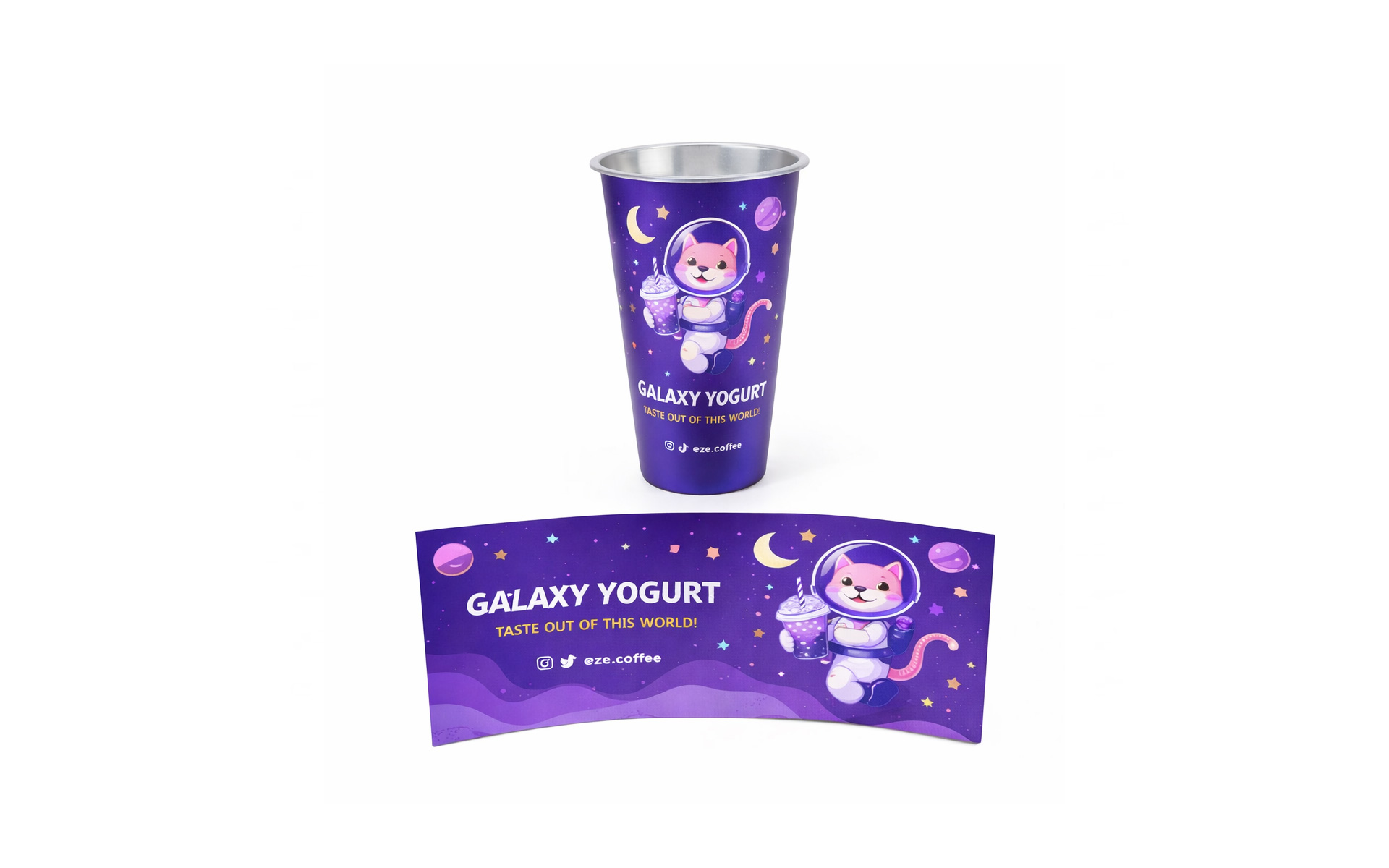
The secret behind IML cold drink cups' ability to "handle both cold and hot" lies in their material – food-grade polypropylene (PP).
PP is a thermoplastic widely used in food packaging, known for its excellent heat resistance, cold resistance, and chemical resistance. Compared to ordinary plastics, PP's molecular structure ensures stability under extreme temperatures – it does not become brittle in the cold nor soften and deform under heat.
IML cold drink cups are injection-molded from food-grade PP, making them safe, odorless, and suitable for direct food contact. Their temperature resistance range spans -20℃ to 120℃. Some high-quality products can even extend this range to -40℃ to 121℃.
More importantly, the IML process fuses the label with the cup body during injection molding. The label is not "stuck on" – it is "grown into" the cup – meaning that under extreme temperatures, the label will not curl, peel, or wrinkle due to thermal expansion and contraction. Whether frozen or heated, the label and the cup body expand and contract together.
2. The "-20℃ Cold Test" – Stable Performance in Frozen Environments
For cold drink cups, low temperatures are "business as usual" – freezers, cold storage, cold chain transport, and beverages with ice often require cups to "survive" in sub-zero environments.
Ordinary plastic cups become brittle in low temperatures and crack easily upon impact. Ordinary pressure-sensitive labels, under the combined assault of low temperatures and condensation, suffer from curling, bubbling, and peeling. IML cold drink cups, however, are completely different.
The -20℃ lower temperature limit means IML cold drink cups can:
- Be stored long-term in -18℃ freezers without becoming brittle or cracking
- Withstand temperature fluctuations during cold chain transport while maintaining structural integrity
- Hold smoothies, ice cream, frozen yogurt, and other frozen desserts without the cup deforming
IML labels also perform exceptionally well in low-temperature environments. The label and cup body are integrally molded, with no "edge gaps" for condensation to penetrate. Even when the cup walls are covered in water droplets, the label remains perfectly flat – no curling, no bubbling, no peeling.
3. The "120℃ High-Temperature Challenge" – Handling Hot Filling with Ease
If low temperatures are "routine operations," then high temperatures are the true "litmus test."
Many cold drink cups are only suitable for cold beverages – once you pour in a warm drink, the cup deforms, softens, or even releases odors. But the 120℃ upper temperature limit of IML cold drink cups allows them to handle hot beverage scenarios with ease.
What does 120℃ mean?
- Boiling water is 100℃
- Hot coffee and tea are typically 70-85℃
- Pasteurization temperature is 72-75℃
- Hot filling temperature is typically 85-95℃
This means IML cold drink cups can not only hold hot coffee, hot tea, and hot chocolate but can also directly withstand hot filling processes and pasteurization treatment.
At high temperatures, food-grade PP material does not release harmful substances. The label's integrated molding with the cup body also ensures that the label will not fade or peel due to heat. The temperature resistance of IML cold drink cups makes them a reliable choice for many food brands' filling processes.
4. "All-Temperature" Versatility – From Smoothies to Hot Coffee
IML cold drink cups' "-20℃ to 120℃" temperature range covers the vast majority of hot and cold beverage temperature requirements. This means one cup can handle the following scenarios:
| Temperature Range | Typical Scenarios | IML Cup Performance |
|---|---|---|
| -20℃ ~ 0℃ | Smoothies, ice cream, frozen yogurt, frozen storage | Cup does not become brittle; label does not curl |
| 0℃ ~ 25℃ | Cold brew coffee, juice, milk tea, room temperature beverages | Daily use; stable performance |
| 25℃ ~ 85℃ | Hot coffee, hot tea, hot chocolate | Cup does not deform; safe and odorless |
| 85℃ ~ 95℃ | Hot filling processes | Can directly withstand hot filling temperatures |
| 95℃ ~ 120℃ | Pasteurization, high-temperature sterilization | Short-term resistance; material remains stable |
A smoothie cup taken straight from the freezer can have 85℃ hot coffee poured into it – the same cup, two extreme temperatures, and IML handles both.
5. IML Gives Cold Drink Cups "Beauty and Brawn" – Not Just Temperature Resistance, But Also Aesthetics
IML cold drink cups' "versatility" is not limited to temperature resistance – it also extends to appearance and durability.
Labels that never peel: IML labels are integrally molded with the cup body, eliminating issues such as curling, bubbling, and peeling. Neither condensation from the freezer nor steam from hot beverages can damage the label.
Patterns that never fade: The ink is sandwiched between the film and the plastic, never directly exposed to the outside. Patterns remain vivid and clear throughout the product's entire life cycle.
Waterproof, oil-proof, and scratch-resistant: IML labels are waterproof, oil-proof, scratch-resistant, abrasion-resistant, and acid/alkali-resistant. In alternating hot-and-cold usage scenarios, the label always looks like new.
Food-grade safety assurance: Food-grade PP material is safe for direct food contact and does not release harmful substances at high temperatures.
6. FAQ
Mainstream products have a temperature resistance range of -20℃ to 120℃. Some high-quality products can achieve -40℃ to 121℃ or even broader ranges.
Yes. IML cold drink cups have an upper temperature limit of 120℃, so boiling water (100℃) is well within the safe range. However, prolonged exposure to high temperatures may affect the cup's lifespan – always follow the product usage instructions.
Some IML cold drink cups are microwave-safe, but check whether the product is labeled "microwave-safe." PP material itself can withstand microwave heating, but the lid and label may have different temperature tolerances. Always consult the specific product's usage instructions.
No. IML cold drink cups are made from food-grade PP material with a lower temperature limit of -20℃. They will not become brittle or crack in freezing environments. IML labels are also unaffected by frozen conditions.
No. IML labels fuse with the cup body during injection molding – they are not "stuck on" with adhesive. Whether frozen or heated, the label will not peel, curl, or bubble.
Very much so. IML cold drink cups use a single PP material (both cup body and label are the same material). During recycling, no label separation is required – the entire cup can be directly shredded and repelletized.
Contact Us
Name*
Telephone*
Region*
Please fill in your request*


