
Not Just About Looks – How IML Helps Cheese Boxes "Slim Down" and "Toughen Up"?
Not Just About Looks – How IML Helps Cheese Boxes "Slim Down" and "Toughen Up"?
When you pick up a cheese box from the supermarket shelf, your eyes are often drawn first to the beautifully designed packaging – vibrant cheese imagery, clear product information, and refined design elements. These are indeed the strengths of In-Mold Labeling (IML) technology. But to think that IML's value ends there would be underestimating it.
The true power of IML technology lies in this: it is both a packaging "decorator" and a structural "engineer." With IML, cheese boxes not only get a beautiful "outer garment" but also achieve thin-wall lightweighting and structural reinforcement – simultaneously "slimming down" and "toughening up."
📖 Table of Contents
1. The Art of "Slimming Down" – How IML Reduces Cheese Box Wall Thickness?
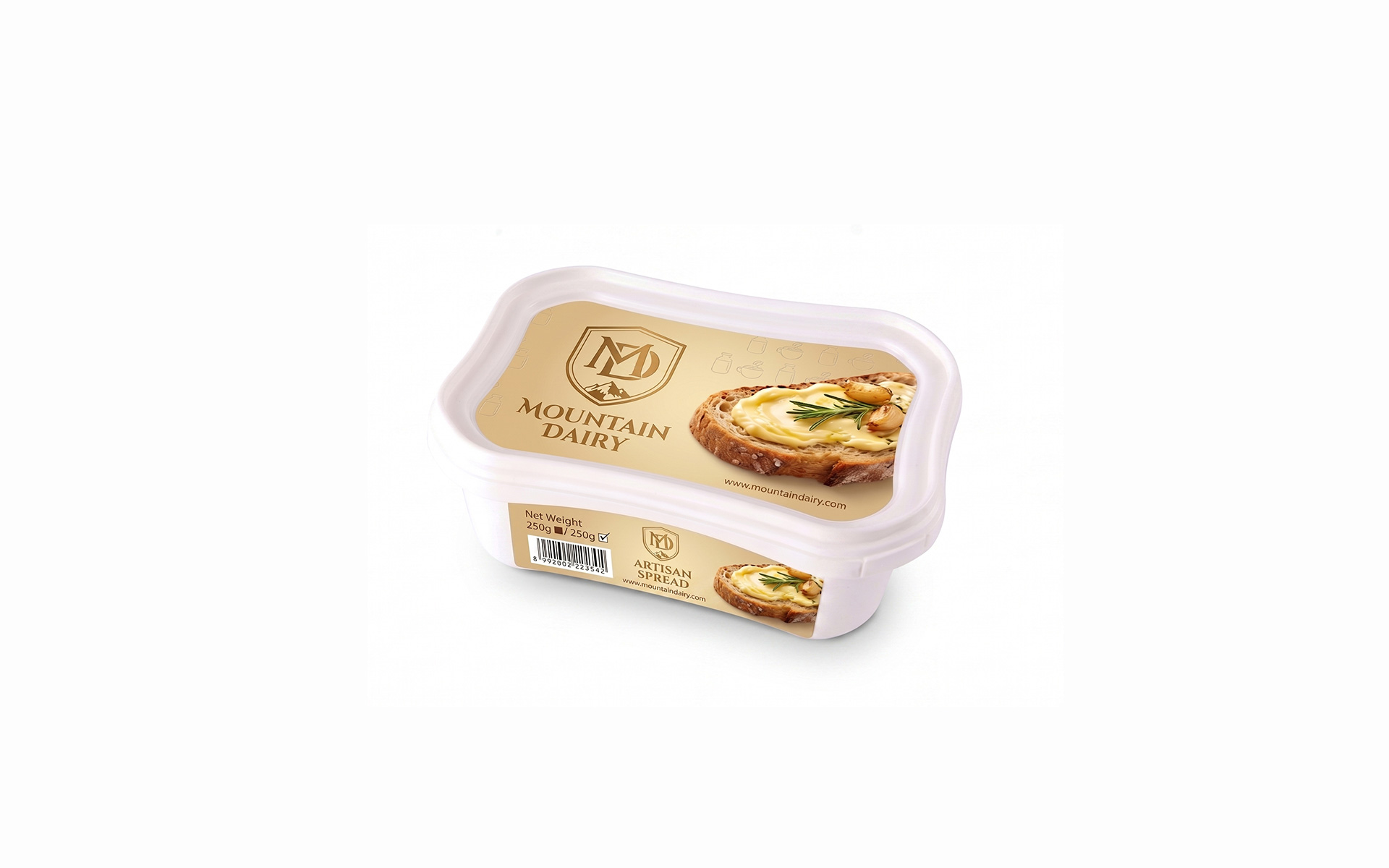
Traditional packaging design has always faced a dilemma: the thinner the packaging, the more material is saved and the more environmentally friendly it is – but also the more prone it is to deformation and damage. Designers have had to choose between "thin" and "strong." IML breaks this trade-off.
1.1 The Process Breakthrough of IML Thin-Walling
Although an IML label is less than 50 microns thick, it provides additional stability to the container during the injection molding process. This structural "bonus" allows container wall thickness to be reduced.
The case of Austrian dairy company Ennstal Milch is compelling. They were already producing Greek yogurt PP mono-material thin-wall cups using IML, but wanted to further reduce material usage. After collaborating with packaging manufacturer Greiner, they successfully reduced container wall thickness by 0.1mm – wall thickness down to 0.3mm, and the base to 0.35mm.
This is not an isolated case. In injection molding, IML thin-wall cups can achieve wall thicknesses as low as 0.37mm (approximately 0.015 inches), with a single-unit weight of just 10.4 grams. The IML thin-wall cup demonstrated by ARBURG at NPE 2024 had a wall thickness of only 0.37mm and a molding cycle time of just 3.95 seconds.
Another typical example is a 150ml IML thin-wall yogurt cup: the labeled product weighed 6.4 grams, while the unlabeled version was only 5.4 grams, with a wall thickness of just 0.32mm and a cycle time of only 3.9 seconds.
1.2 Why Does Thin-Walling Work?
The answer lies in the fact that the label is itself part of the structure.
Traditional decoration methods – pressure-sensitive labels, screen printing, etc. – are merely a layer "stuck on" after the container is formed, serving no structural function. IML is completely different: the label fuses with the container during injection molding, becoming an integral part of the container wall. This film, less than 50 microns thick, effectively adds a "skeleton" layer to the container surface.
This integrated structure allows the container to maintain sufficient strength and stability even with reduced wall thickness.
From 13 grams to 10.4 grams – ARBURG's injection-compression process reduced product weight by 20%. From conventional thin-wall to ultra-thin-wall – StackTeck's TRIM technology further reduced container weight by 41%. Behind these numbers are tangible resin savings and carbon footprint reductions.
2. The Way of "Toughening Up" – How In-Mold Labels Enhance Container Strength?
If "slimming down" is IML's "subtraction" capability, then "structural reinforcement" is its "addition" capability.
2.1 The Label as Skeleton
Once embedded in the container wall, the IML label effectively adds a reinforcing layer to the plastic substrate. This reinforcing layer not only improves the container's sidewall strength but also allows packaging weight to be reduced by 10%-15%.
The label has dual structural and decorative value – it reinforces sidewall strength while enabling weight reduction. In simpler terms: the label is no longer a "stuck-on" burden, but a "grown-in" structural component.
2.2 Improved Compressive Strength
For products like cheese boxes that need to be stacked on shelves and withstand transportation vibrations, compressive strength is a critical performance metric.
IML containers perform more stably during stacking and transport. Some studies show that in-mold labels produced with specific paper materials offer higher packaging strength than traditional film labels, with greater compressive strength and allowing more layers to be stacked.
In the thin-wall yogurt cups produced by Greiner for Ennstal Milch, the new design allows safe stacking even when filled, and feels comfortable and stable in the consumer's hand when scooping – with no noticeable difference from conventional wall thickness products.
2.3 Full-Surface Coverage Reinforcement
IML labels can cover three, four, five, or even eight sides of the container. The larger the coverage area, the more significant the reinforcement effect. When the label covers the entire outer surface, the IML method also helps improve barrier properties.
For cheese boxes that require good freshness preservation, IML enhances both structural strength and protective performance – two benefits in one.
3. Dual Benefits – Lighter, Stronger, and More Sustainable
"Slimming down" and "toughening up" are not separate effects. Together, they deliver threefold value to cheese box packaging:
3.1 Material Benefits – Less Resin, Lower Cost
Thin-walling directly reduces PP resin consumption. The cups Greiner produced for Ennstal Milch saw a 20% reduction in material usage. Saving 20% on one cup might be small, but across a million cups, the material savings are substantial. For large-scale cheese box production, this material saving translates directly into cost advantages.
IML containers' thin-wall design not only reduces resin usage and carbon footprint but also offers recyclability, meeting the growing demand for sustainable packaging.
3.2 Logistics Benefits – Lighter Weight, Higher Efficiency
Lighter packaging means lower transportation costs. The same truck, the same fuel, can carry more product. StackTeck's TRIM technology made containers 20% lighter than conventional thin-wall containers. For cheese brands shipping in large volumes, this weight difference has a significant impact on logistics costs.
3.3 Environmental Benefits – Lower Carbon Footprint
IML thin-wall packaging reduces material usage while also lowering energy consumption and carbon emissions during production. ARBURG's injection-compression process improved energy balance by 20%. Every stage – from raw materials to production to transportation – sees a reduced carbon footprint.
More importantly, IML labels and PP containers use the same material, making the entire package 100% recyclable. NextCycle IML™ labels can be completely separated from PP material during recycling without affecting the quality of the recycled material.
4. FAQ
Yes. IML labels fuse with the container during injection molding, becoming part of the container wall. Although the label itself is only tens of microns thick, it provides additional stability, allowing the container to maintain sufficient strength even with reduced wall thickness.
No. Rigorously tested, containers with IML thin-wall design can stack safely even when filled, with no reduction in compressive strength. Some IML containers even exhibit higher compressive strength, allowing more layers to be stacked.
Yes. IML containers use food-grade PP material with a temperature resistance range of -20°C to 120°C. Thin-wall IML cups are also suitable for hot filling up to 85°C.
The exact weight reduction depends on design and process, but industry data shows IML labels can reduce packaging weight by 10%-15%. Advanced processes can achieve 20%-41% weight reduction.
Very much so. Thin-wall design reduces resin usage and carbon footprint. Additionally, IML labels and containers use the same PP material, enabling 100% recyclability, with no negative impact on recycled material quality.
IML labels are typically less than 50 microns thick. While they do add to the container's total thickness, the structural reinforcement they provide far outweighs this minimal thickness increase, allowing the container to achieve equivalent strength with a thinner main wall.
Contact Us
Name*
Telephone*
Region*
Please fill in your request*


