
Die Cutting – The Final Step in In-Mould Label Manufacturing
Die Cutting – The Final Step in In-Mould Label Manufacturing
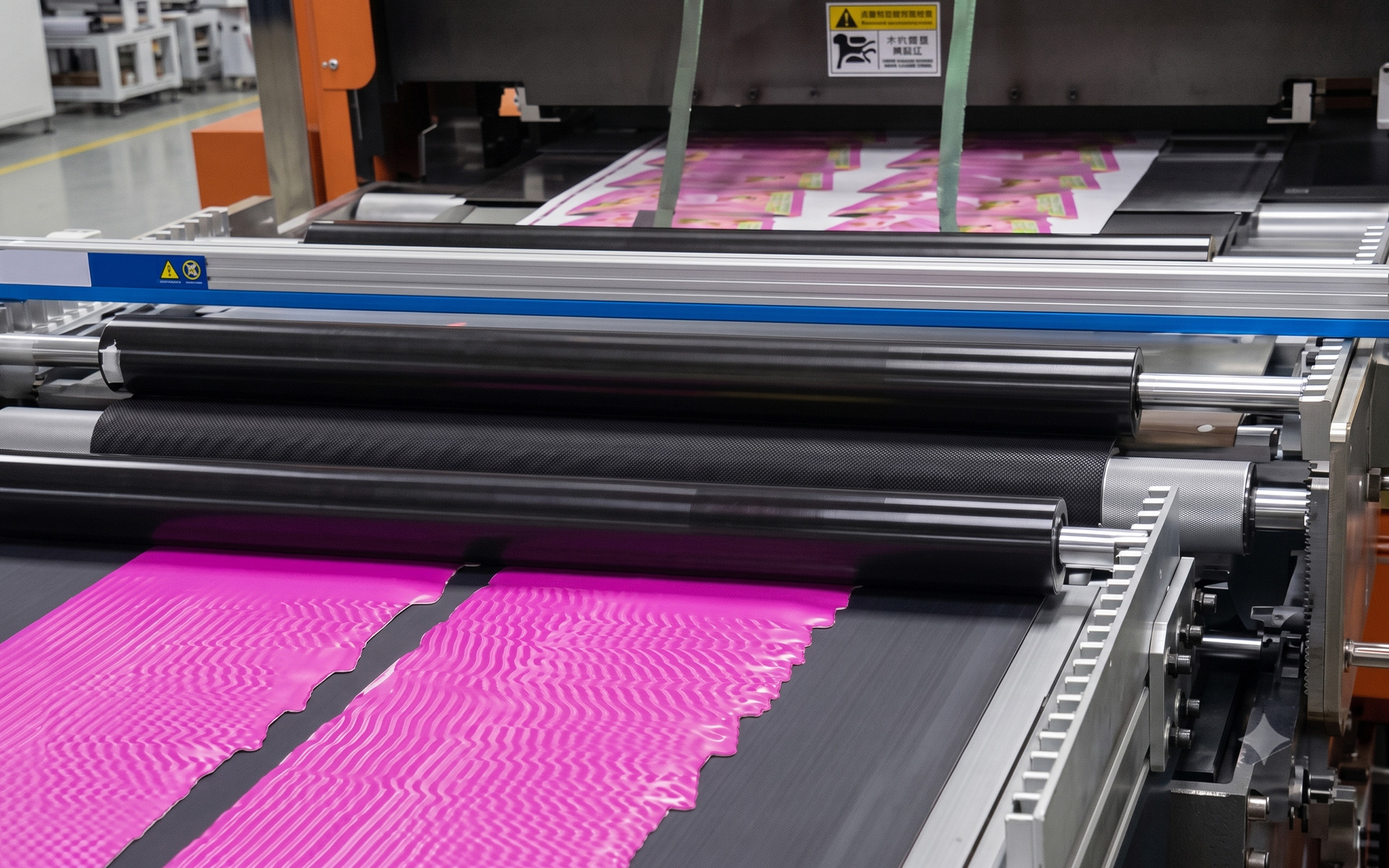
In‑mould labelling (IML) is a process that integrates a pre‑printed label with a plastic container in a single moulding operation. From film manufacturing, multi‑layer lamination, surface modification, gravure printing to coating and varnishing, the label goes through a long processing chain. Die cutting is the very last step in this chain – it determines the dimensional accuracy of the label and the uniformity of the stacked labels, which directly affects the pick‑up success rate of the robot in the subsequent IML labelling process and the accuracy of label placement. Precisely this “final step” plays a decisive role in final product quality.
Taking industry supplier MOTEK as an example, the IML die‑cutting solution used by MOTEK fully reflects the current requirements for high precision, high efficiency and stability. The intermittent die cutter employed by MOTEK is particularly suitable for high‑precision products such as IML labels, and has gained wide application in areas including health & beauty, food & beverage, and lubricant packaging. Regardless of the brand of equipment, IML die cutting must address the following core technical issues.
1. Fundamentals and Classification of IML Die Cutting
The biggest difference between IML labels and traditional pressure‑sensitive labels is: pressure‑sensitive labels have a release liner, so kiss cutting (cutting only the facestock) is possible; IML labels have no liner and must be cut completely through (full cut). This requires the die‑cutting tool to be extremely sharp and the pressure to be precisely controlled, avoiding the two extremes of “not cutting through” or “cutting through too much causing loose pieces”.
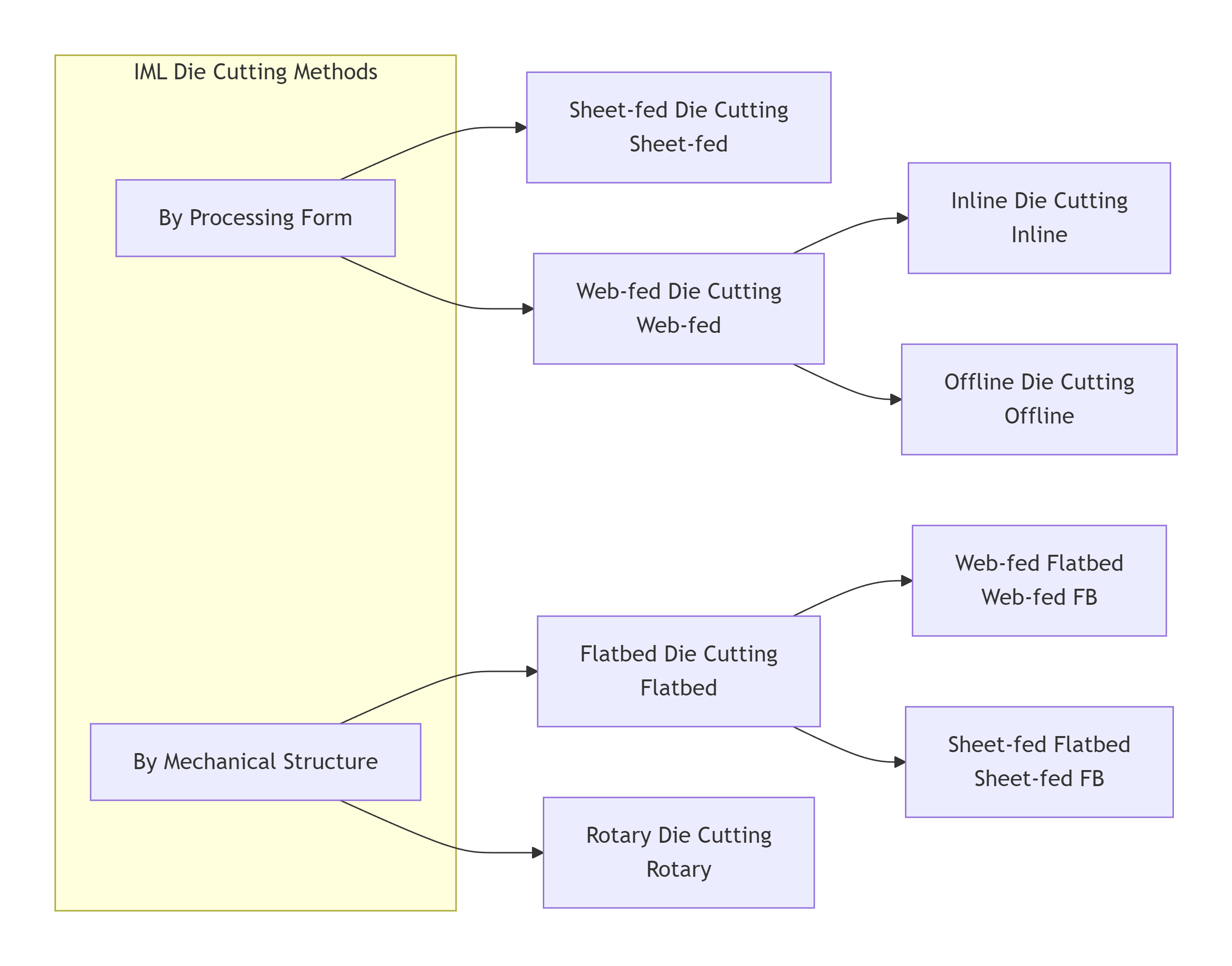
Depending on the product form, die cutting is divided into sheet‑fed die cutting and web‑fed die cutting; depending on the equipment construction, it is divided into flatbed die cutting and rotary die cutting. Web‑fed die cutting can be further divided into inline die cutting (printing and die cutting completed in one pass) and offline die cutting (printing first, then die cutting separately). The inline/offline switching capability of MOTEK equipment gives label converters flexible production organisation.
2. Flatbed Die Cutting
Flatbed die cutting is the most traditional method. The die is a flat plate that moves up and down in a reciprocating motion, “punching” the label from the material like a stamping press.
(1) Web‑fed flatbed die cutting
This method is used for web‑fed IML label materials and is an offline process. There are two feeding methods: intermittent feeding (the die‑cutting unit only moves vertically) and continuous feeding (the die‑cutting unit both moves vertically and oscillates back and forth). After die cutting, the labels are conveyed to a stacking station. In practice, because web‑fed flatbed die cutting requires frequent start‑stop operations, its efficiency is limited at high speeds. Today it is mainly used for small to medium batch orders or sample making.
(2) Sheet‑fed flatbed die cutting
This method is used for sheet‑fed label materials and is also an offline process. An automatic sheet feeder feeds individual sheets into the die‑cutting station; after cutting, waste is automatically stripped, and finished labels are placed on a stacking station by a robot. Sheet‑fed flatbed cutting offers average accuracy (typically ±0.2–0.5 mm) but extremely low tooling cost, making it suitable for small batches, many varieties, or trial production.
(3) Application scenarios for flatbed cutting
Small batch orders (a few thousand to tens of thousands of sets)
Frequently changing label shapes
Label converters with limited budget (low tooling investment)
3. Rotary Die Cutting
Rotary die cutting is currently the mainstream high‑efficiency method. The die is cylindrical and rotates at high speed; the material passes continuously and is cut.
(1) Inline rotary die cutting
This is usually an inline process (printing and die cutting completed in one pass), but it can also be done offline: printing first, then die cutting on a rotary die cutter with automatic waste stripping. Rotary die cutting offers the highest cutting accuracy. However, the cost of manufacturing the die cylinder is relatively high, making it suitable for long runs of more than 100,000 pieces.
The MOTEK equipment adopts the inline rotary die‑cutting path, completing printing, varnishing, die cutting and waste stripping in one pass on a flexographic printing line. According to literature reports, rotary die cutting is suitable for web‑fed IML labels and can be offered in both inline and offline versions. This method is highly efficient in inline flexo production and is popular in the United States.
Main advantages of rotary die cutting:
Very high speed – can match printing speeds above 300 m/min
Extremely high precision – with precise servo control, registration accuracy can reach ±0.1 mm
Long tool life – carbide or magnetic dies can run for millions of cuts
Automatic waste stripping – waste is separated and recovered automatically without manual intervention
(2) Web‑fed flatbed die cutting (as a supplement to rotary)
For high‑precision IML labels made from special materials that cannot be processed inline, offline web‑fed flatbed die cutting can be used for final shaping. This offline method, together with inline rotary cutting, forms a “combined punch” for volume production – long runs use inline rotary, short runs and special shapes switch to flatbed, complementing each other to ensure delivery schedules.
4. Special Considerations for Die Cutting Materials Containing LDPE/PE Layers
IML label materials often contain LDPE or PE layers (e.g., PE+PP composite films). The characteristic of such materials is: LDPE is tough and elastic. If the cut is not clean, it is easy to get “stringing” or “bridging” – the label is not fully cut through, leaving ragged edges or filaments. This not only affects appearance but can also cause failures in automatic waste stripping.
The industry best practice to solve this problem is to use a shear‑cut method with a male/female rotary die. The principle is that the male and female dies form a shearing engagement; the blade does not directly contact the anvil roll, so the blade almost never gets damaged, the die has a long service life, and the cut edge is very clean, effectively preventing the stringing phenomenon caused by incomplete cutting of the LDPE layer. For labels with variable dimensions and higher material density, it is recommended to use a magnetic die cylinder with magnetic sheet‑type dies – when changing jobs, only the magnetic sheet needs to be replaced, not the cylinder, reducing cost and shortening the setup time.
5. Static Electricity Control in Inline Die Cutting
IML labels are good electrical insulators. During printing and web transport, friction‑induced static electricity cannot be easily dissipated through the material itself. This can cause “double‑sheet” problems during robot pick‑up – multiple labels stick together and are picked up simultaneously, leading to inaccurate placement or machine stoppage. This problem is especially prominent in high‑speed inline die cutting.
Therefore, it is essential to install high‑voltage static eliminators (e.g., AC corona bars or pulsed DC bars) at the finished label collection and stacking station to remove accumulated static charges. In actual production, MOTEK equipment includes an active static elimination system at the infeed to the rewinder – this effectively reduces stacking misalignment and double‑sheet faults. Additionally, static elimination is performed again on the label stack just before the IML labelling process, ensuring high pick‑up success rates.
6. Conclusion
Die cutting, as the final step in IML label production, must achieve a full cut through liner‑free label material under conditions of high speed, high precision and automatic waste stripping, while solving production challenges such as static interference, waste separation, and stringing of elastic materials.
The high‑performance intermittent die cutters represented by MOTEK’s solution combine rotary die cutting, inline integrated processing and intelligent control modules, offering label converters an IML die‑cutting path characterised by high efficiency, high precision and high stability. Looking forward, as the penetration of IML labels continues to grow in daily chemicals, food, pharmaceuticals, beverages and electronics, the inline, automated and intelligent development of IML die‑cutting equipment will become the mainstream trend.
Contact Us
Name*
Telephone*
Region*
Please fill in your request*


