
Core Mechanisms of In-Mold Labeling: Four Technical Dimensions
Core Mechanisms of In-Mold Labeling: Four Technical Dimensions
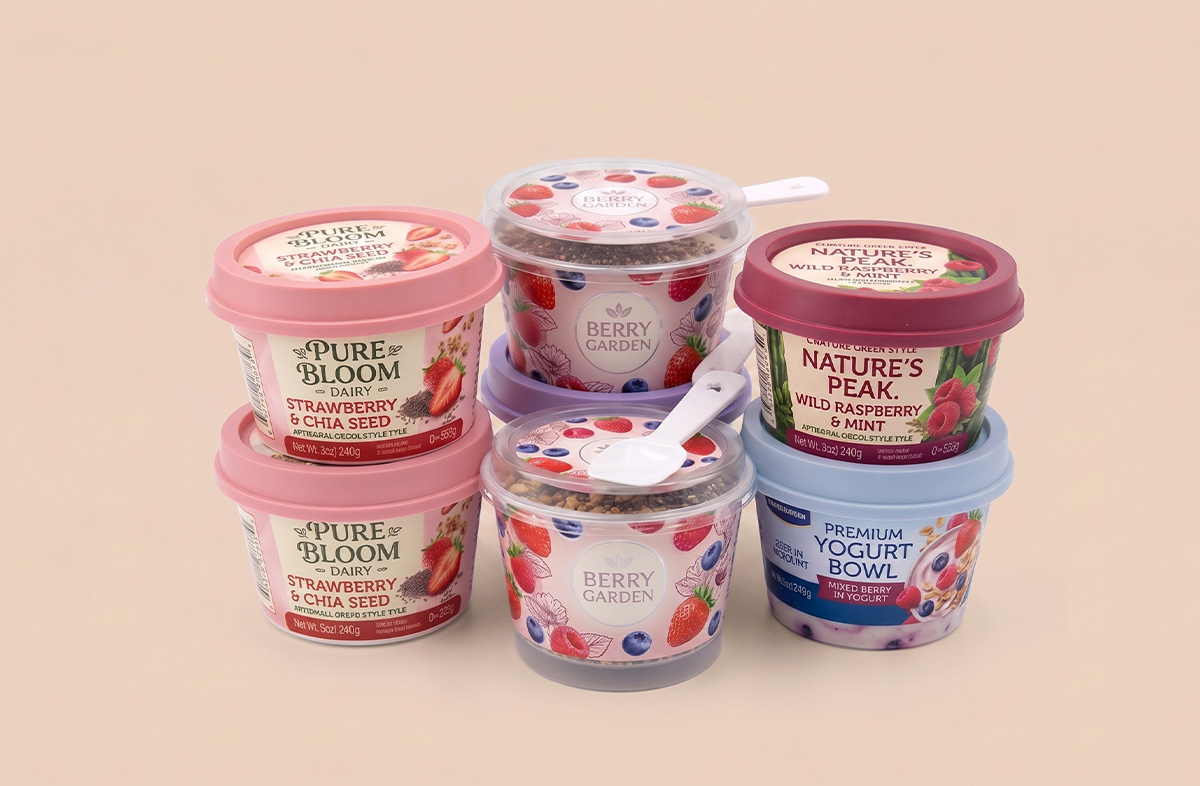
The reason why in-mold labeling (IML) can achieve “molding and labeling in one step” is not the result of a single technological breakthrough, but rather the synergy of four key mechanisms. Understanding these four dimensions – simultaneous molding, heat-seal adhesion, same-material matching, and precise positioning – helps to fully grasp the technical advantages and application boundaries of IML.
1. Simultaneous Molding: Process Integration
Core meaning
Simultaneous molding means that the fusion of the label and the formation of the container are completed within the same mold cycle, with no need for any post-mold labeling operation. Whether in blow molding or injection molding, the label is bonded to the container surface at the same time as the molten plastic fills the mold cavity.
Technical implementation
Before the mold closes, the label is precisely placed on the inner cavity wall (by vacuum or electrostatic adsorption).
When the molten plastic is injected or blown into the cavity, the plastic contacts the back of the label, and the label is bonded during the cooling and solidification of the plastic.
When the mold opens, the label is already integrated with the container – a “finished labeled part” is obtained directly.
Key advantages
Eliminates post-mold processes: Traditional processes require separate pressure-sensitive labeling, shrink sleeving, or screen printing after injection/blow molding. IML embeds labeling within the molding cycle, saving labor, equipment, floor space, and energy.
Avoids secondary damage: Post-mold labeling may cause waste due to inaccurate positioning, glue overflow, or label edge lifting. IML is completed inside the mold with precise positioning and no secondary contamination.
Improves production efficiency: Although each molding cycle adds a small label‑placement time (about 1–2 seconds), the separate labeling line is eliminated. Overall throughput is often higher, especially for high-volume production.
Example comparison
Conventional 1L shampoo bottle production: blow molding (6 s) → collection → transfer to labeler → pressure‑sensitive labeling (3 s) → inspection → packaging. Total cycle time ~9–10 seconds per bottle, requiring two sets of equipment and operators.
IML blow molding: label placement (1.5 s) + blow molding (6 s) performed in parallel – finished part out of the mold. Total cycle time ~7.5 seconds per bottle, single line, with 20–30% lower overall cost.
2. Heat-Seal Adhesion: No Additional Glue
Core meaning
Heat-seal adhesion means that the back of the IML label is pre-coated with a special heat‑activated adhesive (solid at room temperature). When the mold temperature rises to the melt temperature of the plastic, this adhesive layer melts, becomes tacky, and firmly bonds the label to the container wall as it forms. No extra glue or double‑sided tape is required.
Technical details
Adhesive composition: Typically modified polyolefin hot‑melt adhesives that are compatible with PP/PE materials. Their melting point is designed to lie within the melt temperature range of the plastic (approx. 140–200°C) but above the mold ejection temperature, so that they solidify upon cooling.
Coating structure: Depending on label area and application, the adhesive layer can be a smooth continuous film (suitable for small labels) or an embossed mesh/dot pattern (suitable for large labels to allow air venting).
Melting and solidification: During the high‑temperature phase in the mold, the adhesive fully melts and wets both the label substrate and the container surface. During cooling, the adhesive recrystallizes and solidifies, creating a strong bond through mechanical interlocking and intermolecular forces.
Key advantages
Solvent‑free, zero VOC: Hot‑melt adhesives are 100% solids, emitting no organic solvents – environmentally friendly and safe for food and medical packaging.
Instant bonding: The bond is formed simultaneously with container molding; no drying or curing time is needed.
Excellent weatherability: The cured adhesive layer is resistant to water, oil, common chemicals, and temperature variations (–20°C to 80°C).
Common misconception
Some believe that IML bonding relies mainly on the molten plastic itself “melting” the back of the label. In fact, the vast majority of IML labels depend on a dedicated adhesive layer. Even when the label substrate and container are the same material, without an adhesive layer the bond strength from molecular chain diffusion alone is limited, and delamination can easily occur. Therefore, Motek emphasizes that a well‑designed adhesive layer is essential for high‑quality IML.
3. Same‑Material Matching: Molecular Fusion & Recyclability
Core meaning
Same‑material matching means that the label substrate and the plastic container are made from the same type of polymer (e.g., PP label with PP container, PE label with PE container). This “same‑material” design allows the molecular chains of the label and the container to interdiffuse and entangle at the interface during high‑temperature molding, achieving true molecular‑level fusion – not just simple mechanical anchoring or adhesive bonding.
Scientific principle
When two identical or fully compatible polymers contact each other in the molten state, the molecular chains at the interface cross the original boundary, diffusing into and entangling with each other. After cooling, the interface disappears and becomes a continuous entity.
For IML, the label substrate (e.g., BOPP film) and the container melt (e.g., PP) contact each other under high temperature and pressure inside the mold. The molecular chains at the interface gain enough mobility to interdiffuse. Together with the assistance of the heat‑seal adhesive layer, an inseparable integrated structure is formed.
Key advantages
Extremely high bond strength: In destructive tests, failure usually occurs in the bulk material rather than at the label‑container interface, meaning the label cannot be peeled off intact.
No delamination risk: Conventional pressure‑sensitive labels are prone to edge lifting or peeling under humid, high‑temperature, or stressed conditions. A same‑material fused IML label does not have this problem.
Easy recycling: Because the label and container are the same (or compatible) material, the entire package can be directly sent to shredding, washing, and re‑pelletizing without label separation – supporting a circular economy. In contrast, a different‑material label (e.g., PET label on a PE bottle) requires an extra separation step; otherwise it contaminates the recyclate.
Material matching table
| Container material | Recommended label substrate | Same‑material? | Recycling compatibility |
|---|---|---|---|
| PP | PP | Yes | Perfect – can be directly co‑ground |
| PE (HDPE/LDPE) | PE | Yes | Perfect |
| PET | PET (special adhesive required) | Yes | Directly recyclable, but process difficulty is high |
| PS | PS | Yes | Compatible |
| Multi‑layer composite bottle | Same as innermost or outermost layer | Depends | Evaluate case by case |
Note: Although same‑material IML is theoretically possible with PET, due to PET’s crystallization rate and higher processing temperature, commercial applications are rare. Mainstream IML today is still dominated by PP and PE.
4. Precise Positioning: Vacuum Adsorption & Electrostatic Adsorption
Core meaning
Precise positioning means that before the molten plastic enters the mold cavity, the label must be accurately placed at the intended position on the cavity wall and must not shift during the high‑speed / high‑pressure filling process. Otherwise, defects such as label skew, positional misalignment, or even the label being washed away will occur. IML mainly uses two methods to achieve precise positioning – vacuum adsorption (primarily for blow molding) and electrostatic adsorption (primarily for injection molding).
4.1 Vacuum Adsorption
Working principle
Many tiny vacuum holes (0.3–1.0 mm diameter) are drilled in the cavity wall in the label area. These holes are connected through internal vacuum channels to a vacuum generator. When the robot places the label against the cavity wall, the vacuum system activates, and the negative pressure holds the label firmly against the mold surface until the plastic fills and solidifies.
Applicable processes
Mainly used in blow molding IML, because the blow pressure is low (0.2–1.0 MPa compressed air) and the vacuum holes do not significantly affect the process.
Key parameters
Vacuum level: –60 kPa to –90 kPa
Vacuum hole density: about 1–4 holes per cm² to ensure no label lifting
Vacuum timing: activated immediately after label placement and maintained until the initial stage of plastic solidification
Common issues
Clogged vacuum holes: Plastic dust or label debris may block the small holes; regular cleaning is required.
Incomplete label holding: may be caused by poorly positioned vacuum holes or insufficient vacuum pressure.
4.2 Electrostatic Adsorption
Working principle
In injection molding IML, the cavity wall is not drilled with vacuum holes (to avoid high‑pressure plastic puncturing the label or clogging the holes). Instead, a high‑voltage electrostatic charge (typically tens of thousands of volts) is applied to the cavity wall, giving the mold surface one polarity; the label surface acquires the opposite polarity, and the electrostatic attraction holds the label against the cavity wall.
Applicable processes
Mainly used in injection molding IML, because injection pressures are extremely high (50–200 MPa) and vacuum adsorption is not feasible.
Technical
The mold must be designed with insulating/conductive layers, often by coating the cavity surface with a conductive layer or embedding electrodes.
The electrostatic voltage must be precisely controlled: too low gives insufficient holding force; too high may puncture the label or cause sparking.
Electrostatic adsorption must remain stable throughout mold closing and injection until the plastic solidifies.
Advantages
The mold surface is intact with no holes, eliminating clogging or plastic seepage issues.
Uniform holding force, suitable for large labels.
Enables high‑speed automated production.
Limitations
Special mold material conductivity requirements, resulting in slightly higher mold cost.
Electrostatics may attract dust; the mold must be kept clean.
4.3 Comparison of the two methods
| Aspect | Vacuum Adsorption | Electrostatic Adsorption |
|---|---|---|
| Main application process | Blow molding IML | Injection molding IML |
| Holes in mold | Yes (tiny vacuum holes) | No |
| Source of holding force | Negative pressure differential | Electrostatic force |
| Tolerance to molding pressure | Low to medium | High (unaffected by pressure) |
| Mold cost | Lower | Higher |
| Maintenance requirements | Regular cleaning of vacuum holes | Keep surface clean; prevent electrostatic breakdown |
Synergy of the Four Dimensions
These four mechanisms do not work independently – they support each other and are all indispensable:
Simultaneous molding provides the time window that allows the other mechanisms to act within the same mold cycle.
Heat‑seal adhesion provides the physicochemical process needed for bonding, making the label “stick” to the container.
Same‑material matching provides molecular‑level compatibility, giving the bond maximum strength and enabling recyclability.
Precise positioning ensures the label does not shift during molding, so the finished product meets the designed graphic position.
Without precise positioning, even the best adhesion will be misaligned. Without heat‑seal adhesion, same‑material matching alone cannot achieve a robust bond. Without simultaneous molding, the whole concept reverts to conventional post‑mold labeling. It is the organic combination of these four mechanisms that makes in‑mold labeling an efficient, aesthetic, and environmentally friendly technology for modern packaging.
Conclusion
Understanding the four core mechanisms of in‑mold labeling – simultaneous molding, heat‑seal adhesion, same‑material matching, and precise positioning – helps engineers make better decisions when designing packaging, selecting materials, and tuning processes. Motek has extensive practical experience in these areas, from material formulation optimization to mold design for adsorption systems, and provides professional technical support to customers.
For further information on specific applications or sample trials, please contact the Motek technical team.
Contact Us
Name*
Telephone*
Region*
Please fill in your request*


