
How to Choose the Right In-Mold Labels for Plastic Flower Pots
How to Choose the Right In-Mold Labels for Plastic Flower Pots
📖 Table of Contents
- 1. Key Takeaways
- 2. What Are In-Mold Labels and Why Do Flower Pots Need Them?
- 3. Preparations Before Choosing IML Labels
- 4. How to Choose the Right IML Material
- 5. Label Size: Precision Fit Is Critical
- 6. Choosing a Reliable IML Supplier
- 7. Prototyping and Validation: A Step You Cannot Skip
- 8. FAQ
- 9. Conclusion
1. Key Takeaways
- In-Mold Labeling (IML) fuses the label with the plastic flower pot during the injection molding process, ensuring the label never peels, fades, or lifts.
- Material choice is crucial – film-based labels offer vivid colors and high durability, making them the top choice for flower pots; paper labels deform when wet and are not recommended for horticultural applications.
- Label dimensions must match the mold precisely – oversized or undersized labels will compromise the final product quality.
- Surface finish determines visual impact – glossy for vibrant graphics, matte for a natural, premium look.
- Partner with an experienced IML supplier to guarantee material compatibility and process stability.
- Prototyping is essential – always verify adhesion, color accuracy, and durability before full-scale production.
2. What Are In-Mold Labels and Why Do Flower Pots Need Them?
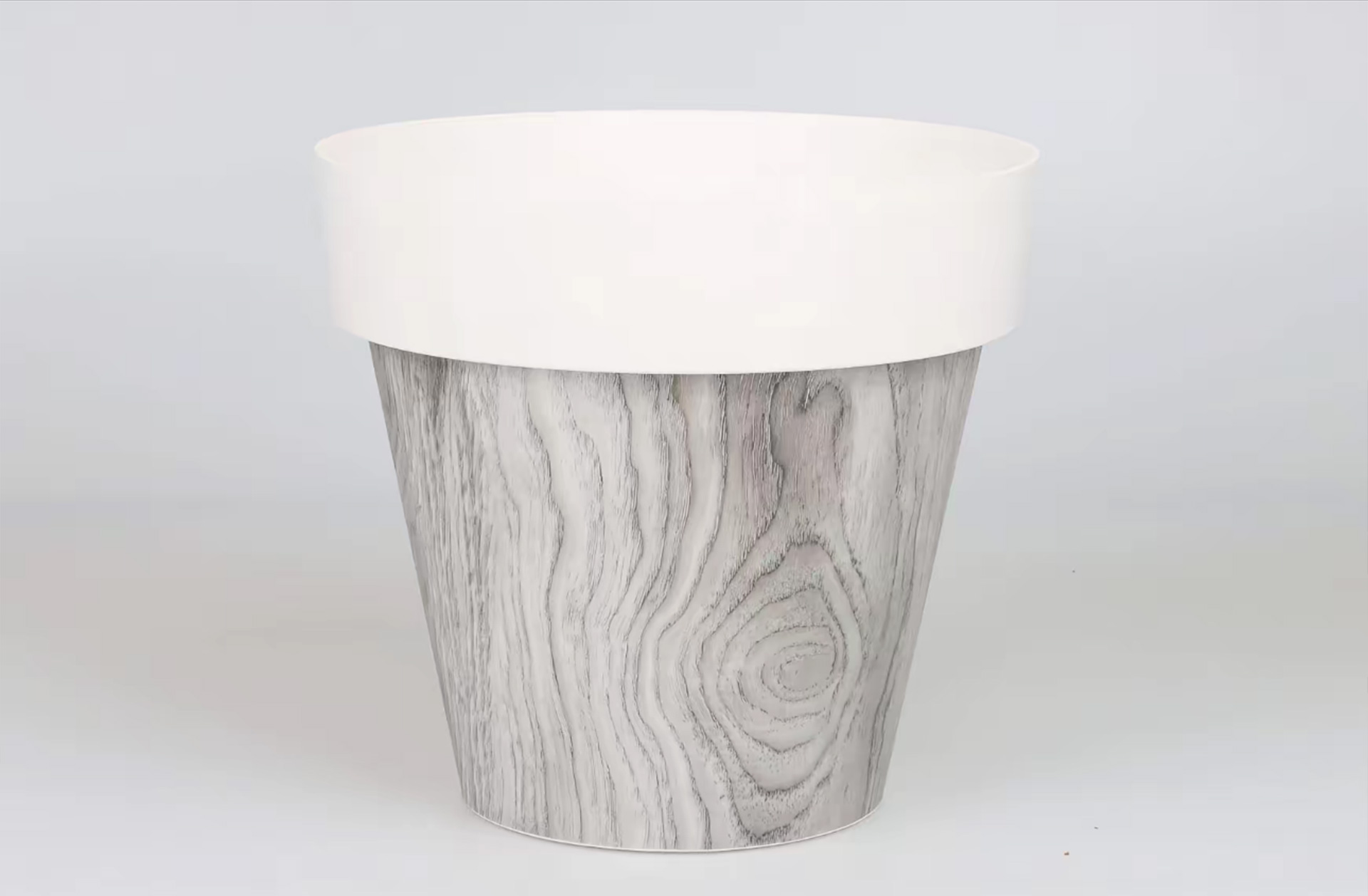
Have you ever stopped in front of a garden shelf, admiring those beautifully decorated plastic pots that seem to have the design printed directly onto the surface? That's not a sticker – that's In-Mold Labeling (IML). If you are considering upgrading your plastic flower pots with premium decoration but don't know where to start, this guide will help you. Choosing the right IML label can make your pots stand out on the shelf, improve product durability, and strengthen your brand image.
In-Mold Labeling is a technology that integrates the label with the plastic product during the molding process. In simple terms, before the flower pot is injection-molded, a pre-printed label is placed inside the mold cavity. When molten plastic is injected, the heat activates the adhesive on the back of the label, bonding it permanently to the pot. In the final product, the label and the pot are on the same plane – you cannot see the label edge, as if the artwork is printed directly onto the surface.
For plastic flower pots, IML offers several clear benefits:
- Permanent durability – the label becomes one with the product; it will not peel, fade, or scratch, and it resists moisture and temperature changes.
- Premium appearance – high-quality, full-color printing gives the pot a refined look that enhances shelf appeal.
- Water and moisture resistance – horticultural pots frequently come into contact with water and soil, and IML labels are completely unaffected.
- Eco-friendly and recyclable – when the label is made of the same polymer as the pot, the entire product can be recycled without separating the label.
- Production efficiency – by combining labeling and molding into one step, IML eliminates a separate labeling process, reducing overall production time and labor costs.
3. Preparations Before Choosing IML Labels
Before selecting your IML labels, you need to do some homework – just as you would check your health and choose the right shovel before shoveling snow. Being prepared helps you avoid mistakes.
3.1 Identify the Material and Use of Your Flower Pot
Is your pot made of PP or PE? Will it be used indoors or outdoors? Will it be exposed to water, soil, or fertilizers? These factors determine the required weather resistance and chemical stability of the label.
- PP pots – choose PP-based IML labels for the best bonding compatibility.
- PE pots – prefer PE-based IML labels, which are easier to recycle together with the pot.
- Outdoor use – the label must have excellent UV resistance and weatherability.
3.2 Evaluate Production Volume and Budget
IML is more cost-effective for large production runs. If your order quantity is small, discuss with your supplier whether standard-sized labels are available, or assess whether the mold investment is justified.
3.3 Define Your Design Requirements
Do you need a multi-color, intricate graphic, or a simple single-color logo? High-precision digital printing can achieve complex designs, but you also need to consider your budget. IML supports a wide range of customization options for high-quality printing.
4. How to Choose the Right IML Material
IML materials fall into two main categories: paper and plastic film. Your choice will directly affect the final quality of the pot.
4.1 Film vs. Paper
Paper labels were the early choice for IML. However, ordinary synthetic paper has low surface smoothness and strength, making high-quality color printing difficult. Paper labels can deform when exposed to moisture, reducing their value. More importantly, since paper and plastic are not the same material, they hinder the recyclability of the pot. For horticultural pots that frequently contact water and soil, paper labels are not an ideal choice.
Film-based labels are specially formulated multi-layer co-extruded films with a smooth surface that accepts various printing methods. They do not distort during processing, ensuring accurate registration and die-cutting. Some films can stretch and conform to the pot's shape without wrinkling. Printed film labels are more vivid, have greater three-dimensionality, and offer far superior color performance compared to paper.
Currently, mainstream film materials include PE, BOPP, and co-extruded PE/PP blends. Choosing a film that matches the pot's base material not only improves adhesion but also enhances recyclability.
| Material Type | Print Quality | Durability | Water Resistance | Recyclability | Suitability for Pots |
|---|---|---|---|---|---|
| Paper | Fair | Low | Poor | Not favorable | Not recommended |
| Film (PE/PP) | Excellent | High | Excellent | Good | Highly recommended |
4.2 Label Thickness and Durability
The thickness of the IML label affects both its durability and print quality. Film labels typically have a thickness of at least 114.3 microns, but the exact thickness should be determined based on product requirements. Thicker labels are more durable but may not conform as easily during molding; thinner labels conform better but may be less robust. Balance these factors according to your pot's intended use.
4.3 Surface Finish: Glossy vs. Matte
The surface finish determines the final visual appearance:
- Glossy (high-gloss) – saturated colors, eye-catching graphics – ideal for brands seeking visual impact. Common glossy thicknesses include 60µ, 70µ, 80µ, etc.
- Matte (satin/matte) – natural, understated elegance – ideal for brands promoting a natural or eco-friendly image. Matte finishes can achieve a translucent effect after molding.
- Special textures – such as orange-peel, offer unique tactility and differentiation for high-end positioning.
5. Label Size: Precision Fit Is Critical
Flower pots come in many shapes and sizes – from small nursery pots to large decorative containers, round or square – so the label size must precisely match the mold.
Design considerations:
- The label should cover the main visible area of the pot but avoid extending to edges or sharp corners.
- The more curved the pot, the greater the stretchability required of the label.
- Always coordinate with the mold designer to confirm the exact position and dimensions of the label within the mold.
Measuring tips:
- Use precision tools to measure the labelable area of the pot.
- Factor in the curvature of the surface and allow appropriate stretch tolerance.
- Run prototype trials to verify the final appearance after molding.
6. Choosing a Reliable IML Supplier
IML is a highly technical process – from material selection to mold design, experience matters greatly. Choosing a supplier with proven expertise in horticultural pot IML can prevent many potential issues. Just as you need the right shovel (the right height, lightweight, ergonomic design) to shovel snow efficiently, the right IML partner will make your project a success.
What to look for in a supplier:
- Industry experience – do they have successful cases with flower pots?
- Material capability – can they provide labels compatible with your pot's material?
- Print quality – how accurate is their color reproduction? Can they meet your design needs?
- Mold coordination – can they work effectively with your mold maker?
- Prototyping service – do they offer sampling and validation?
7. Prototyping and Validation: A Step You Cannot Skip
Before mass production, always run prototypes. Just as you would warm up and check your physical condition before shoveling snow, prototyping ensures your final product meets quality standards.
What to check during prototyping:
- Adhesion and fusion – are there bubbles, wrinkles, or lifted edges?
- Color accuracy – do printed colors match the design proof?
- Placement – is the label positioned correctly on the pot?
- Durability testing – simulate real use (water, soil, temperature changes) to verify label endurance.
8. FAQ
No. The IML label becomes an integral part of the pot during injection molding. It will not peel or lift like a traditional sticker.
IML combines labeling and molding in one step, eliminating separate labeling operations – this often reduces overall production costs. While initial mold investment may be higher, the cost per unit becomes very competitive for large production volumes.
Yes, they are excellent for outdoor use. IML labels have outstanding weatherability, resisting UV radiation, rain, and temperature fluctuations.
No. If the label and pot are made of the same polymer (e.g., both PP or both PE), the entire item can be recycled together – one of IML's environmental advantages.
IML is most cost-effective for large runs. For smaller orders, discuss with your supplier whether standard-sized labels are available, or evaluate the mold investment carefully.
IML supports very high-quality printing. The ink is encapsulated between film layers, keeping colors vivid and fade-resistant. Film-based IML labels offer superior color performance compared to paper.
IML offers rich customization – choose different film thicknesses, print various patterns, and achieve unique brand expression.
9. Conclusion
Choosing the right in‑mold labels for your plastic flower pots comes down to two key principles: matching and expertise. Match the material to the pot's polymer, match the size to the mold, and match the finish to your brand identity. And partnering with a professional IML supplier ensures every match is executed flawlessly.
A high‑quality IML label will make your pots stand out on the shelf and keep your brand visible throughout the product's entire life. It is not just decoration – it is a lasting conversation between your brand and your customers.
Just as snow shoveling requires proper warm‑up, the right tool, and taking breaks, selecting IML labels requires preparation, thorough evaluation, and step‑by‑step validation. Do it right, and your flower pots will win market favor.
Contact Us
Name*
Telephone*
Region*
Please fill in your request*


